There is no single answer for how long chemical stays in the body, because the word itself covers different compounds. But roughly, synthetic cannabinoid products are detected in urine for one to three days after intermittent use, possibly extending to a week or more with heavy daily smoking, remain in the blood for hours to a day or two, and in hair for up to about three months. More important than the figures is that the usual test strip mostly doesn’t detect chemical, so a negative result means almost nothing. This article explains why this happens, the right test, and how the family should read the result.
Why is chemical hard to detect?
Rapid tests work on the idea of “lock and key”: the strip is designed to recognize the shape of a specific molecule, such as the products of the active substance in natural cannabis. The compounds sprayed on chemical herbs mimic the effect of cannabis, but their chemical shape is different, so the strip doesn’t recognize them. And the manufacturers change the formula every so often, so even specialist tests need constant updating of the lists of compounds they look for. In other words, chemical doesn’t deliberately hide from the test every time, but it is by nature a moving target.
What happens to chemical inside the body?
After smoking, the substance reaches the blood and brain within minutes. The liver then turns it into many metabolites, some of which stay active and prolong the effect, and these leave mainly through the urine. The original compound disappears from the blood relatively quickly, while its products remain longer. And because these substances dissolve in fat, they may partly accumulate in body tissues with long-term use and leave slowly, which explains the longer detection period in heavy users.
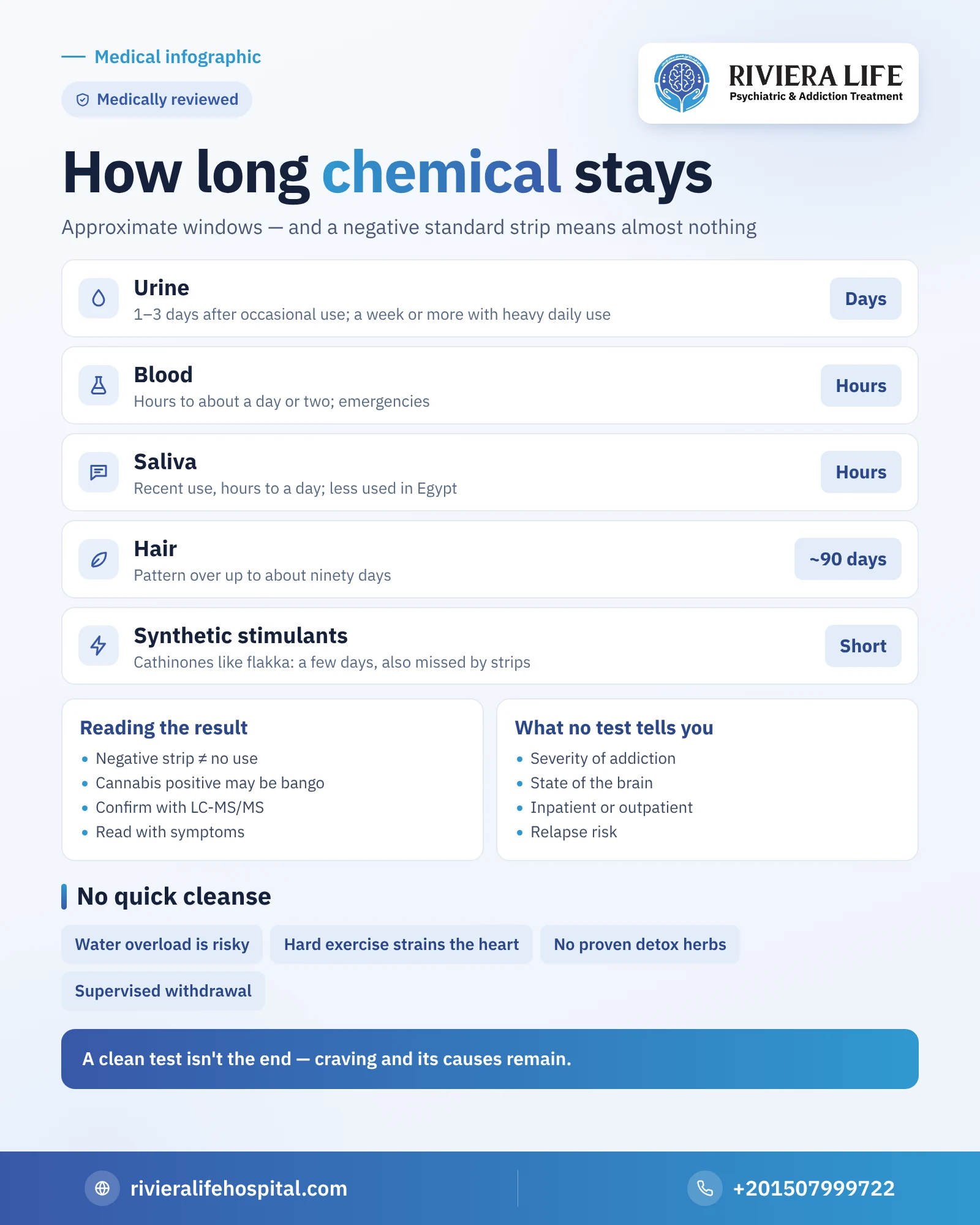
How long chemical shows in each type of test
Urine test
This is the most used in treatment follow-up. With specialist tests, synthetic cannabinoid products can usually be detected from one to three days after occasional use, and it may extend to a week or more for someone who has smoked daily for a long time, depending on the compound.
Blood test
Its window is short, from hours to about a day or two. It is used more in emergencies or when the doctor needs to know whether use was very recent.
Saliva test
It detects recent use, usually within hours to a day, and is less widespread in Egypt for this type of substance.
Hair test
It gives a picture of the pattern of use over a period of up to about ninety days, but it doesn’t detect the last few days, nor does it determine the number of times precisely.
And what about the synthetic stimulants sold as chemical?
If the substance is a stimulant from the cathinone family, such as flakka, its detection time in urine is relatively short, usually a few days. But it also doesn’t show in many of the usual tests, and needs a specialist test. You can see our page on flakka to learn the difference between the two families.
Why does the duration differ from person to person?
- The actual type of compound, which is the biggest variable and usually unknown.
- How often and for how long the person has used: long daily use widens the window.
- The amount of fat in the body, because these substances dissolve in it.
- Liver and kidney efficiency, and age.
- The sensitivity of the test itself and the list of compounds the laboratory looks for.
That is why the figures in this article are general estimates that don’t apply precisely to every person, and the family shouldn’t base a final judgment on them.
Testing in the emergency department: what is the doctor looking for?
When a young man arrives at the emergency department agitated or seizing after smoking chemical, the doctor doesn’t wait for the test result to start treatment, because specialist tests may take days at a reference laboratory. What matters in the first hours are the vital signs, the ECG, kidney function, salts, muscle enzymes and blood sugar. A comprehensive drug test is sometimes requested to rule out other substances such as opioids or sedatives that change the treatment plan.
Here the value of what the family says becomes clear: the street name they heard, the approximate time of use, and any other pills. This information partly makes up for the absence of an immediate result, and lets the doctor anticipate possible complications instead of discovering them late.
Screening and confirmatory tests
A screening test is fast and cheap, but it gives a “possibility”, not certainty. A confirmatory test is done in the laboratory with devices such as liquid chromatography with mass spectrometry (LC-MS/MS), and can identify the compound by name if it is on the laboratory’s list. In the case of chemical, the confirmatory test is the closest route to knowing what the person took, not just an extra step after the strip.
How should the family read the test result?
A negative result on a home strip doesn’t mean the person isn’t using chemical. A positive cannabis result on the strip may mean they are using bango or hashish alongside it, not chemical specifically. And a positive result for other substances such as tramadol reveals part of the picture, not all of it. The practical rule: the test complements observation and doesn’t replace it, and the symptoms the family sees, as explained in our article on chemical addiction symptoms, may be more truthful than the strip.
What can no test tell you?
The test doesn’t tell you the severity of the addiction, the state of the brain, whether the person needs inpatient or outpatient treatment, or the risk of relapse. Nor does it determine the amount used precisely. These are questions answered by the medical and psychiatric assessment, which uses the test as only one of its tools.
And even a positive confirmatory test only reveals the compounds the laboratory is looking for. If the bag contains a new substance not yet added to the laboratory’s list, the result may come back negative despite use. This isn’t a flaw in a particular laboratory, but part of a constant race between those who make these substances and those who try to detect them. So doctors treat a chemical test result as important but incomplete information, and place it alongside the history, the symptoms and the examination.
Advice for the family before buying a test strip
Many families turn to a home strip because it is quick and available in pharmacies, and believe it will settle the doubt in minutes. But with chemical specifically, the opposite usually happens.
Buying the strip and doing the test secretly or under threat may destroy trust at a time when the family needs it more than anything. And if the result comes back negative, the family may be wrongly reassured and delay intervening. It is better for the test to be done as part of a medical assessment, where the doctor chooses the right type of test and interprets its result in the context of the whole case.
Chemical leaving the body doesn’t mean the problem is over
After days or weeks the test may become completely negative, while the craving and the disturbance of sleep and mood remain, and the reasons that drove the drug use remain. So “cleaning the body” isn’t considered the end of the road. You will find what to expect in this period in our article on chemical withdrawal symptoms.
How are tests used during treatment?
In treatment programs, periodic tests are used as a means of support, not accusation. They give the patient tangible evidence of their commitment, and help the team intervene early if a slip happens. At Riviera Life, doctors choose the type of test according to what the patient actually uses, and any result is discussed with them calmly within the plan, as our article on chemical addiction treatment explains.
Can the body be cleaned of chemical quickly?
Many look for a way to rid the body of chemical in a day or two, and the truth is that there is no safe recipe that does that. What is sold under this name is a changing group of synthetic compounds, and how they are processed in the body differs from one substance to another and from one person to another.
Myths circulate around the subject that deserve correcting:
- Drinking large amounts of water or “cleansing” drinks: doesn’t speed up clearing the substance, and may upset the balance of salts in the body, increasing the risk.
- Strenuous exercise or heavy sweating: doesn’t end the substance’s effect, and may strain an already tired heart.
- Ready-made supplements and herbs: there is no medical evidence that they cleanse the body of these substances.
The truth is that the body clears the substance at its natural speed, and what a user really needs is medical supervision during the withdrawal period, because agitation, anxiety and an irregular pulse may appear at this stage. You will find what to expect in it in our article on chemical withdrawal symptoms.
Real cleansing is withdrawing the substance under medical care, followed by psychotherapy that treats the reason for returning to it, which is explained in our article on chemical addiction treatment.
More from our chemical guide
- Chemical: the complete guide
- The harms of chemical
- Chemical addiction symptoms
- Chemical withdrawal symptoms
Questions many people ask
Usually not, because the bango strip looks for products of natural cannabis, and the synthetic compounds are chemically different and not recognized by it.
With specialist tests it usually shows for one to three days after occasional use, and may extend to a week or more with long-term daily use.
A specialist hair test can detect many of these compounds for a period of up to about three months, but it doesn't detect the last few days.
It needs a laboratory with a specialist confirmatory test, and it is preferable for a doctor to request it as part of an assessment that determines the sample type and the compounds required.
No, especially with chemical. The compound may not be on the laboratory's list, so the test is read together with the symptoms and the history.