
Treating glue and inhalant addiction starts with the body before anything else: checking the heart, liver, kidneys and nerves, then stopping inhaling completely under the care of a team that knows these substances may cause sudden cardiac arrest even on the first or lightest use. There is no medicine given to cancel the craving as happens with some other substances, so treatment rests on medical safety, psychotherapy, family involvement, and addressing the circumstances that pushed the person to inhale, many of whom are teenagers and children. This guide explains the stages in order and clarifies what you should ask before choosing a place of treatment.
Why is treating inhalants different from others?
Inhalants are ordinary household and industrial products, such as glue, solvents, sprays and petrol. These substances are available in every home and workshop, so they can’t be “removed from the life” of the patient the way pills or a drug can be kept away. A large proportion of users are also children and teenagers, some on the street or among workshops, so conventional medical treatment isn’t enough for them without dealing with education, the family and where they live.
Finally, nerve and organ damage may have begun before anyone reaches treatment, so the extended medical examination is part of treatment, not just a routine procedure. To understand the substances themselves and their types, you can refer to the inhalants and glue guide.
Stage one: medical assessment and safety
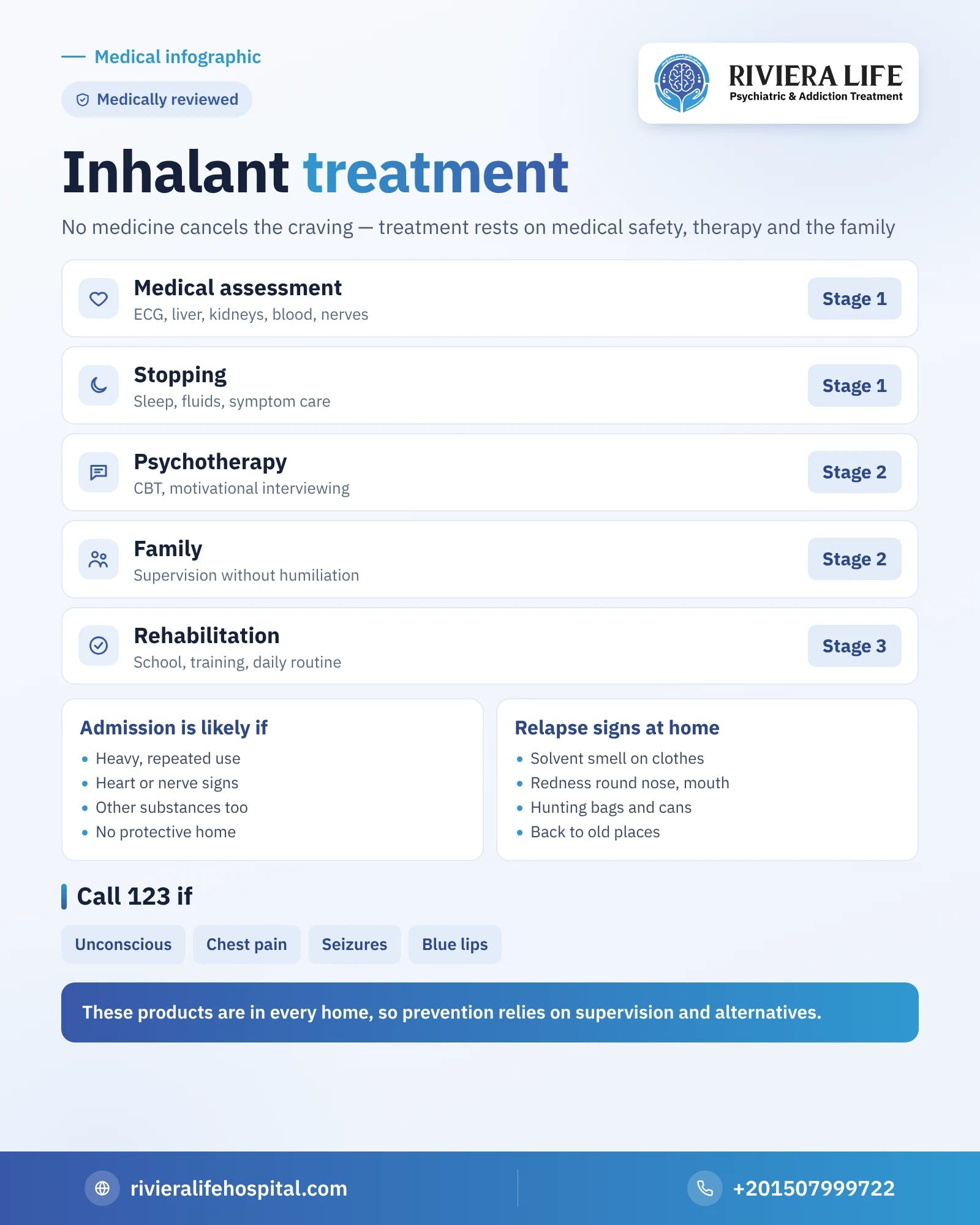
The doctor asks about the substance used, the duration and frequency of use, and any accompanying substances such as hash, tramadol or alcohol. After that, tests are requested including an ECG to detect irregular heartbeat, liver and kidney function, a blood count, and a neurological assessment covering balance, tremor, memory and concentration. Some inhalants may affect hearing or peripheral nerves, and some the blood and bone marrow, so the doctor directs the examination according to what appears. This stage also helps with another decision: is outpatient treatment enough, or does the person need admission?
What happens on stopping?
Inhalant withdrawal symptoms are usually milder than those of opioids or alcohol, but they are real, the most prominent being disturbed sleep, tension, mood swings, nausea, loss of appetite, sweating, hand tremor and craving. No specific medicine is given to end this dependence; instead the symptoms are treated: regulated sleep, fluids and nutrition, heart monitoring if needed, and sometimes a supporting medicine the doctor decides on after assessment. This stage is harder when the person has inhaled for a long time or in repeated amounts, and when other substances accompany it.
Emergency signs during treatment
Call an ambulance on 123 immediately if you see
Inhalants may cause a fatal heart rhythm disturbance or suffocation, and these signs don't wait for a clinic appointment.
- Loss of consciousness or being unable to wake the person
- Chest pain, severe palpitations or shortness of breath
- Seizures
- Blue lips or face
- Severe confusion or hallucinations with agitation
Admission or outpatient treatment?
Doctors lean towards admission when the amount inhaled is large and repeated, there are heart or nerve symptoms, the person uses other substances with it, acute psychiatric disturbances appear, or they live in a place that doesn’t protect them from immediate return. Someone who has tried the substance a limited number of times, shows no danger signs and is supported by a present family may be served by an outpatient program with regular follow-up. The decision is made after assessment, not before, and may change midway if the condition worsens. The full residential program explains when this option is the most suitable.
Stage two: psychological and behavioral therapy
Once the body has calmed, the longer work begins. Cognitive behavioral therapy helps identify the situations that precede craving, such as boredom, hunger, separation from the group and family pressure, and build alternatives to them. Motivational interviewing helps the hesitant teenager who doesn’t see a problem. Accompanying problems such as anxiety, depression, conduct disorder and old trauma need a separate psychological assessment, and are treated at the same time, not after, which is the idea explained by the dual diagnosis program.
Involving the family: not a detail
Most people who inhale at a young age return to an environment that hasn’t changed. That is why the family, or whoever cares for the child, is invited to sessions that explain the nature of the problem and train them to supervise without humiliation, to know the places and tools that are easy to use, and to recognize signs of return such as a smell of solvents on clothes, redness around the nose and mouth, and frequently searching for bags and cans. If the patient has no capable family, working with care agencies and the school or workplace becomes part of the treatment plan. The program for students and teenagers covers this side from the angle of the family and the school.
Stage three: rehabilitation and returning to life
If problems in concentration, memory or balance appear, a neurocognitive assessment and rehabilitation exercises may be needed, while giving the body and brain time to recover that can’t be precisely set for each person. A teenager needs an organized return to school or vocational training, because idleness is the greatest enemy of recovery. The discharge plan usually includes a useful daily activity, review appointments, and a clear plan of whom to tell when a strong craving appears.
Relapse prevention: an environment not free of triggers
Because the substances can’t be banned from the home, the relapse prevention plan relies on supervision and alternatives. Solvents and sprays are kept out of reach of the young, the place where the child spends his time is watched, a routine is built for him with sport and healthy friends, and it is reviewed constantly with the team. The chances of continuing increase when follow-up is regular, as in the aftercare program. A stumble doesn’t mean failure, but a signal to adjust the plan. For prevention before it starts, see ways to prevent drug use.
The right hospital for glue and inhalant addiction: how to choose
The right hospital for inhalant addiction is the one that offers what this patient specifically needs: a comprehensive medical assessment of the heart, nerves and organs, monitoring able to deal with emergencies, and experience in dealing with teenagers and their families. Before you decide, ask:
- Is an extended medical examination including the heart, liver, kidneys and nerves carried out before the plan starts?
- Is there round-the-clock medical supervision able to deal with irregular heartbeat or loss of consciousness?
- Does the team have experience treating teenagers and children who inhale, not just adults?
- Does the program treat accompanying psychiatric disorders at the same time?
- Is the family or care agency involved in the sessions and the plan?
- Is there aftercare and rehabilitation for returning to school or work?
And beware of any place that promises you a guaranteed cure or ending the problem in a few days.
How Riviera Life meets these standards in inhalant addiction treatment
Here is how these criteria are met at Riviera Life:
- Official license: a hospital licensed by the Ministry of Health for psychiatry and addiction treatment.
- Round-the-clock medical supervision: 24-hour monitoring to detect any disturbance in pulse, breathing or consciousness.
- Consultants in psychiatry and addiction treatment: who assess the case medically and psychologically in one plan.
- Fourteen years of experience: and thousands of cases recovered from various substances.
- Treating accompanying psychological problems: such as anxiety, depression and conduct disorder.
- A family program: sessions that train parents to supervise and support without humiliation.
- Aftercare: follow-up after discharge that reduces the risk of return.
- Complete confidentiality: the data of the patient and their family is protected at every stage.
The first consultation is free, and you can get in touch around the clock on +201507999722; we are based in Sheikh Zayed, Giza.
More from the inhalants guide
- Inhalants and glue: the complete guide
- The addiction treatment program for students and teenagers
- The dual diagnosis program
- Ways to prevent drug use
Questions many people ask
There is no approved medicine that ends dependence on inhalants. Treatment is based on treating symptoms, monitoring the body, psychological and behavioral therapy, and family support.
Yes, inhalants may affect the heart, liver, kidneys and nerves. The doctor usually requests an ECG, tests, organ function and a neurological assessment depending on each patient's condition.
They usually include disturbed sleep, tension, mood swings, nausea, loss of appetite, sweating, hand tremor and craving. Their severity varies with the duration of use.
Many improve with stopping, treatment and support, but the extent of recovery depends on the duration of use, the degree of nerve damage and the child's circumstances. Early assessment increases the chances.
Look for a comprehensive medical examination, round-the-clock supervision, experience with teenagers and a family program. Riviera Life in Sheikh Zayed, Giza meets these criteria.