Disulfiram is an old treatment used to help someone who has stopped alcohol not to go back to it, known internationally as “Antabuse”. Its idea is unusual: it doesn’t reduce the desire to drink, but makes any amount of alcohol cause an unpleasant and possibly dangerous physical reaction, so it acts as a psychological and physical barrier against a slip. Because of this, it doesn’t suit every patient, and is only given after examination, discussion and the explicit consent of the patient themselves. Here we explain how it works, when the doctor considers it, and what the patient and family should know, without mentioning doses because setting them is the doctor’s decision alone.
What is disulfiram and how does it work?
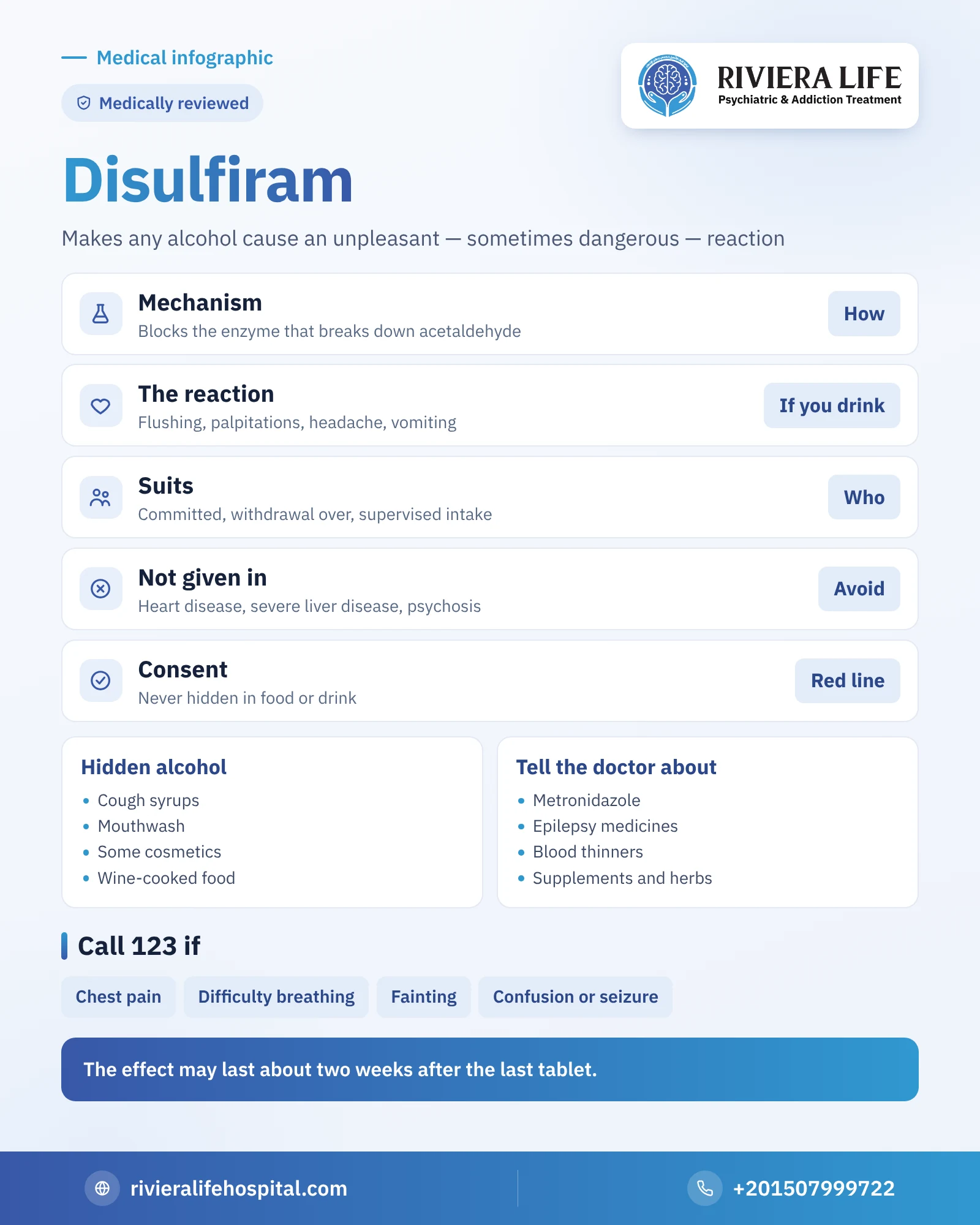
When a person drinks, the liver turns alcohol into a toxic intermediate substance called acetaldehyde, then breaks it down quickly with a particular enzyme, so the drinker doesn’t feel it. Disulfiram disables this enzyme. Then the intermediate substance builds up in the blood if alcohol reaches it, and what is called “the reaction with alcohol” occurs.
It is like an advance warning: the patient knows any glass will be followed by half an hour or more of feeling bad, so they back off before starting. And this is an important point: the medicine only works if the patient actually takes it every day, and it doesn’t treat addiction in itself, but supports a decision the person has made.
What does the reaction with alcohol look like?
The reaction usually starts minutes after drinking a small amount, and its severity varies from person to person and amount to amount. Its best-known signs:
- Flushing of the face and neck and warm skin.
- Palpitations, a fast heartbeat and a drop in blood pressure.
- A throbbing headache, nausea and vomiting.
- Shortness of breath, heavy sweating, dizziness and anxiety.
In severe cases chest pain, fainting, heart rhythm disturbance or a seizure may occur, which is why the patient needs a heart assessment before the medicine, and needs to know when to call an ambulance.
Call an ambulance on 123 immediately if, after drinking during disulfiram treatment, you see
These are signs of a severe reaction; don't wait at home for the symptoms to pass:
- Chest pain or severe palpitations
- Difficulty breathing
- Fainting or severe dizziness with low blood pressure
- Confusion or a seizure
- Continuous vomiting that doesn’t stop
Who does the doctor consider prescribing it for?
Disulfiram usually helps someone who fits this picture: a patient who has completed the withdrawal stage and is no longer drinking, whose decision to abstain is clear, but who fears moments of weakness. Preferably they have someone who follows them, such as a family member, a wife or a brother, who makes sure the medicine is taken with their agreement. Studies have shown that its benefit is clearer when it is taken under supervision, while when it is left to the patient’s mood many quietly stop it before a night out.
For a hesitant patient, someone who drinks daily and hasn’t finished withdrawal, or someone living in an environment where supervision is impossible, the doctor may see other options as more suitable, such as acamprosate or naltrexone.
When isn’t disulfiram given?
There are cases in which the doctor avoids it or handles it with great caution:
- Heart and artery disease, because the reaction strains the heart.
- Severe liver disease, as the medicine itself may harm the liver in rare cases.
- Psychosis or a history of psychotic episodes, because the medicine may worsen some of them.
- Pregnancy and breastfeeding, except by the doctor’s judgment.
- Someone currently drinking or who has drunk in the last few days.
- Someone who doesn’t consent themselves, or where someone wants to give it to them without their knowledge.
Informed consent: a red line
It is not permissible, ethically or medically, to slip disulfiram into the patient’s food or drink to scare them off alcohol. This method is widespread in some homes out of desperation, and it is dangerous, because the person may drink without knowing this medicine is in their body, and suffer a sudden reaction that may end in the emergency department. It also destroys trust between them and their family forever if they discover it.
The simple rule: the patient knows the name of the medicine, why it is prescribed and what will happen if they drink, and signs or clearly agrees verbally in front of the doctor. They usually carry an identification card warning emergency doctors that they are taking the medicine.
What to avoid during treatment
The alcohol meant isn’t only drinks. Disulfiram’s effect continues in the body for days after the last tablet, and may extend to about two weeks, which is why doctors say caution also covers the period after stopping. And attention should be paid to the fact that some products contain alcohol in varying proportions:
- Some liquid medicines and cough syrups.
- Mouthwashes, antiseptics, perfumes and some cosmetics, as absorbing or inhaling them may cause mild symptoms in some people.
- Some foods cooked with wine or sweets containing alcoholic flavorings.
There is no need to panic about everything, but ask the doctor or pharmacist about any product containing alcohol, and tell every doctor or dentist you deal with that you are taking disulfiram.
Other side effects
Even without alcohol, the medicine may cause drowsiness and fatigue in the first weeks, a metallic taste or a garlic-like smell in the mouth, and headache or skin spots in some. The rare but important effects include liver inflammation, nerve inflammation that appears as numbness or tingling in the limbs, and psychological disturbances such as confusion or psychotic thinking. That is why the doctor requests liver tests before starting and during, and should be told immediately of yellowing of the eyes, dark urine or any sudden change in thinking or behavior.
Drug interactions worth attention
Disulfiram interacts with some medicines, including well-known antibiotics such as metronidazole, and some epilepsy and blood-thinning medicines. It may increase the effect of some sedatives. So tell the doctor about everything you take of medicines, supplements and herbs, and don’t add a new medicine without consultation.
Is the medicine enough on its own?
No. The most disulfiram does is close the door to a reckless slip, but it doesn’t teach the patient what to do when they feel low or angry or meet drinking friends. That is why the most successful treatment is the medicine with behavioral treatment, family sessions and regular follow-up. For the full picture of alcohol medicines in their different stages, you can read the article on alcohol addiction medications, and about the stages of treatment itself alcohol addiction treatment.
Don’t stop the medicine or change its schedule yourself
Starting, stopping and adjusting disulfiram are done only with the doctor. And if the urge to drink comes to you, stopping the medicine beforehand doesn’t take it out of your body immediately; it is better to call your doctor or the treatment team and tell them what is happening, as they may change the plan instead of you facing it alone. And if a slip happens during treatment, it is information the team benefits from, not a reason to hide.
Where is disulfiram prescribed safely?
The right hospital for treating alcohol addiction with relapse-preventing medicines, including disulfiram, is the one that assesses the patient before prescribing anything, explains the medicine and takes their consent, and follows them afterwards. Ask before you decide:
- Is an ECG and liver tests done before prescribing disulfiram?
- Is withdrawal completed under medical supervision before starting any relapse-preventing medicine?
- Does the doctor explain the reaction with alcohol to the patient and take their explicit consent?
- Are there alternatives such as acamprosate and naltrexone if disulfiram doesn’t suit?
- Does the plan include psychological and family sessions, not just medicine?
- Is there follow-up after discharge to review the medicine and liver tests?
And beware of any party that promises to cure alcohol for good with a medicine or implant, or a complete cure within days.
How Riviera Life meets these standards in alcohol addiction treatment
This is what the patient and their family find at Riviera Life in practice:
- Ministry of Health license: a hospital licensed for psychiatry and addiction treatment.
- Safe withdrawal before any deterrent medicine: round-the-clock medical supervision until withdrawal ends.
- Choosing the medicine after a full assessment: consultants in psychiatry and addiction treatment choose between disulfiram and others after tests.
- Long experience: fourteen years in addiction treatment, and thousands of recovered cases.
- Consent and explanation: the patient knows their medicine fully and no medicine is given without their knowledge.
- Complete confidentiality: the patient’s data and treatment are fully protected.
- The family and aftercare: a family program and follow-up after discharge to review the medicine and prevent relapse.
The first consultation is free, and you can get in touch around the clock on +201507999722; we are based in Sheikh Zayed, Giza.
More from the alcohol guide
- Alcohol: the complete guide
- Alcohol addiction medications
- Acamprosate
- Quitting alcohol: what happens from withdrawal to recovery?
Questions many people ask
No, it doesn't reduce craving or treat the causes of addiction, but makes drinking physically unpleasant to support the decision to abstain, and works better with psychotherapy and follow-up.
Flushing, palpitations, headache, nausea, vomiting and shortness of breath may appear, and in severe cases it may reach chest pain or fainting, which calls for an ambulance.
Absolutely not; they may drink without knowing and suffer a dangerous reaction, and they must know about the medicine and explicitly agree to it.
The reaction with alcohol may continue for days, perhaps about two weeks, after the last tablet, so caution continues after stopping.
Look for supervised withdrawal before any deterrent medicine, heart and liver checks, a clear explanation and explicit consent, alternatives such as acamprosate and naltrexone, psychotherapy and follow-up. Riviera Life in Sheikh Zayed, Giza meets these criteria.