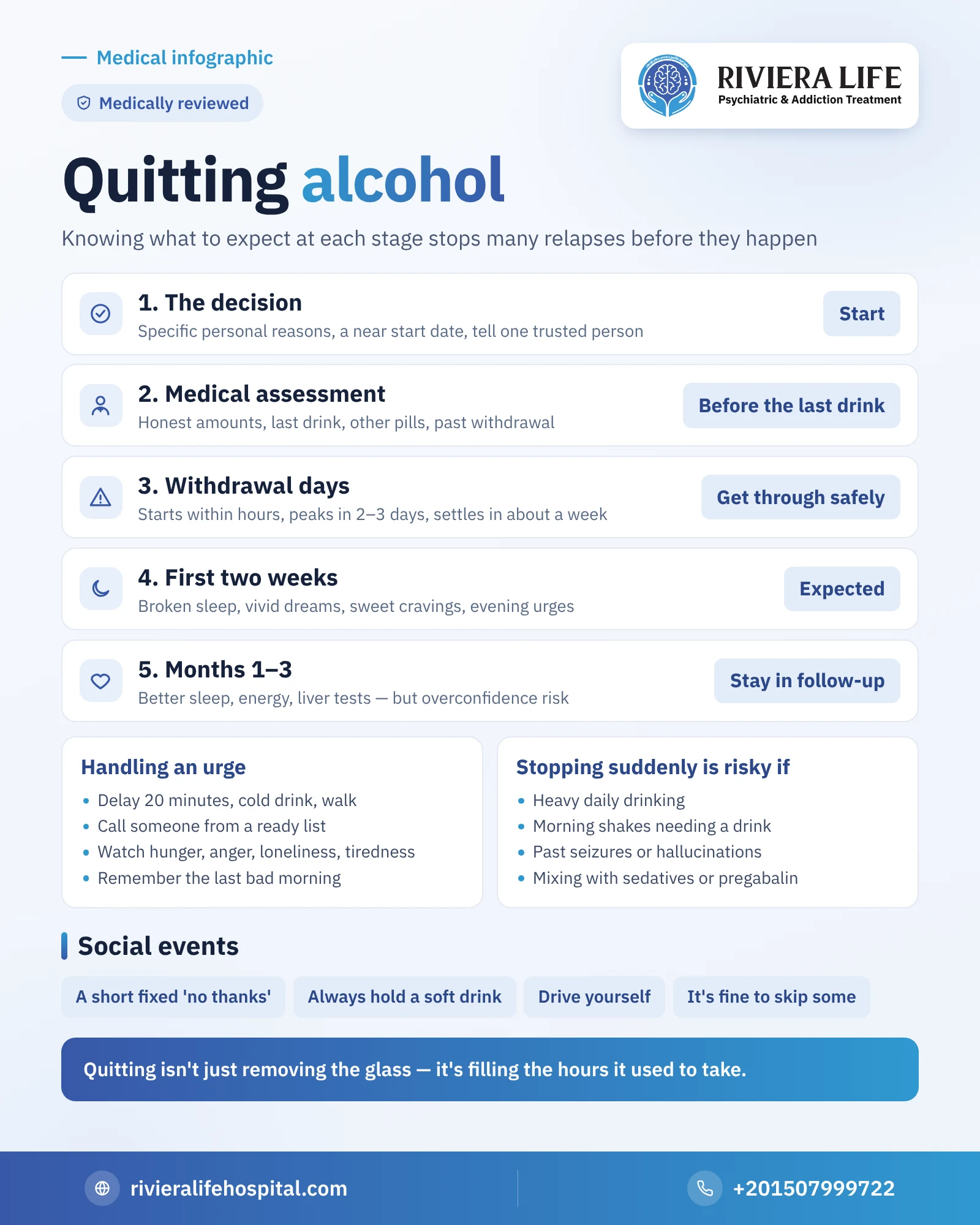
Quitting alcohol is a journey with clear stages: a decision that wavers for weeks before it settles, then a medical assessment that determines whether stopping at home is safe, then the days of withdrawal, then the first weeks in which sleep, mood and appetite change, then months in which a new life is built where the glass has no place. Knowing what awaits a person at each stage makes the road less daunting, and prevents many relapses that happen only because no one told them that what they feel is normal and temporary. This is a practical guide to those stages, written for those thinking of stopping and for their families.
Before you start: is stopping suddenly safe?
This is the first and most important question. Someone who drinks occasionally or in small amounts can usually stop without physical danger. But for someone who drinks large amounts every day, who wakes up shaking and needs a drink to calm down, who has had a seizure or hallucinations on stopping before, or who mixes alcohol with sedatives or pregabalin, stopping suddenly alone can be dangerous. These people need a medical assessment before the last drink, not after. Our article on alcohol withdrawal symptoms explains why alcohol differs from other substances on this point.
Stage one: the decision
The decision rarely comes in a single moment. More commonly, the person goes through a long period of hesitation: they know drinking harms them, and at the same time fear life without it. What helps many get past this stage:
- Writing specific personal reasons for stopping, such as “I want to remember what I said to my children last night”, instead of general phrases.
- Writing down what they actually lose because of drinking: money, time, health and relationships.
- Choosing a near, specific date to start, not “after the next occasion”, which never ends.
- Telling one trusted person about the decision, because announcing it turns intention into commitment.
Stage two: the medical assessment
At the first visit it helps to be as frank as possible: how much they really drink, for how long, when the last drink was, what other medicines or pills they take, and whether they have had withdrawal symptoms before. Many reduce the numbers out of embarrassment, which leads the doctor to estimate a lower risk than the reality. On the basis of this assessment and liver and blood tests, the setting is decided: supervised withdrawal in hospital, or an outpatient plan with close follow-up.
Stage three: the days of withdrawal
Symptoms usually begin within hours of the last drink, are at their worst in the first two or three days, then gradually settle within about a week. In these days the only goal is to get through safely, not to think about the whole future. Someone who goes through withdrawal under medical supervision receives medicines that ease tremor, anxiety and insomnia and prevent complications, so this week becomes far more bearable than someone who has tried stopping alone at home imagines.
The first two weeks after withdrawal
This is where a stage begins that surprises many. The acute physical symptoms are over, but body and mind haven’t settled yet. What people usually describe in this period includes:
- Broken sleep and very vivid dreams, sometimes dreams about drinking itself.
- A craving for sweets and sugars, because the body got used to the calories from alcohol.
- Mood swings between relief and pride in the morning and discomfort and boredom in the evening.
- An urge to drink that intensifies at the usual time for a drink, such as the end of the working day.
- General tiredness and poor concentration that improve day by day.
Knowing that these things are expected greatly reduces their danger, because they aren’t then interpreted as “failure” or as proof that life without alcohol is unbearable.
From the first month to the third
At this stage many notice tangible improvement: deeper sleep, a less puffy face, better energy in the morning, improving liver tests, and money staying in the pocket. But it is also a deceptive stage, because improvement breeds overconfidence that can lead to the thought “one drink won’t hurt”. Some also experience what are called protracted post-withdrawal symptoms: waves of anxiety, insomnia or low mood that come and go for weeks or months and then gradually ease. Regular follow-up with the treatment team in this period is what separates stable recovery from a sudden relapse.
Beyond the first months: a new life, not just abstinence
Quitting alcohol doesn’t just mean removing something from the day, but filling the space it left. The hours that were spent drinking and recovering from it need an alternative: sport, an old hobby, time with the children, or volunteer work. Part of the social circle also changes, as some friendships were built on the glass alone. This change is sometimes painful, but it is one of the strongest protections for long-term recovery.
How do people deal with intense cravings?
The urge to drink comes as a wave: it rises, peaks, then falls, usually within minutes rather than hours. Practical techniques people in recovery use include:
- Delaying the decision for twenty minutes, drinking something cold or walking during that time.
- Calling someone from a list prepared in advance.
- Paying attention to four states that multiply the urge: hunger, anger, loneliness and tiredness, and dealing with them directly.
- Reminding yourself of the last bad morning after drinking, not of the enjoyable first drink.
Social occasions and social pressure
Weddings, work dinners and travel are among the hardest situations in the first months. It helps to prepare a short sentence to repeat without long explanation, such as “No thanks, I’ve stopped”, to always hold a non-alcoholic drink, and to go in your own car so you can leave whenever you want. There is no shame in excusing yourself from some occasions completely at first; protecting recovery matters more than social courtesy.
Cutting down or stopping completely?
Many ask whether they can settle for cutting down. For someone who has reached physical dependence or has tried cutting down repeatedly and failed, doctors usually recommend stopping completely, because a single drink reactivates the same circuits in the brain. In milder cases, the doctor may discuss different goals depending on the situation. This is a decision made with the doctor, not alone; our article on alcohol addiction treatment sets out the options available.
If they go back to drinking
Going back to drinking after a period of stopping happens to many, and doesn’t mean everything before has been lost. What matters is dealing with the slip quickly: stopping again, telling the treatment team, and understanding what led to it. If the person goes back to daily drinking for days, the risk of withdrawal may return when they stop again, so they shouldn’t stop suddenly without advice. Intense guilt after a slip is one of the most dangerous things that turns it into a full relapse.
The family’s role during the journey of quitting
The family can help with simple things: keeping alcohol out of the house, celebrating the days and weeks without exaggeration, and avoiding constant surveillance or bringing up past mistakes in every disagreement. The family itself also needs support, as years of drinking leave a mark on it too. And if it wants to understand what drove its relative to drink in the first place, our article on the causes of alcohol addiction is a good starting point.
How can Riviera Life help you?
Riviera Life accompanies every one of these stages: a free, confidential assessment that determines the risk of withdrawal, safe withdrawal under round-the-clock supervision, then psychotherapy, a family program and follow-up after discharge for the months when relapse is most common.
More from our alcohol guide
- Alcohol: the complete guide
- Alcohol withdrawal symptoms and danger signs
- Alcohol addiction treatment: stages and medicines
- Alcohol and sex: desire, erection and fertility
- How to deal with someone addicted to alcohol: a family guide from safety to treatment
Questions many people ask
In most people the acute withdrawal symptoms have settled, but sleep, mood and concentration are still stabilizing, and a desire to drink may remain at the usual times.
Many notice improvement in sleep, energy and appearance within weeks to about three months, and improvements in concentration, the liver and mood continue for months afterwards.
Usually yes for someone who drinks lightly or occasionally. Someone who drinks heavily every day or has had withdrawal symptoms before needs a medical assessment before stopping, because withdrawal can be dangerous.
Because the body got used to alcohol's calories and sugars, and sugar partly stimulates the same reward circuit. This craving is common and eases with time.
No. A slip is common and can be caught quickly by stopping again, telling the treatment team and reviewing what led to it, without it turning into a full relapse.