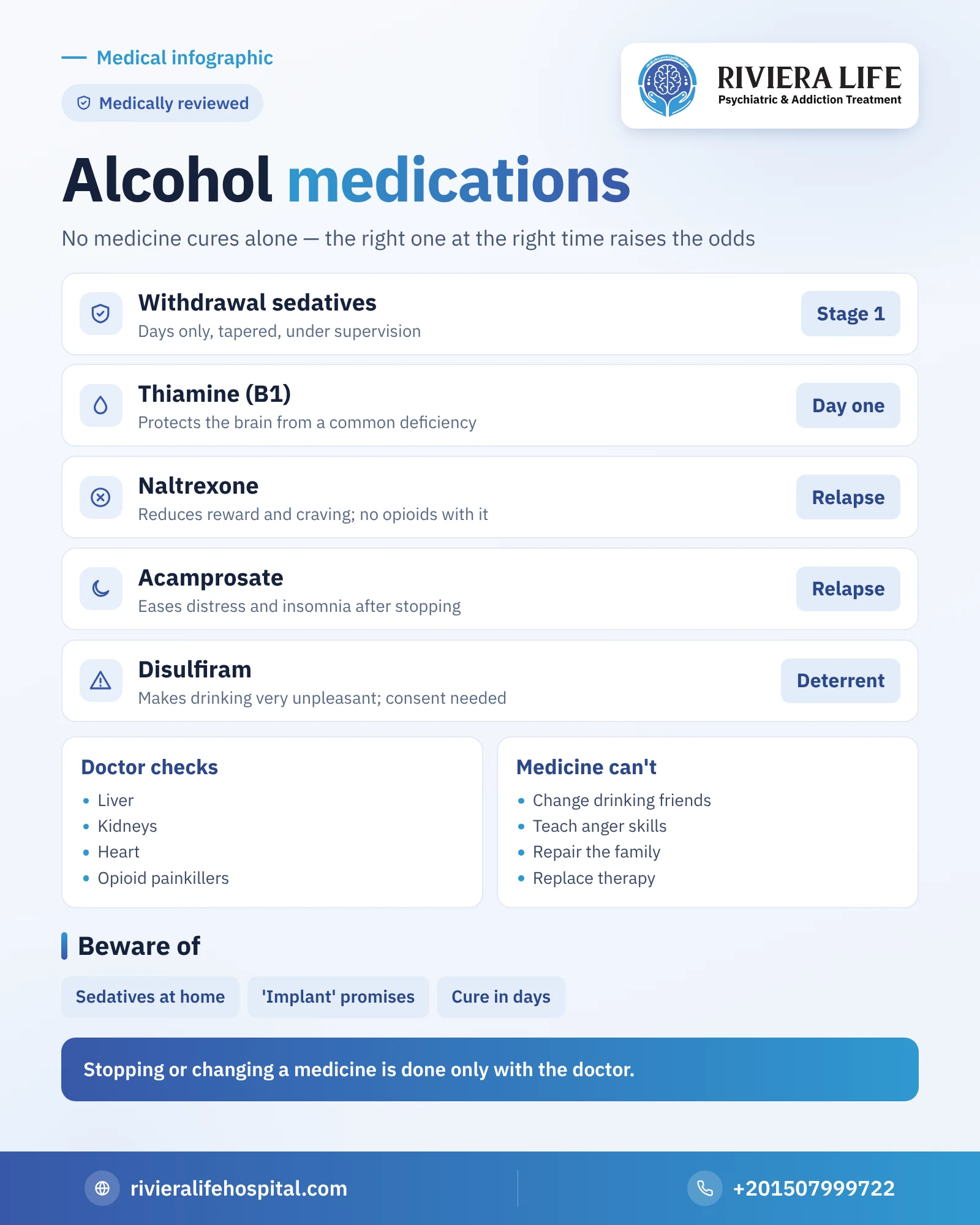
Alcohol addiction medications are three groups, each with a different function: medicines that protect the patient during the days of withdrawal from seizures and delirium, medicines that then help them not return to drinking such as naltrexone, acamprosate and disulfiram, and vitamins, led by thiamine, that protect the brain from a deficiency common in heavy drinkers. No medicine treats addiction on its own, and no injection makes a person hate alcohol forever, but the right medicine at the right time clearly raises the chances of recovery. Here we explain what the doctor may use and why, without doses, because the choice and the dose are an individual medical decision.
Three stages and three different goals
Confusing these groups is one of the things that confuses families most. The sedative given in the first days isn’t a relapse prevention medicine, and shouldn’t continue for months. And a relapse prevention medicine doesn’t protect against withdrawal seizures. That is why treatment usually follows this order:
- The withdrawal stage: days to about a week, and the goal is to get through it safely.
- The stabilization and relapse prevention stage: months, and the goal is to reduce craving and support abstinence.
- Throughout treatment: correcting vitamins and electrolytes, and treating accompanying anxiety, depression or insomnia.
Medicines for the withdrawal stage
When someone used to daily drinking stops, their brain suddenly loses the calming substance it adapted to, and enters a state of excitation: tremor, sweating, palpitations and insomnia, which may reach a seizure or delirium tremens. The main medicines here are sedatives from the benzodiazepine family, which the doctor gives and then withdraws gradually over days according to the severity of the symptoms the team measures regularly. In some cases other medicines may be added, such as anti-seizure medicines or medicines to control blood pressure and pulse, with fluids and correction of electrolytes.
What matters is that these medicines are used for a short period and under supervision, because they can themselves cause dependence, and because mixing them with alcohol is dangerous for breathing. That is why giving the patient sedative pills at home to stop on their own is a common and dangerous mistake. The details of this stage’s symptoms and timing are in the article on alcohol withdrawal symptoms.
Thiamine: the vitamin not to forget
Heavy drinking reduces the absorption of vitamin B1 (thiamine) and uses up its store, especially with malnutrition. Its deficiency may cause a serious neurological condition that shows as confusion and disturbance in walking and eye movement, and may leave permanent memory weakness if not treated. That is why doctors give thiamine early to most alcohol patients, often before sugar solutions, along with other vitamins, folic acid and magnesium when needed. It is a simple measure, but it may protect the brain from damage that can’t be repaired.
Relapse prevention medicines: what do they actually do?
After withdrawal ends, the biggest challenge remains: the craving that returns with distress, a night out or the end of an exhausting week. This is where relapse prevention medicines come in; they are non-addictive medicines that work in different ways and give their best results with psychotherapy and follow-up. The best known are three:
Naltrexone
It blocks the opioid receptors through which part of the sense of pleasure from drinking passes, so the glass becomes less tempting, and a single slip is less likely to turn into a night of heavy drinking. It is available as tablets, and in some countries as a long-acting injection. It isn’t suitable for anyone taking any opioid painkillers, including tramadol, and the doctor reviews liver function before and during it. You will find its details in the article on naltrexone, and in the naltrexone treatment program.
Acamprosate
It doesn’t reduce the pleasure of drinking so much as ease the distress, anxiety and insomnia that continue for weeks after stopping and that many consider the spark of relapse. It suits someone who has already stopped and wants to maintain abstinence; it isn’t much affected by the liver, but needs caution with weak kidneys. It doesn’t cause a reaction if the patient drinks while on it, but it loses its benefit with a return to drinking.
Disulfiram
Its idea is different: it stops the body from breaking down alcohol normally, so if the patient drinks, a substance builds up that causes flushing, palpitations, nausea, vomiting and a severe headache. It is a deterrent, not a craving reducer, and usually helps a motivated patient who agrees to it and has someone who follows their commitment. It is never given to a patient without their knowledge or while drunk, and its effect lasts for days after the last tablet, so alcohol in all its forms must be avoided, even in some medicines and products.
A quick comparison of relapse prevention medicines
| The medicine | How it helps | The doctor needs to review |
|---|---|---|
| Naltrexone | Reduces reward and strong craving | The liver, and any use of opioid painkillers |
| Acamprosate | Eases distress after stopping | The kidneys |
| Disulfiram | Makes drinking a very unpleasant experience | The heart and liver, and the patient’s explicit consent |
How does the doctor choose the right medicine?
There is no best medicine for everyone. The doctor asks questions such as: is the patient’s goal complete stopping, or are they still hesitant? How are the liver, kidneys and heart? Do they take opioid painkillers or use other substances such as pregabalin? Is there pregnancy or chronic illness? And have they tried a medicine before? They may start with a medicine and then change it if it doesn’t suit, and the duration may last months. Stopping or changing the medicine is done only with the doctor, not by personal decision after weeks of improvement.
Other medicines you may hear about
Some people may mention other medicines sometimes used to treat alcohol outside their original use, such as some epilepsy medicines or muscle relaxants. These are options the specialist doctor turns to in selected cases when the main medicines don’t suit, and some of them can be misused, so they are never taken on the advice of a friend or a pharmacy. Adverts also circulate about “implanting a capsule” under the skin that prevents drinking; the evidence for these methods is weaker than for approved medicines, and they don’t replace psychotherapy and follow-up.
Treating what stands behind the glass
Many patients started drinking to calm anxiety, depression or insomnia. Some of these symptoms improve on their own after weeks of stopping, and some need specific treatment decided by the psychiatrist, while avoiding long-term use of dependence-causing sedatives. If depression is left untreated, it remains constant pressure pushing towards going back. The article on depression and addiction explains this relationship.
What medicine can and can’t do
Medicine may reduce craving, shorten the length of a slip, and give the patient space in which to learn new skills. But it doesn’t change the friends who gather around drinking, doesn’t teach the patient how to deal with anger or loneliness, and doesn’t repair a cracked family relationship. That is why medicine always comes as part of a broader plan, whose stages you will find in the article on alcohol addiction treatment.
The right hospital for medical treatment of alcohol addiction: how to choose
The right hospital for treating alcohol addiction with medicines is the one that doesn’t settle for dispensing a medicine, but provides what an alcohol patient specifically needs: safe withdrawal with medicines adjusted to the severity of symptoms, thiamine from the first day, then a relapse prevention medicine chosen after careful tests. Ask before you decide:
- Are withdrawal medicines given under round-the-clock medical supervision, and withdrawn gradually according to approved scales?
- Does the team start thiamine and vitamins early and correct electrolytes?
- Are liver and kidney tests done before choosing a relapse prevention medicine?
- Does the doctor explain the medicine to the patient and take their consent, especially with disulfiram?
- Are accompanying depression and anxiety treated without long-term reliance on sedatives?
- Is there follow-up after discharge to review and adjust the medicine?
And beware of any place that promises you a medicine or capsule that cures alcohol for good, or complete treatment within days.
How Riviera Life meets these standards in alcohol addiction treatment
Riviera Life applies these criteria as follows:
- Ministry of Health license: a hospital licensed for psychiatry and addiction treatment, dispensing medicines within medical protocols.
- Safe withdrawal around the clock: 24-hour medical supervision that adjusts withdrawal medicines moment by moment.
- Specialist consultants: consultants in psychiatry and addiction treatment choose the relapse prevention medicine after a full assessment.
- Long experience: fourteen years in addiction treatment, and thousands of recovered cases.
- Integrated treatment: medicine and psychotherapy together, with treatment of accompanying disorders.
- Complete confidentiality: the patient’s data and treatment are fully protected.
- The family and aftercare: a family program and follow-up after discharge to review the medicine and prevent relapse.
The first consultation is free, and you can get in touch around the clock on +201507999722; we are based in Sheikh Zayed, Giza.
More from the alcohol guide
- Alcohol: the complete guide
- Alcohol addiction treatment: the stages and relapse prevention
- Naltrexone: uses and warnings
- How to deal with an alcoholic
- Disulfiram: how it works, its reaction with alcohol and when it isn’t given
- Acamprosate: how does it ease craving and insomnia after quitting alcohol?
Questions many people ask
No medicine cures on its own. Relapse prevention medicines reduce craving or deter drinking, and work better with psychotherapy and follow-up for a sufficient period.
The main relapse prevention medicines don't cause addiction. The sedatives of the withdrawal stage, however, may cause dependence, which is why they are used for a few days and withdrawn gradually under supervision.
Because heavy drinking often causes its deficiency, and its deficiency may lead to a serious neurological disorder affecting memory and walking. Giving it early is an important preventive measure.
No, naltrexone blocks the effect of opioid painkillers and may cause sudden withdrawal symptoms. The doctor must be told about all medicines before starting.
Look for safe withdrawal with 24-hour supervision, thiamine from day one, liver and kidney tests before choosing a relapse prevention medicine, psychotherapy and follow-up after discharge. Riviera Life in Sheikh Zayed meets these criteria.