Inhalants is a name that brings together ordinary household and industrial products that release vapors or gases, which some children and teenagers inhale in search of a quick dizziness that resembles drunkenness. The best known in Egypt is “kolla”, that is, shoe and tire glue, whose name has become linked with street children. Their danger is that they are cheap and available in every home and shop, that their effect is short so inhaling is repeated, and that sudden death may happen from the first time. In this guide we explain the types of inhalants in general terms, why the young in particular fall into them, what they do to the brain, liver and kidneys, how the family can discover the matter early, and what treatment and prevention look like.
What are inhalants?
Inhalants aren’t a single drug, but a wide group of volatile chemicals that have nothing in common except their way of entering the body through the nose and mouth. Most of them are legitimate products made for cleaning, gluing, painting or fuel, and were never meant to reach the brain. When a person inhales their vapors at a high concentration, they cross the lungs into the blood and then to the brain in seconds, so the person feels an effect resembling drunkenness that wears off within minutes.
This shortness of effect is one of the secrets of their danger; the user repeats inhaling several times in a row to prolong the feeling, so the substance accumulates in the body and they come close to suffocation or heart disturbance without feeling it.
Types of inhalants
Specialists usually divide them into four major categories, and we mention them here for awareness only, so the family knows what deserves attention at home:
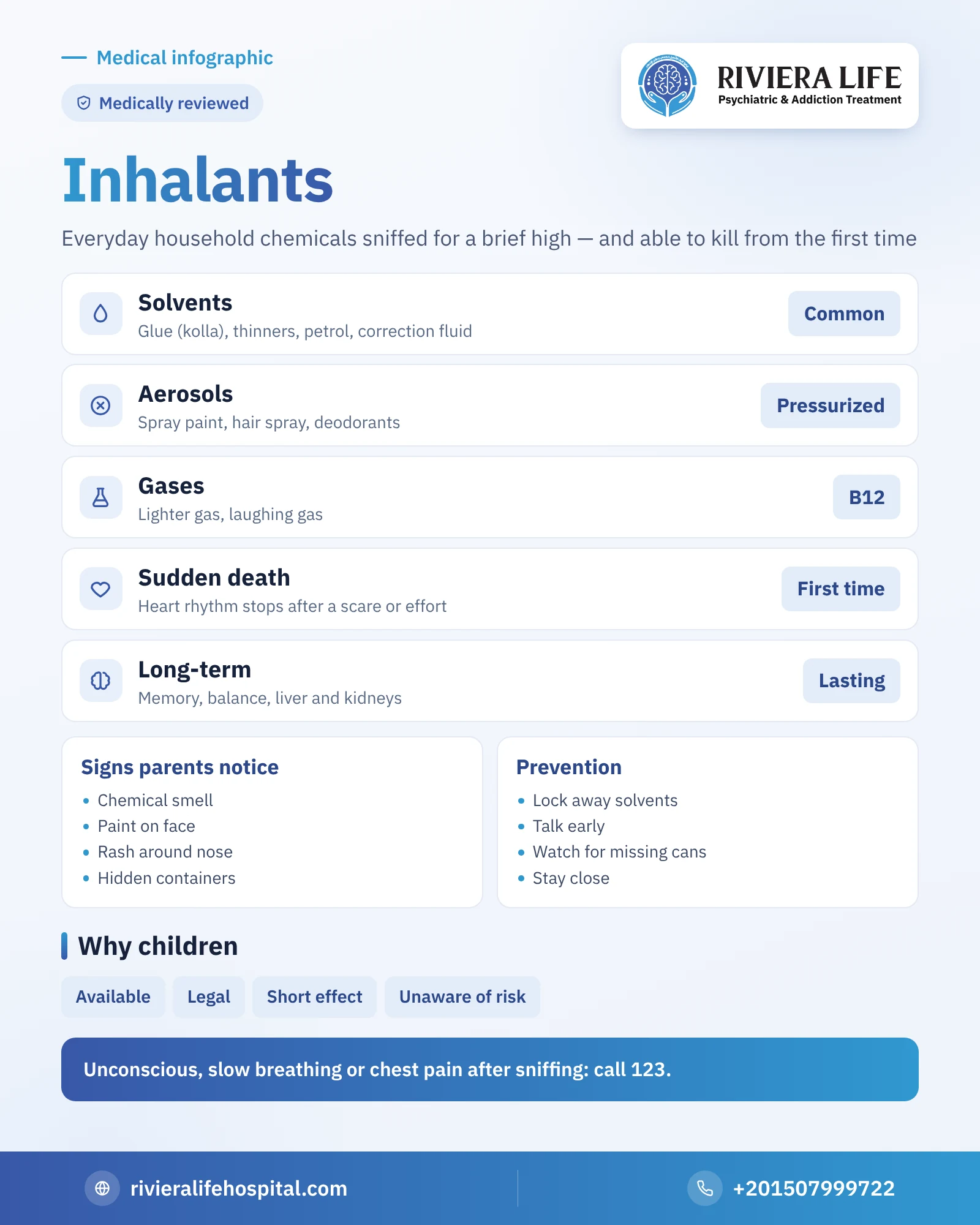
- Volatile solvents: liquids that evaporate at room temperature, such as adhesives including kolla, paint thinners, petrol, nail polish remover, correction fluid, and some marker pens.
- Aerosols: pressurized cans containing solvents and propellant gases, such as spray paints, hair sprays, deodorants and electronics cleaning sprays.
- Gases: such as lighter gas and gas cylinders, and gases used in the medical field such as nitrous oxide, known as “laughing gas”.
- Nitrites: a category different in its effect, widening blood vessels instead of depressing the brain; some adults use them for sexual purposes, and they spread in small bottles sold under misleading names.
Each type differs in its toxicity, but the rule is one: there is no “safe” inhaled substance, as all of them were made for something other than the human body.
Glue and street children
Kolla remains the best-known inhalant in Egypt, and the image associated with it in people’s minds is a small child in shabby clothes at a traffic light. The truth is that this child usually isn’t looking for pleasure, but for a drug that silences hunger, cold, fear and loneliness for a few hours. Kolla is very cheap, no one asks the buyer’s age, and its quick effect makes them feel warm and bold and forget their night on the street.
The matter doesn’t stop at street children; children from stable homes may also try, out of curiosity or a dare between friends, or after a clip they saw on the internet. The difference is that the street child needs shelter, safety and education before treatment, while the child at home needs early attention and calm dialogue.
Why do children and teenagers fall into inhalants?
Inhalants are among the few substances tried more by younger children than by older people, and research bodies such as the US National Institute on Drug Abuse describe them as among the first substances children try at an early age. Clear reasons come together for this:
- They are available in the kitchen, the bathroom and the father’s workshop, and don’t need a dealer or much money.
- They are legal, so the child doesn’t feel they are doing something dangerous.
- Their effect is quick and short, so the child thinks they can hide it before returning home.
- The child doesn’t know that death may happen from a single time.
- Deeper factors, such as neglect or violence at home, dropping out of school, or older company.
What do inhalants do to the brain and body?
Most inhalants depress the nervous system, so they begin with a feeling resembling drunkenness: dizziness, mild euphoria and loss of inhibition, then slurred speech, staggering when walking and vertigo, and hallucinations may appear. With repetition come drowsiness, headache and nausea, and the person may lose consciousness. After the effect wears off, a headache and lethargy remain that may last for hours. This picture sometimes makes parents confuse it with drunkenness or ordinary tiredness.
Sudden sniffing death
The most dangerous thing the family must know is that inhalants may kill from the first time, in what doctors call “sudden sniffing death syndrome”. Some of these substances make the heart muscle extremely sensitive to adrenaline, so if the person is startled, frightened or makes a sudden physical effort, such as being caught and running, the heart rhythm may be disturbed and stop. These risks increase with gases and aerosols in particular.
Besides the heart there are other ways of dying: suffocation when the vapors take the place of oxygen in the lungs, blockage of the airway by vomit in someone who has lost consciousness, burns because many of these substances are flammable, or accidents during dizziness and staggering.
The harm of inhalants to the brain, liver and kidneys
With repeated use over months or years, temporary harm turns into injuries that may not heal completely:
- The brain and nerves: some solvents dissolve the fatty sheath that protects nerve fibers, so weakness in memory and concentration and a decline in school performance appear, along with staggering and tremor and disturbed hearing and vision, and some of them may damage the peripheral nerves so the limbs weaken and tingle.
- The liver: it bears the burden of breaking down these chemicals, so it may become inflamed or damaged, especially with chlorine-containing solvents.
- The kidneys: the balance of salts and acids in the blood may be disturbed, and the kidney is harmed with long use.
- The heart, lungs and blood: heart rhythm disturbance, lung irritation, and effects on the bone marrow with some substances.
Some use laughing gas thinking it is harmless, while repeating it may cause vitamin B12 deficiency and damage to the nerves and spinal cord. Nitrites affect the blood’s ability to carry oxygen, and lower blood pressure dangerously if combined with some medicines.
Inhalant addiction and withdrawal
Yes, inhaling can turn into inhalant addiction in the full sense of the word: an urgent craving, daily repetition, failure to stop despite harm, and decline in studies and relationships. On stopping after long use, withdrawal symptoms may appear, such as irritability, insomnia, headache, nausea, sweating and intense craving. They aren’t usually life-threatening, but they explain why many go back to the can after a day or two.
Signs parents notice
A single sign doesn’t mean the child is inhaling, but more than one sign coming together deserves attention:
- A chemical smell on the breath, clothes or room.
- Paint stains or adhesive substances on the face, fingers or clothes.
- Redness or a rash around the nose and mouth, a frequently runny nose, and red eyes.
- Empty containers, or tissues and cloths soaked in chemicals hidden in strange places.
- Behavior resembling drunkenness: staggering, slurred speech and dizziness, then a headache.
- A decline at school, loss of appetite, irritability, and a sudden change of friends.
The article on drug names circulating among young people in Egypt gives a wider picture of the terms the family may hear.
How is inhalant addiction treated?
Treatment begins with a comprehensive medical assessment, because the harm may be silent: an examination of the nervous system, tests of liver and kidney function and salts, and an assessment of memory and concentration. There is no dedicated medicine that removes the craving for inhalants, so treatment rests on other foundations. The first is cognitive behavioral psychotherapy, which teaches the child or teenager to recognize risky situations and deal with them.
The second is family therapy, because the child returns to the same home, and unless the home changes it is hard for the child to change. The third is addressing the deeper causes, such as depression, anxiety, trauma, violence or dropping out of school. Because some patients suffer weakened concentration due to the substance, sessions are simplified and repeated, and the treatment period lasts longer than usual. The addiction treatment program for students and teenagers provides this kind of age-appropriate care.
Prevention: the home first
Because the substance itself is legal and available, prevention rests on attention, not on restriction alone:
- Keep solvents, aerosols and gases in a closed place away from children, and know what you have of them.
- Talk with your children early and clearly: these substances are toxic and may kill from a single time, and talking doesn’t encourage trying but protects against it.
- Watch for containers disappearing or running out quickly, or being in the children’s rooms without reason.
- Contact the school if you notice a change in behavior or performance.
- Be close: a child who finds someone to listen to them looks less for escape.
For a broader discussion of protecting children from all substances, see the article on drug prevention.
The inhalants guide: related articles
These articles complete other aspects of the subject:
The addiction treatment program for students and teenagers
How treatment is designed for young ages while keeping up studies and involving the family.
Drug prevention
Practical steps for the family and the school to reduce the chances of the first try.
Hallucinogenic pills
Another family of substances that alter perception, explaining the difference between their types and their psychological risks.
Common myths about inhalants
The myth: kolla isn’t a drug, since it is sold in any shop. The truth is that being legal doesn’t reduce its toxicity, and that it may damage the brain and liver and kill suddenly.
The myth: one time to try doesn’t harm. The truth is that sudden sniffing death may happen the first time, and it is impossible to predict who will be affected by it.
The myth: inhalants are only a problem of street children. The truth is that children and teenagers from stable homes try them, and families may not notice because the substances are already in the home.
The myth: laughing gas is safe because it is used at the dentist. The truth is that medical use is at a calculated concentration, with oxygen and under monitoring, while repeating it outside this framework damages the nerves.
When is the situation an emergency?
Call the ambulance on 123 immediately if any of these appear
If you find a child or person after inhaling a chemical substance and any of these signs appear on them:
- Loss of consciousness or difficulty waking them
- Slow or irregular breathing, or breathing has stopped
- Chest pain, an irregular pulse or sudden collapse
- Seizures
- Vomiting while drowsy or severely dizzy
- Burns or fire near the face
Until the ambulance arrives, move the person away from the source of the vapors to a well-ventilated place, and don’t shout at them, frighten them or chase them, because sudden agitation may disturb the heart. If they are unconscious and breathing, put them on their side, and if their breathing stops, start resuscitation if you know how. And keep the container so the emergency team knows the type of substance.
When should you ask for help?
Ask for a specialized assessment if the signs are repeated or the child admits trying more than once, or a decline in memory and studies appears, or inhalants are combined with other substances. At Riviera Life, the consultants in psychiatry and addiction treatment assess the case in complete confidentiality, and put in place an age-appropriate plan that includes medical examination and psychological and family therapy, with round-the-clock medical supervision when the case needs admission, and follow-up after discharge.
Medical sources and referencesThe information in this article is based on reliable scientific sources