Drug prevention doesn’t mean a frightening lecture given once to the children, but a set of daily habits that reduce the chance of first use and delay it, and catch any slide early before it turns into addiction. And research says something reassuring: the later the age of first use, the lower the risk of addiction later, and the closer the family’s relationship with its children and the clearer the rules, the greater the protection. In this guide are practical steps for the individual, the family and the school, what suits each age stage, common mistakes that weaken prevention, and a weekly plan you can start today.
What is meant by drug prevention?
Specialists divide prevention into three levels. The first prevents use altogether or delays it, and is aimed at everyone. The second targets those who have started experimenting or have clear risk factors, intervening early before use becomes repeated. The third concerns those who have already been treated, protecting them from relapse. This article focuses on the first and second levels, that is, what the family and school can do before treatment is needed.
Risk factors and protective factors: where does your child stand?
A young person doesn’t fall into drugs because of a single factor, but through risk factors accumulating in the absence of protective factors:
| Factors that increase risk | Factors that protect |
|---|---|
| Friends who use or boast about trying | Company with clear interests such as sport or study |
| Absence of supervision and rules at home | Known rules with calm follow-up |
| Family conflict, violence or a painful separation | A warm relationship with at least one parent |
| Untreated anxiety, depression or ADHD | Early treatment of any psychiatric disorder |
| Easy access to the substance or medicines | Secured medicines at home and a community that rejects use |
| Long idle time and boredom | Regular activities and a sense of achievement |
Having a risk factor doesn’t mean your child will become addicted, but it does mean they need more attention and conversation. To understand the biological side of this susceptibility, you can read dopamine and addiction.
Prevention by age: what do you say to your child at each stage?
From six to ten
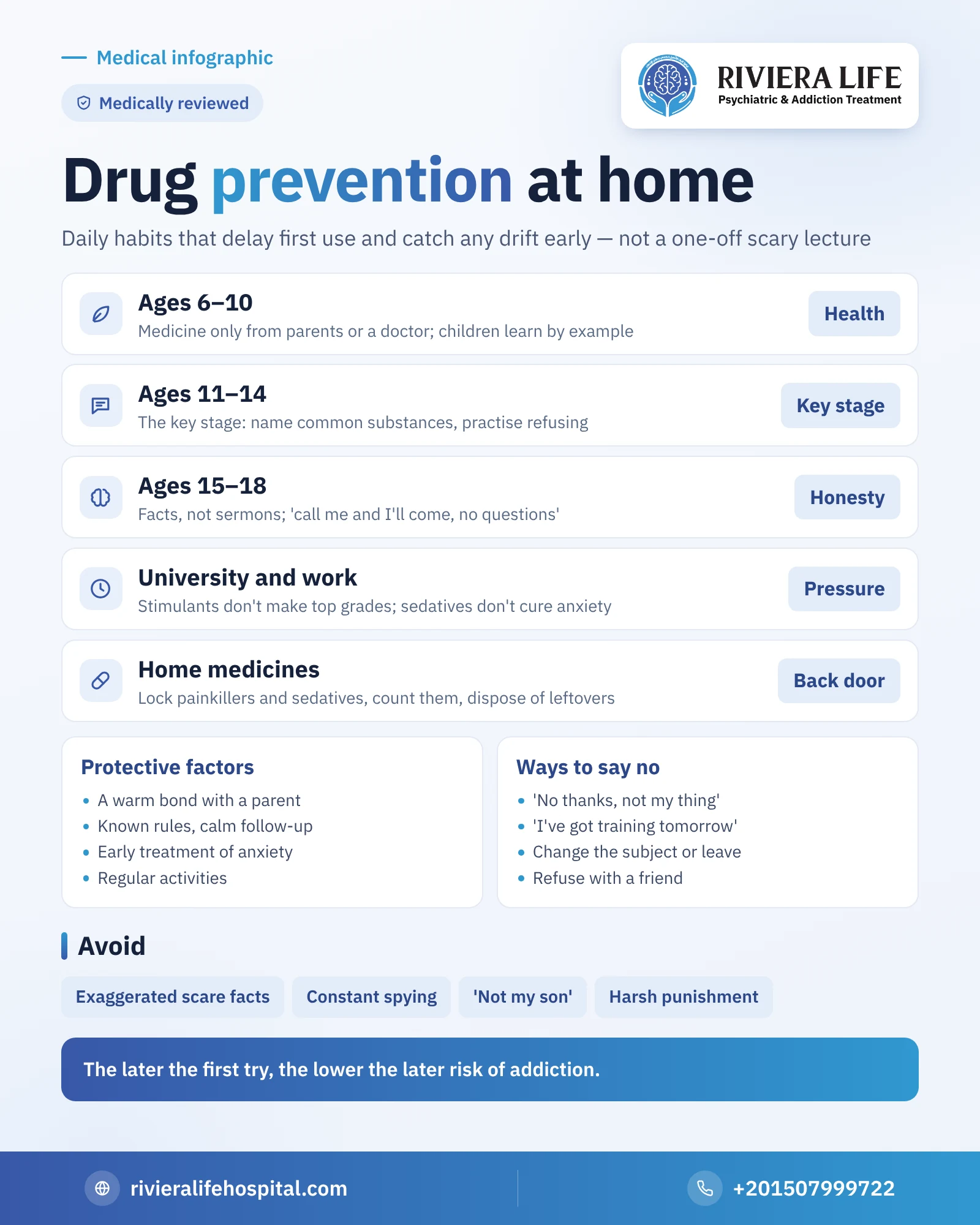
The talk here is about medicine and health in general: that medicine is taken only from the father, mother or doctor, and that our bodies deserve protection. Children at this age learn from actions more than words, so the way adults deal with cigarettes and medicines is a message in itself.
From eleven to fourteen
This is the most important stage, because first use may begin in it. Talk clearly about the substances in circulation and their names, ask about what they hear at school, and practise refusal situations with them. Keep the conversation short and repeated rather than a single long session.
From fifteen to eighteen
The teenager here hates preaching and respects frankness. Discuss the facts with them: what substances do to the developing brain, the risks of mixing, and the danger of riding in a car with a driver under the influence. And agree with them on the rule “call me at any time and I’ll come and pick you up, no questions tonight”.
University and starting work
Direct supervision falls away and pressure, late nights and exams increase. The important message: stimulants don’t create academic excellence, sedatives aren’t a solution to anxiety, and asking for psychological help under pressure is strength, not weakness.
How do you talk to your child about drugs without frightening or tempting them?
- Start with a question, not an accusation: “I heard some people at school are trying things — what do you think?”.
- Listen more than you talk, and don’t interrupt when they talk about others.
- Use real situations from the news or TV series as a natural way into the conversation.
- Avoid inaccurate exaggeration, because if a teenager discovers an exaggerated piece of information, they may doubt everything you say.
- State your position clearly: “I don’t accept drug use, and I will always love you and help you with any problem”.
Many families fear that talking about drugs may draw their children’s attention to them, but the reality is that silence doesn’t protect, because the information will reach them from worse sources.
Refusal skills: how does a young person say “no” in front of friends?
The hardest moment isn’t knowing that drugs are harmful, but saying “no” without looking weak. Help your child prepare ready replies that suit their personality:
- Direct refusal: “No thanks, it’s not my thing”.
- A personal reason: “I’ve got training tomorrow morning” or “my dad does surprise tests”.
- Changing the subject or place: suggesting another activity or leaving the gathering.
- Bringing in one friend who refuses with them, as refusing as a group is easier.
Why drugs spread in society
Understanding what widens the circle of use makes prevention more precise, because it shows where the family, school and community can intervene. These are causes that combine, and none is enough on its own:
- Easy access to the substance: cheap pills and new substances whose names and formulas keep changing.
- Weak control of mind-altering medicines: so they pass from the pharmacy or the home to people who don’t need them.
- Idleness, economic pressure and unemployment: so a young person looks for an escape or a quick source of income.
- Mistaken ideas: that a pill increases energy, treats anxiety or improves performance — promises that only hold temporarily.
- Friends and surroundings: when use seems normal among peers, refusing becomes harder.
- Online promotion: accounts that present drugs as a harmless “solution”.
- Stigma and fear of scandal: these delay seeking treatment, so the user continues and affects those around them.
You aren’t expected to hold yourself accountable for every one of these factors, as some are outside the family’s control. But what happens inside the home, such as conversation, calm supervision, securing medicines and knowing the children’s friends, makes up for a large part of what is outside. Our article on prescription drug addiction covers the first door through which many start, and teen addiction explains why this age is more vulnerable.
Medicines at home: a back door to addiction
In Egypt, many young people start with tablets already in the home: a strong painkiller after an operation, or a sedative prescribed for one of the parents. Prevention here is simple and effective: keep painkillers and sedatives in a locked place, know how many there are, dispose of what remains after treatment ends, and don’t give anyone a medicine prescribed for someone else. Our page on pregabalin explains how a legitimate medicine turns into a substance of addiction.
The internet and social media: hidden promotion
The dealer no longer stands only in the street; promotion sometimes happens through accounts and groups that use codes and slang. Know the apps your child uses, and talk with them about advertisements that portray drugs as “natural” or “safe”. Learn the terms in circulation in our guides to drug slang and drug names in Egypt.
The role of school, university and workplaces
The school most successful at prevention isn’t the one that gives the most lectures, but the one that builds skills: managing pressure, making decisions and asking for help. Having a psychologist or social worker who can be reached confidentially makes a big difference. And at work, clear policies that treat use as a treatable health problem help, encouraging the employee to ask for help instead of hiding it.
Common mistakes that weaken prevention
| The mistake | The better alternative |
|---|---|
| Frightening with exaggerated information | Accurate facts the child can check |
| Constant searching and spying | Open follow-up and agreed rules |
| “My son could never do that” | Calm attention without accusation or denial |
| Harsh punishment at the first mistake | Conversation and clear, proportionate consequences |
| A father smoking or taking sedatives in front of the children | A role model consistent with the words |
A simple weekly plan for the family
- Day one: dinner without phones, and an open talk about each person’s day.
- Day two: review the home’s medicines and secure painkillers and sedatives.
- Day three: ask your child what they hear about drugs around them.
- Day four: agree on rules for going out and coming back, and how to stay in touch.
- Day five: a quick refusal-situation practice through role play.
- Day six: a shared activity your child enjoys, sport or an outing.
- Day seven: a calm review of what worked and what needs adjusting.
When does prevention become early intervention?
If you notice a sudden change in sleep, friends, pocket money or grades, don’t wait for certainty. Start with a calm conversation, then ask for a specialist assessment if the doubts continue. You will find the list of signs worth attention in our guide how do I know if my son is addicted to drugs?, and for teenagers who have already started using there are programs designed for their age, such as the addiction treatment program for students and adolescents. At Riviera Life the family can start with a free, confidential consultation with a specialist, even before the son agrees to come.
And prevention inside school plays a role that complements the home’s, from programs that build skills to what a teacher does on noticing worrying signs; the details are in drug prevention in schools.
Read also
- Drug addiction: definition, signs and treatment
- How to know if there is a drug addict in your home
- Drug testing: types and reading the result
- The family rehabilitation program
- Inhalants: the complete guide
- Glue and inhalant addiction treatment: medical examination, psychotherapy and the family
Questions many people ask
You can start from school age by talking about medicine and health, then the conversation becomes more open and specific from about age eleven, because first experimentation may begin in early adolescence.
No. A calm, fact-based conversation protects more than silence, because the information will reach children anyway, and it is better that it comes from you.
Prepare clear refusal replies, find a friend who shares your position, leave gatherings where use happens, and widen your circle with new activities and interests.
They are an important protective factor but not enough on their own; they must go with family conversation, clear rules and early treatment of any anxiety or depression.
Not necessarily, but it is a warning that deserves a serious conversation and follow-up, because repetition can lead to dependence, and some substances are dangerous from the first time.