
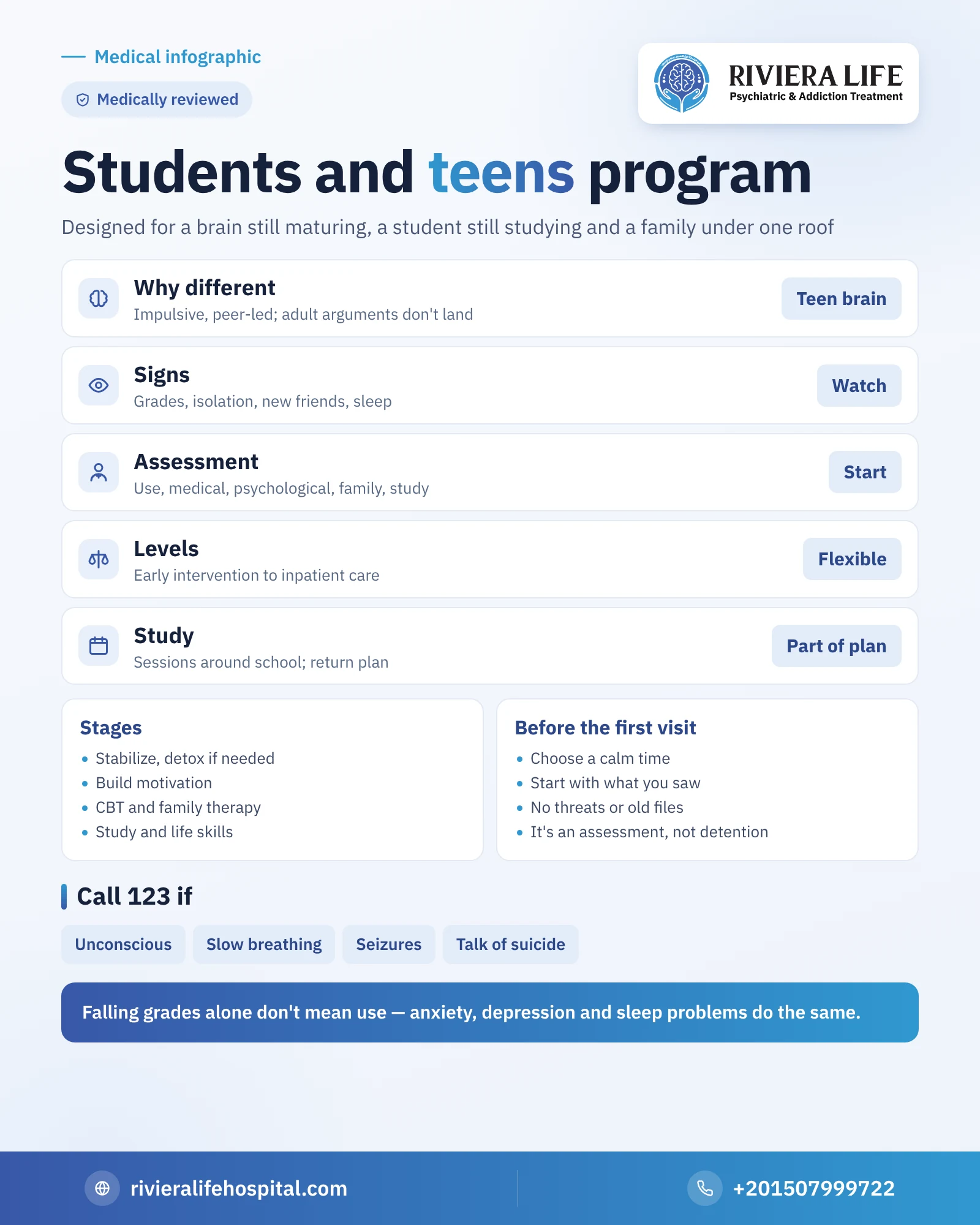
The addiction treatment program for students and teenagers is a plan designed for an age at which brain development isn’t yet complete, and takes into account that the patient is still at school or university and lives under their family’s roof. It differs from adult programs in that the family is a partner at every stage, study is part of the plan rather than something postponed, and early intervention prevents big losses. It always starts with a comprehensive assessment that determines the suitable level of care, from clinic sessions to residence inside the hospital. On this page: when a student needs the program, how they are assessed, the levels of care, the treatment stages, and how Riviera Life offers it.
Why does a teenager need a program different from adults?
The front part of the brain, responsible for planning and controlling impulsivity, continues to mature until about the mid-twenties. That is why a teenager is affected by the substance faster, makes more impulsive decisions, and is influenced by their friends more than by advice. And words that convince a man of forty, such as the risk of divorce or losing a job, mean nothing to a sixteen-year-old student.
That is why the program relies on language suited to their age, and on near goals they can see with their own eyes: passing the next exam, returning to the football team, the arguments at home stopping. The details of the program differ with teenagers, but the foundations of drug addiction treatment remain the same: assessment, safe withdrawal, rehabilitation and follow-up.
When does a student need an addiction treatment program?
Academic signs
A sudden decline in grades, repeated absence, and teachers’ complaints about sleeping in class or aggressive behavior.
Psychological and behavioral signs
Unusual irritability, isolation in the room, a sudden change of friends, and lying about pocket money and places.
Physical signs
Red eyes, disturbed sleep and appetite, a strange smell, and weight loss. You will find a detailed explanation of these signs and how to confirm them in the article on how do I know if my son is addicted to drugs?.
When is the case an emergency?
Some teenagers try dangerous mixtures, such as strox, pills of unknown source or sedatives with alcohol, without any idea of their effect. The family doesn’t wait for the assessment appointment in these cases:
Call an ambulance on 123 immediately if there appear
Stay beside him until help arrives, and if he is unconscious and breathing, put him on his side.
- Loss of consciousness or difficulty waking him
- Very slow or intermittent breathing or blue lips
- Seizures
- Chest pain or very high fever with agitation
- Severe hallucinations or sudden violent behavior
- Talk of suicide or self-harm
How is the student assessed before starting the program?
- Pattern of use: which substances? Since when? Does he use alone or with a group? Does he mix more than one substance?
- Medical assessment: a physical examination and tests to determine the substances and the extent of the need for detox.
- Psychological assessment: as many teenagers use to deal with anxiety, depression or attention deficit hyperactivity disorder.
- Family and social assessment: the way of communicating at home, disputes, and peer pressure.
- Academic assessment: the stage, subjects behind, and near exam dates.
What levels of care are available?
| Level | Usually suits |
|---|---|
| Early intervention and clinic sessions | Experimenting or use at its start without physical dependence |
| An intensive program or half residency | Regular use with a supportive family and ability to commit |
| Therapeutic residence | Severe use, mixing substances or an unsafe environment |
| Care inside the hospital | Dangerous withdrawal, psychosis or danger to self |
The level isn’t a final verdict, as a teenager may start with residence then move to the clinic, or the reverse if outpatient follow-up doesn’t succeed.
What are the stages of the addiction treatment program for students and teenagers?
- Stabilization and detox: when needed and under medical supervision.
- Building motivation: with motivational interviewing, because most teenagers come forced.
- Cognitive behavioral therapy: to deal with peer pressure, boredom and anger.
- Family therapy: to repair communication and set clear rules at home.
- Treating co-occurring disorders: within the dual diagnosis program if needed.
- Academic rehabilitation: a realistic plan to return to study and make up for what was missed.
- Life skills: managing time and money, confident refusal, and alternative activities.
- Relapse prevention: a trigger map suited to a student’s life, such as exams, holidays and parties.
- Follow-up: periodic sessions after the intensive stage ends.
How does the program deal with study?
The difficult decision families face: should the son stop studying to be treated? The answer depends on the severity of the case. In outpatient levels sessions are arranged around school or university times. In residence, the team helps the family plan for after discharge, and postponing a semester may be less of a loss than repeated failure or a relapse in the middle of the year. And the team doesn’t communicate with the school except with the family’s agreement.
How do you talk with your son before the first visit?
The way the idea of treatment is presented greatly affects the first session. Choose a time when your son is calm and not under the influence, and start with what you have noticed, not with accusation: “I’ve noticed you’re not sleeping, and your grades have dropped, and I’m worried about you”. Avoid threatening scandal or throwing him out, and don’t open the file of all the old mistakes in one session.
And explain to him that the first visit is an assessment and consultation, not detention. Many teenagers refuse because they imagine a closed and harsh place, so if they know the goal is for their voice to be heard too, their refusal decreases. And if he refuses completely, the family can start on its own with a session with the team to arrange the next step.
What is the family’s role?
The family in the teenagers’ program isn’t a guest but part of the treatment. It learns how to set steady rules for pocket money, going out and the phone without shouting, how to reward commitment, and how to avoid comparison with siblings. And if you haven’t yet convinced your son of treatment, read how do I help an addict and persuade my son to get treatment. Organized work with the whole family is offered by the family rehabilitation program.
The effect of drugs on academic achievement
Teachers and parents notice this effect before the student admits anything: grades declining for no clear reason, repeated absence, and homework not handed in. Drugs strike the abilities learning rests on, and do so at an age when the brain is still building its connections.
- Attention: the student is distracted during explanations, and needs longer to understand what they used to grasp quickly.
- Memory: it is hard to fix information then retrieve it on exam day.
- Sleep: long staying up or sleeping by day makes them miss morning classes.
- Motivation: they lose interest in studying and in the activities they used to love.
- Discipline: lateness, absence and tension with teachers, and the matter may end in failing or expulsion.
But declining grades alone don’t mean your son is using, as anxiety, depression and sleep disorders do the same thing. That is why we start with assessment before any judgment, and you will find the signs that distinguish them in the article on how do I know if my son is addicted to drugs. And if use is confirmed, the academic effect is usually recoverable with stopping the substance and a realistic study plan, as we explain in the guide to teen addiction.
The right hospital for treating addiction in students and teenagers: how to choose
The right hospital for treating teen addiction is one that deals with your son as a teenager with developmental, academic and family needs, not as a small copy of an adult patient. Ask:
- Is a psychological assessment carried out that looks for anxiety, depression and attention deficit behind the use?
- Is the age group taken into account in sessions and activities?
- Is the family really involved with regular sessions, or does it settle for visits?
- Is there a plan for returning to study?
- Can one move easily between levels of care according to how the case develops?
- How is the student’s confidentiality kept from the school and neighbors?
And keep away from any place that promises a guaranteed cure or treating a teenager in a few days.
How Riviera Life meets these standards in treating students and teenagers
Riviera Life applies these criteria as follows:
- Official license: a hospital licensed by the Ministry of Health.
- A look deeper than the use: consultants in psychiatry and addiction look into the motives of use.
- Round-the-clock supervision: for cases of withdrawal or dangerous mixtures.
- Long experience: fourteen years and thousands of recovered cases.
- A family program: makes the parents partners in treatment.
- Aftercare: accompanies the student in their return to study.
- Complete confidentiality: no one outside the family knows except with its agreement.
If your son or daughter is using, book a free first consultation or call us at any time on +201507999722. The hospital is in Sheikh Zayed, Giza.
Read also
- How do I know if my son is addicted to drugs?
- Drug prevention: a guide to protecting your family
- The family rehabilitation program for addiction treatment
- The dual diagnosis program
- Mental illness in children: signs by age and when to worry
- Teen addiction: why are they more at risk and how do parents protect their children?
- Teen depression: the signs, how parents talk and treatment options
- Psychological changes in adolescence: what is normal and what is worrying?