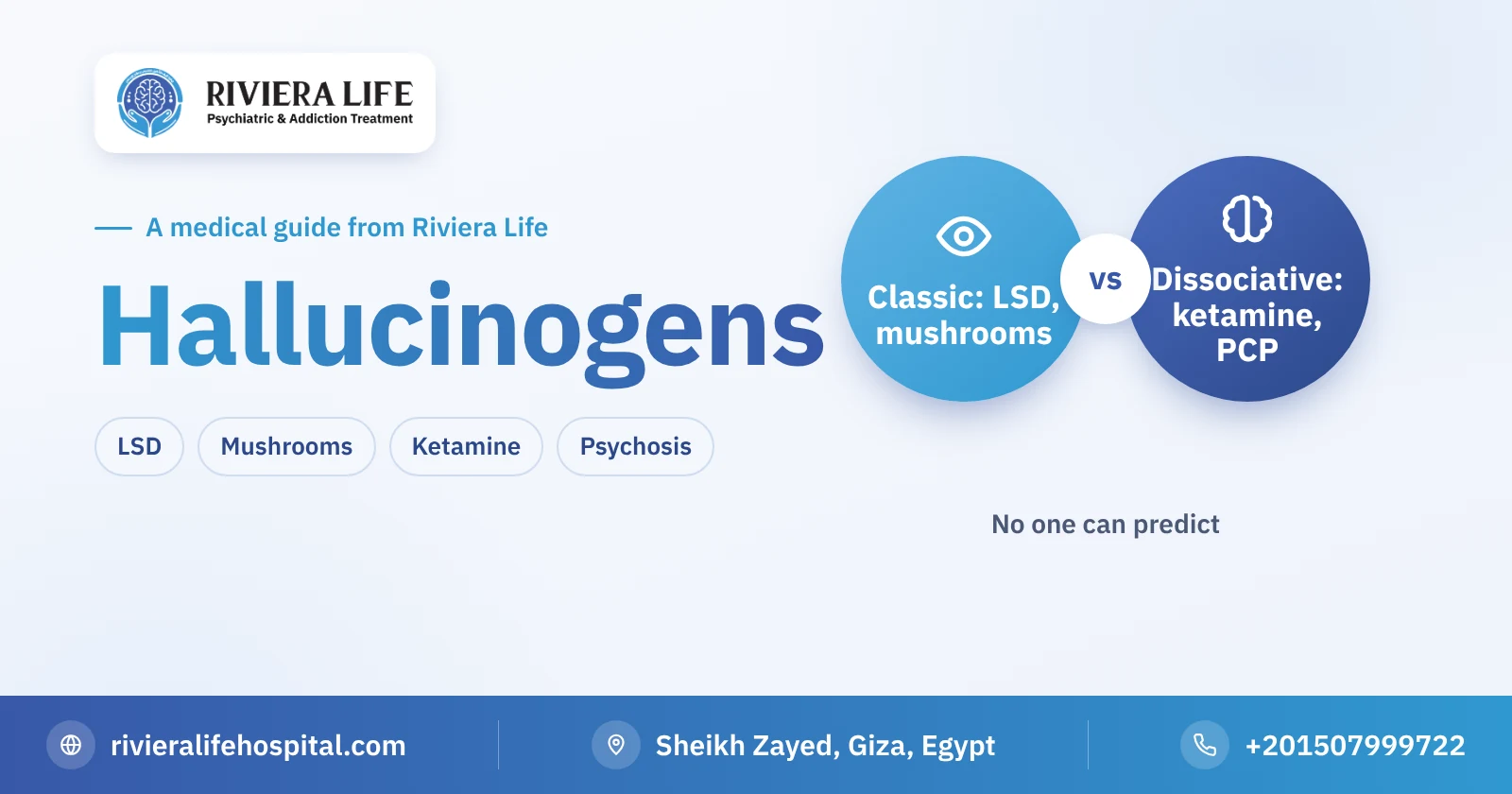
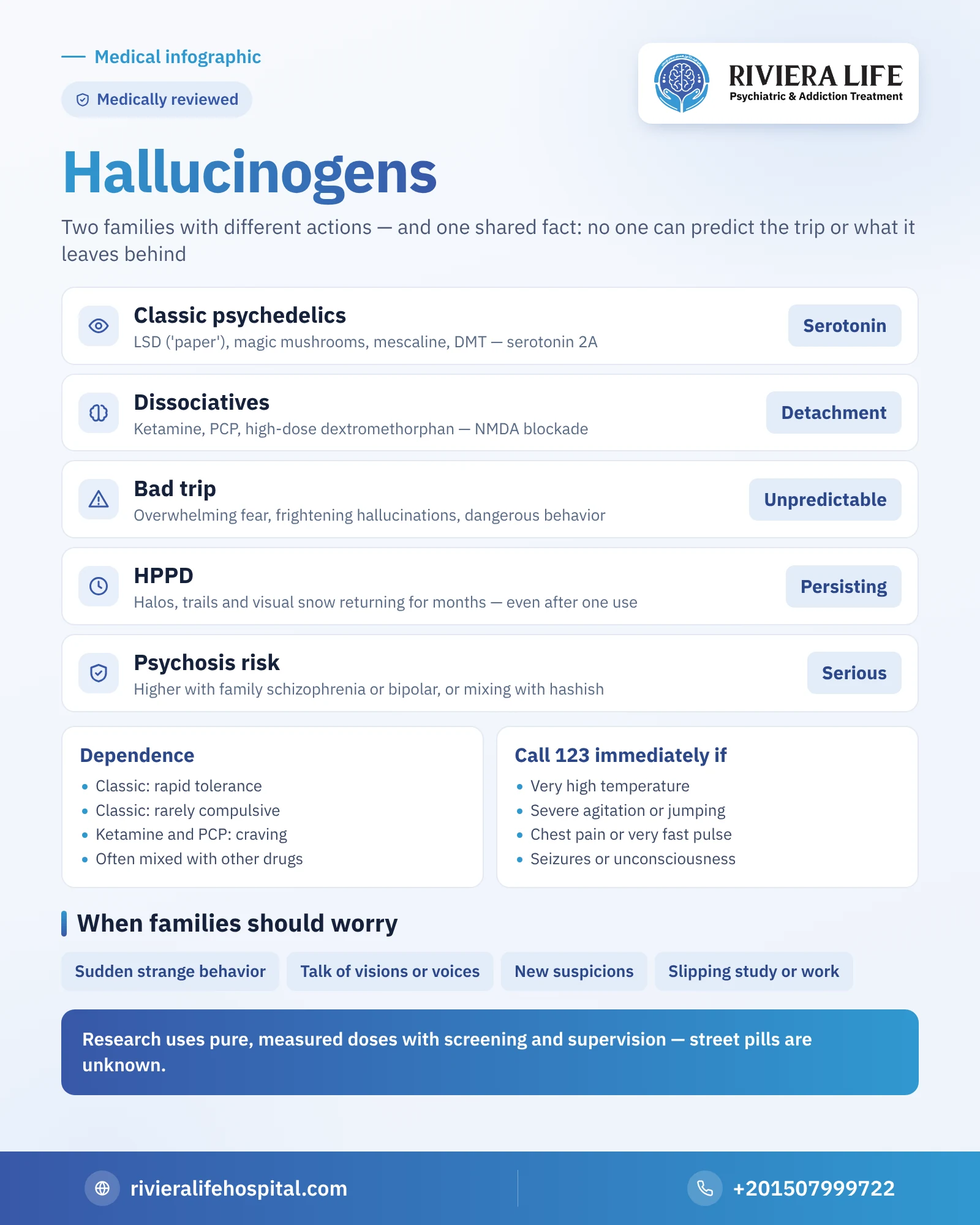
“Hallucination pills” is a broad popular expression people use for any substance that makes someone see, hear or feel what isn’t there. Scientifically, hallucinogens divide into two main families: classic psychedelics such as LSD, known in Egypt as “paper”, magic mushrooms and mescaline, and dissociative substances such as ketamine and phencyclidine, which separate a person from their body and surroundings.
These substances differ in their effects, but they share one thing: no one can predict what the experience will be like, or what it may leave behind. In this article we explain the types and their effects, bad trips, persisting perception disorder, the risk of psychosis, and to what extent they cause dependence.
What do people mean by “hallucination pills”?
On the Egyptian street, the word isn’t limited to true hallucinogens. Young people may use it for ecstasy pills at parties, or for medicines used outside their purpose in large amounts that cause hallucinations as a sign of poisoning, such as Parkinol. This confusion is dangerous, because someone who thinks they know what they took may in fact be facing a substance with completely different toxicity. Hallucinogens in the medical sense are substances whose main effect, not a side effect, is changing perception, mood and thinking.
Classic psychedelics
This group works mainly on serotonin receptors in the brain, especially the type called “2A”, changing the way the senses and emotions are processed. Its best-known members are:
- LSD: an extremely potent synthetic substance, of which a tiny amount is enough, which is why it spreads on small paper squares that Egyptians call “paper” or “bebar”. Our guide to the paper drug explains the details.
- Magic mushrooms: types of mushroom containing psilocybin, which carry an added danger because some poisonous wild mushrooms resemble them.
- Mescaline: a substance found in some types of cactus, less widespread in the Arab region.
- Dimethyltryptamine (DMT): found in some plants and also manufactured; its effect is short but intense.
Dissociative substances: ketamine and phencyclidine
These substances work in a different way, blocking NMDA-type glutamate receptors, so the user feels detached from their body, as if watching themselves from outside, with numbness and a distorted sense of time and place. The best known is ketamine, a legitimate surgical anesthetic misused in some party circles; our guide to ketamine explains its particular harms to the bladder and kidneys. Others include phencyclidine (PCP), known for its ability to provoke agitation, aggression and high body temperature, as well as very large amounts of some cough medicines containing dextromethorphan. This group differs from the classic one in being closer to causing dependence, as we will explain.
How do hallucinogens affect the mind and body?
Colors and sounds change and things appear to move or ripple, and the senses may blend so the person feels they “see” music. The sense of time stretches so minutes seem like hours, and emotions swing quickly between euphoria, anxiety and crying. With dissociatives, numbness, detachment and difficulty moving and speaking dominate.
The body responds with a rise in pulse, blood pressure and temperature, dilated pupils, sweating or chills, and nausea, especially with mushrooms. With phencyclidine and large amounts of ketamine, the sense of pain may weaken so the person is injured without realizing, or their movement slows until they can’t respond to what is around them. The effect of LSD lasts many hours, which may approach half a day, while the effect of others is much shorter.
The bad trip: when the experience turns to terror
The bad trip is the face that those who promote these substances don’t talk about. The experience may start calm and then suddenly turn into overwhelming fear: the person feels they are being chased, that they will die or that they have lost their mind forever, and the hallucinations may become terrifying.
In this state they may run into the street, jump from a high place thinking they can fly or to escape an imaginary danger, or hurt whoever tries to approach them. There is no guaranteed way to avoid a bad trip; the substance itself, the person’s psychological state, the place and the company all interact in a way that can’t be controlled. How doctors deal with these acute cases is explained in our article on hallucinogen addiction treatment.
Persisting perception disorder after hallucinogens
Some people who have used hallucinogens, even a few times, notice visual changes returning days or months after the last use: halos around lights, trails following moving objects, sparkling dots covering the field of vision, or colors that seem more intense than normal.
If these changes come as short episodes they are called “flashbacks”, and if they persist and distress the person, doctors call it “hallucinogen persisting perception disorder”, abbreviated HPPD. It is uncommon, but may last months or years, and causes intense anxiety because the person knows what they see isn’t real and can’t stop it. It isn’t always linked to the number of times of use, and may appear after a single experience.
Hallucinogens and the risk of psychosis
Hallucinations during the effect are expected, but the bigger worry is that they continue after the substance has gone. In some people, hallucinogens may reveal a hidden vulnerability to psychosis, so suspicions, delusions and hearing voices appear and last days or weeks, or an episode of schizophrenia or mania begins after them. This risk is clearly higher in those with a family history of schizophrenia or bipolar disorder, those who have had a psychotic episode before, and those who combine hallucinogens with hashish or stimulants. You will find an explanation of psychosis, its symptoms and treatment in our guide to psychosis.
Are hallucinogens addictive?
The answer differs by family. Classic psychedelics such as LSD and mushrooms usually don’t cause the compulsive drive that characterizes opioid or stimulant addiction, nor clear physical withdrawal symptoms. But the body acquires rapid tolerance to them, so their effect lessens within days if repeated, and this tolerance extends to other members of the family. This doesn’t mean they are safe; some users repeat them despite bad trips and psychological harm, and doctors consider it a use disorder when use continues despite harm.
For dissociatives the picture is different: ketamine and phencyclidine may cause urgent craving and repeated use that is hard to stop, with psychological symptoms after stopping such as anxiety, depression and sleep disturbance. Added to this, hallucinogen users often combine them with ecstasy, hashish or alcohol, so the dependence is on the whole group, not on a single substance. To compare this with the best-known party pill, see our guide to ecstasy.
What about medical research on hallucinogens?
Young people may hear that psilocybin or ketamine are used to treat depression, and think that taking them at a party is a kind of treatment. The truth is that this research is carried out with pure substances in measured amounts, after careful psychiatric screening that excludes those with a vulnerability to psychosis, and under the supervision of a medical team before, during and after the session. What has been approved so far is very limited and is given only inside medical facilities. The substance sold on the street is of unknown source and concentration, and may be another, far more dangerous substance.
Hallucinogens and the law in Egypt
Egyptian law lists LSD, psilocybin, mescaline and phencyclidine among prohibited narcotic substances, and ketamine is under strict control as an anesthetic medicine not traded outside hospitals. Legal details change and are subject to the judgment of the competent authorities, but what is certain is that possession and trading expose a person to liability, while voluntarily seeking treatment remains a safe path.
Among the popular street brand names are “blue elephant” pills, tablets of unknown composition sold as hallucinogens; our article on blue elephant pill addiction treatment explains their risks and how their complications are handled.
When should the family worry?
Seek a specialist assessment if you notice sudden strange behavior with dilated pupils, talk of visions and voices, suspicions that weren’t there before, persistent anxiety about visual changes, or a decline in study and work. At Riviera Life, consultants in psychiatry and addiction treatment assess these cases in complete confidentiality, and distinguish between the effect of the substance and the beginning of a mental illness that needs early treatment.
Call an ambulance on 123 immediately if you see
After taking any hallucinogenic or unknown substance, don't wait for the trip to end if you see:
- A very high temperature with heavy sweating or hot skin
- Severe agitation, aggression, an attempt at self-harm or jumping
- Chest pain or a very fast pulse
- Seizures or loss of consciousness
- Confusion that doesn’t improve, or inability to move and speak
More from our hallucinogens guide
- The paper drug: the complete guide
- Treating hallucinogen addiction and bad trips
- The short- and long-term harms of the paper drug
- The harms of ketamine on the bladder, kidneys and brain
- Magic mushrooms: what they are, how they affect the brain and whether they are addictive
Questions many people ask
They divide into classic psychedelics such as LSD, psilocybin and mescaline, and dissociatives such as ketamine and phencyclidine; people sometimes also use the name for other substances that cause hallucinations as a sign of poisoning.
It varies by substance: the effect of LSD may last many hours, while the effect of some other substances is much shorter, and psychological effects may remain after the effect ends.
An experience dominated by panic, frightening hallucinations and a feeling of losing one's mind, which may drive the person to dangerous behavior; there is no guaranteed way to avoid it.
They may reveal a hidden vulnerability to psychosis in some people, especially those with a family history of schizophrenia or bipolar disorder, and may cause a perception disorder that lasts months.
Classic psychedelics are less likely to cause compulsive addiction but cause rapid tolerance, while ketamine and phencyclidine may cause urgent craving and clear dependence.