Hallucination treatment always begins with one question: what is the cause? A hallucination is a symptom, and silencing it without treating its source is like switching off the fire alarm and leaving the fire. Hallucinations from fever disappear when the infection is treated, hallucinations from alcohol withdrawal need supervised medical detox, hallucinations from a medicine improve when it is adjusted, and hallucinations from a psychotic disorder need antipsychotics with psychotherapy and follow-up. This article explains the assessment steps, treatment options by cause, the medicine classes without doses, the role of psychotherapy, when hospital admission is needed, and how to choose the right place.
The first rule: treat the cause, not just the symptom
Imagine three people who see people who aren’t in their rooms: the first is an elderly man with a urinary tract infection, the second a young man who hasn’t slept for four days because of shabu, and the third a patient with Lewy body dementia. If all three were given the same medicine, at least two of them would be harmed. The elderly man needs an antibiotic and fluids, the young man needs safe withdrawal and sleep then addiction treatment, and the dementia patient may suffer a severe decline if given some antipsychotics. That is why assessment comes before any prescription.
The assessment steps
- Medical history: when the hallucination began, how it developed, which sense is affected, which medicines and substances are used, and when the last dose or last drink was.
- Physical and neurological examination: temperature, pulse, blood pressure, consciousness, movement and reflexes.
- Mental state examination: attention, memory, mood, the presence of delusions and the risk of harm.
- Tests: a blood count, salts, sugar, liver, kidney and thyroid function, a drug test, and a urine test for infection when needed.
- Additional tests as the case requires: a brain scan, an EEG, or an eye and hearing examination.
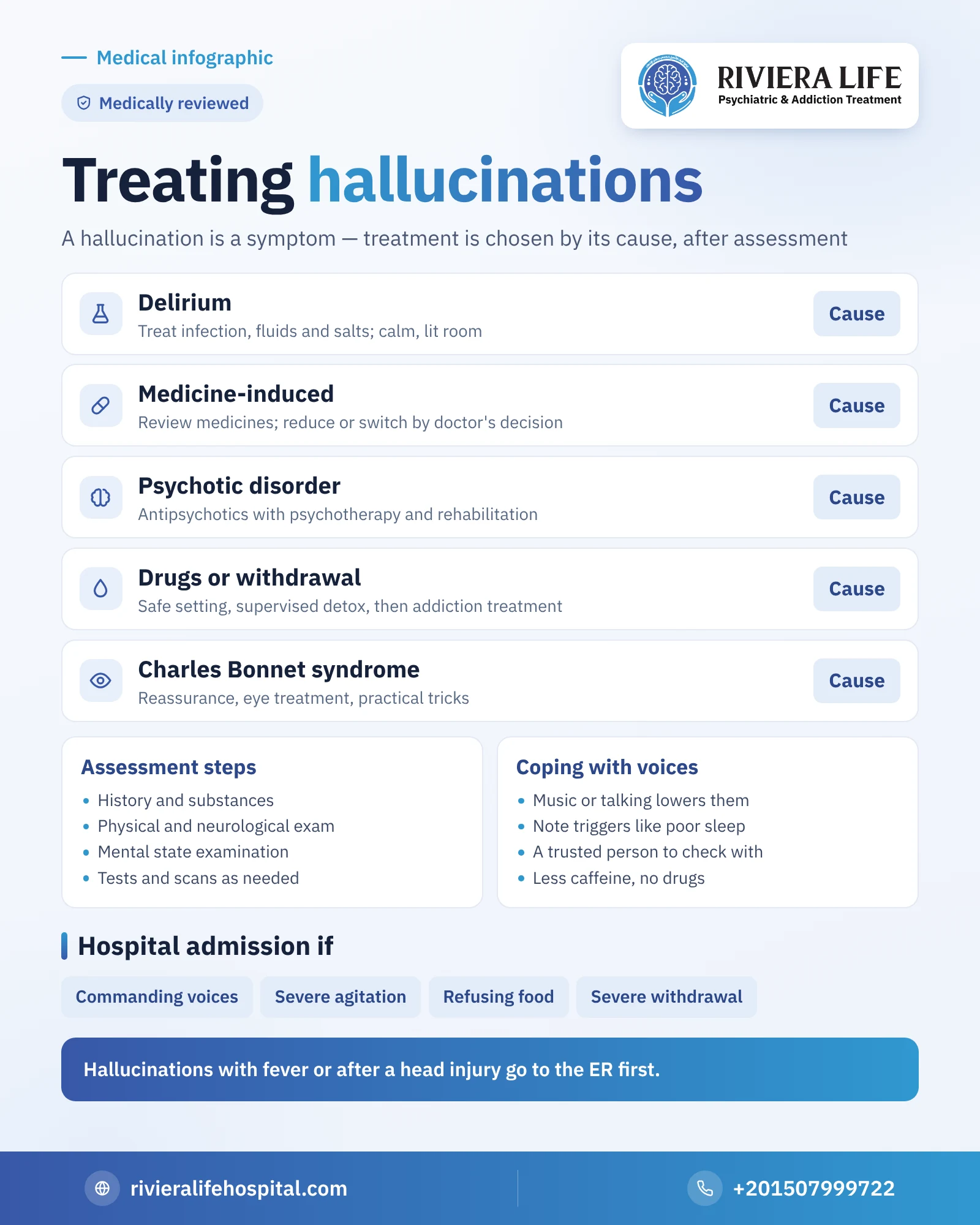
Treatment by cause
| Cause | Focus of treatment |
|---|---|
| Delirium from infection, dehydration or salt imbalance | Treating the infection, replacing fluids and salts, a calm, well-lit environment and familiar faces |
| A causative medicine | Reviewing medicines, and reducing the dose or replacing the medicine by the doctor’s decision |
| A psychotic disorder such as schizophrenia | Antipsychotics with psychological and family therapy and rehabilitation |
| Mania or depression with psychotic features | Treating the mood disorder itself, with an antipsychotic when needed |
| Hallucinogen or stimulant use | A safe environment and monitoring, then an integrated addiction treatment program |
| Alcohol or sedative withdrawal | Supervised medical withdrawal, vitamin replacement and monitoring of vital signs |
| Parkinson’s or Lewy body dementia | Reviewing Parkinson’s medicines, medicines that support acetylcholine, and great caution with antipsychotics |
| Epilepsy | Antiepileptic medicines suited to the type of seizure |
| Charles Bonnet syndrome | Reassurance, treating the eye problem as far as possible, and practical tricks such as changing the lighting and moving the eyes |
| Sleep deprivation or sleep paralysis | Organizing sleep and treating any sleep disorder |
Our page on the causes of hallucinations sets out each of these families of causes in detail.
The classes of medicine used
There is no single medicine called “the hallucination medicine”, but classes the doctor chooses from according to the cause:
- Antipsychotics: ease hallucinations and delusions in psychotic disorders and manic episodes, and are sometimes used for a short period in severe agitation. They have side effects that need monitoring, such as weight gain, drowsiness and stiffness.
- Sedatives from the benzodiazepine class: have a key role in supervised medical alcohol withdrawal, and aren’t used for long periods without necessity because of the risk of dependence.
- Cholinesterase inhibitors: may ease hallucinations in some types of dementia.
- Antidepressants and mood stabilizers: when the hallucination is part of a mood disorder.
- Antiepileptics: when the hallucination is part of a seizure.
Choosing the medicine, the dose and the duration of use is purely a medical decision, and any psychiatric medicine is stopped gradually and under supervision, not suddenly.
Psychotherapy and coping with voices
Medicine isn’t the only solution, especially when some voices persist despite treatment. This is where cognitive behavioral therapy for psychosis comes in, a treatment recommended by British guidelines for psychosis and schizophrenia. It doesn’t aim to convince the patient that the voice doesn’t exist, but to change their relationship with it: understanding what triggers it, testing what it says instead of obeying it, and reducing the fear and power they give it. With it, the patient learns practical tools such as:
- Playing music, talking with someone or humming, as these activities may lower the intensity of the voices.
- Recording when the hallucination appears and what precedes it, such as lack of sleep or tension.
- Identifying a trusted person to ask when in doubt: “Did you hear that?”.
- Avoiding excess caffeine, late nights and drugs, because they increase symptoms.
Psychoeducation for the family also helps them understand what the patient is going through and how to deal with them without arguing or mocking.
Treating hallucinations from drugs and withdrawal
Hallucinations from drug use usually ease as the substance leaves the body, but the acute stage can be dangerous: agitation, fever, and suspicion that may drive violence or running away. So the person needs a calm, safe environment and medical monitoring, not being locked in a room at home. And if psychotic symptoms continue for weeks after stopping, the drug use may have uncovered an underlying disorder that needs separate treatment. Severe alcohol withdrawal is a medical condition that may develop into delirium tremens, and its details are in our article on alcohol withdrawal symptoms. Our pages on methamphetamine and hashish explain how addiction is treated after the episode passes.
When is hospital admission needed?
- Voices ordering harm to oneself or others, or talk of ending life.
- Severe agitation that puts the patient or those around them in danger.
- Refusing food and drink, or being unable to care for oneself.
- Moderate or severe alcohol or sedative withdrawal.
- Stimulant-induced psychosis with severe suspicion.
- The need for careful assessment or a medicine change under monitoring.
Hallucinations with confusion and fever, or after a head injury, belong first in the emergency department of a general hospital to rule out a physical cause; call an ambulance on 123.
The family’s role during treatment
The family is the doctor’s eye at home. It is the family that notices disturbed sleep or repeated turning around returning before the patient complains, and that makes sure the medicine and follow-up appointments are kept regularly. It is best to keep the home as calm as possible, avoid heated arguments about what the patient sees, and keep a written list of medicines, warning signs and the doctor’s number. The warning signs themselves are explained in our article on hallucination symptoms.
How long does recovery take?
The duration follows the cause. Hallucinations from fever or a medicine may disappear within days of treating the cause, and delirium in older people may take weeks to clear completely. Stimulant hallucinations usually settle within days to weeks of stopping. Psychotic disorders, however, need a long plan extending over months or years with follow-up to prevent relapse, and many patients stabilize and return to their lives by sticking to it.
The right hospital for hallucination treatment: how to choose
The right hospital for hallucination treatment is one that looks for the cause before treating it, can handle the patient safely in the acute stage, and then treats the psychiatric or addiction cause itself. Ask before choosing:
- Is the hospital licensed, and is treatment led by consultants in psychiatry and addiction treatment?
- Does it start with an assessment that rules out physical and medicine-related causes, and refer to general emergency care when needed?
- Is a medical team present day and night to contain agitation, commanding voices and severe withdrawal?
- Can it treat drug-induced hallucinations and co-occurring addiction in the same plan?
- Does it offer psychotherapy and training in coping with voices, not medicine alone?
- Is there follow-up after discharge and a family program?
And beware of any provider that promises to stop hallucinations for good within days, or a guaranteed cure rate, before knowing their cause.
How Riviera Life meets these standards
Here is how these criteria are met at Riviera Life:
- Official licensing: a hospital licensed by the Ministry of Health.
- A record of experience: fourteen years of practice in psychiatry and addiction treatment.
- Specialist consultants: psychiatrists and addiction consultants who identify the cause of the hallucination before setting the plan.
- Safety in the acute stage: round-the-clock medical supervision for agitation, withdrawal and commanding voices.
- Dual diagnosis: treating drug-induced hallucinations and co-occurring addiction together.
- The family as a partner: a family program and follow-up after discharge to prevent relapse.
- Complete confidentiality: full privacy for the patient and their family.
- Tangible results: thousands of recovered cases.
There is no cost for the first consultation; contact us about hallucinations at any time, day or night, on +201507999722, and we welcome you in Sheikh Zayed, Giza.
More from our hallucination guide
- Hallucination: the complete guide
- The causes of hallucinations and risk factors
- Hallucination symptoms and signs
- Types of hallucination by sense
- Psychosis treatment: early intervention, medicine, psychotherapy and relapse prevention
Questions many people ask
There is no single medicine for all cases. Antipsychotics help in psychotic disorders, but hallucinations from infection, medicine or withdrawal are treated by treating their cause, and some patients are sensitive to antipsychotics.
Sometimes yes, as in hallucinations from lack of sleep, Charles Bonnet syndrome or grief. Hallucinations from psychosis or severe withdrawal usually need medicine along with psychotherapy.
They usually settle within days to weeks of stopping. If psychotic symptoms persist longer, there may be an underlying psychiatric disorder that needs separate assessment and treatment.
When there are voices ordering harm or talk of ending life, severe agitation, refusing food, severe alcohol or sedative withdrawal, or a need for careful assessment and monitoring.
Choose a licensed hospital that looks for the cause first, with consultants, round-the-clock supervision, safe care in the acute stage, treatment of co-occurring addiction and family follow-up. Riviera Life in Sheikh Zayed meets these criteria, with complete confidentiality and a free first consultation.