Types of hallucinations are divided mainly by the sense in which they occur: auditory, visual, olfactory, gustatory and tactile, as well as bodily-sensation hallucinations and hallucinations at the start and end of sleep. Each type has a different meaning; voices point more towards psychotic disorders, sudden images more towards organic causes and drugs, and fleeting smells may be an epileptic seizure. This article explains each type with real-life examples, how doctors distinguish a true hallucination from what resembles it, and why identifying the type helps reach the cause. Classifying the experience doesn’t replace the medical assessment that determines what lies behind it.
How do doctors classify hallucinations?
The fifth edition of the Diagnostic and Statistical Manual of Mental Disorders describes a hallucination as a perception-like experience that occurs without an external stimulus, is vivid and clear with the force of normal perception, and isn’t under the person’s voluntary control. What matters is that in DSM-5 and in the eleventh edition of the International Classification of Diseases, a hallucination is a symptom that enters into the description of many disorders, not a standalone diagnosis.
Doctors use more than one axis to describe a hallucination:
- The sense: the main division this article is built on.
- Simplicity and complexity: a flash of light or a whistle versus a whole face or an understandable sentence.
- Timing: during full wakefulness, or on entering or leaving sleep.
- Insight: does the person know that what he perceives isn’t real, or is he fully convinced of it?
- Link with mood: is its content consistent with his mood or not?
Auditory hallucinations
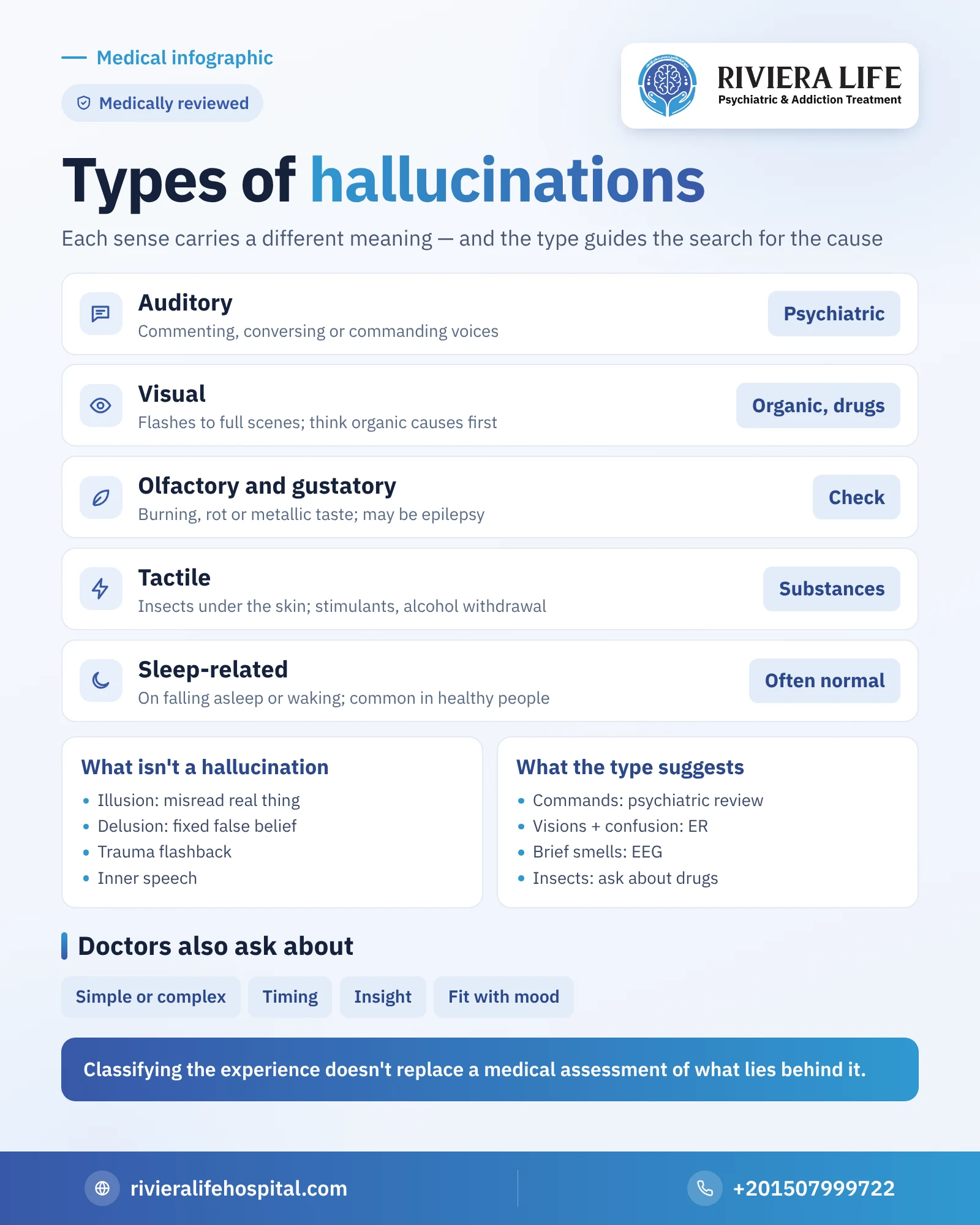
The most common in psychiatric disorders, ranging from simple sounds such as knocking, whistling and whispering to clear speech. Their forms include:
- Commenting voices: describing what the person is doing moment by moment, such as “now he’s opening the door”.
- Conversing voices: two or more talking about him in the third person.
- Command voices: asking him to do something; the most dangerous order harm to oneself or others, and they call for urgent assessment.
- Hearing one’s thoughts: a sensation that his thoughts are being spoken aloud.
- Musical hallucinations: hearing songs or tunes with no source, appearing more in older people with hearing loss.
Patients describe the voices in varied ways: some familiar, like a relative’s or a neighbor’s voice, some completely strange, and they may sometimes be friendly but are usually critical or threatening. It helps the doctor to know how many voices there are, whether they address the person directly, and whether he can ignore them, because these details help estimate the risk and follow improvement with treatment. Auditory hallucinations appear in schizophrenia, severe mania and psychotic depression, and also with stimulants and alcohol withdrawal. Their link to schizophrenia is explained in our schizophrenia guide.
Visual hallucinations
If visual hallucinations appear suddenly for the first time, the doctor thinks of organic causes and drugs before psychiatric disorders. They come in several forms:
- Simple: flashes of light, zigzag lines or colored spots, as in migraine and some eye diseases.
- Complex: people, animals or whole scenes, as in Lewy body dementia, delirium and Charles Bonnet syndrome.
- Small in size: seeing very small people or creatures, sometimes described in delirium and some neurological diseases.
- Distortions of perception: a change in the size or colors of things or rippling walls, closer to what hallucinogens produce, such as paper (LSD).
Olfactory hallucinations
Smelling odors that aren’t there, usually unpleasant: burning, rot, gas or chemicals. They may come as a few seconds preceding a temporal lobe epileptic seizure, and may be linked to problems in the nose and sinuses, migraine, or after head injuries, and rarely with psychotic disorders. A persistent strange smell that others don’t smell is something that deserves a medical check.
Gustatory hallucinations
A metallic, bitter or salty taste without cause. They are the least common type, and often come with olfactory hallucinations because the two senses are close. They may appear in epilepsy or with some medicines, and in psychosis they may lead the patient to believe his food is poisoned so he refuses it.
Tactile hallucinations
A sensation of touch or movement on or under the skin without cause. Its best-known form is the sensation of insects crawling under the skin, strongly linked to stimulants such as cocaine and methamphetamine, and to alcohol withdrawal. This sensation may push the person to scratch his skin until it bleeds. Its forms also include feeling the touch of a hand or a breath on the neck, or an electric current running through the body.
Bodily-sensation and presence hallucinations
Some people feel that their limbs are changing or moving on their own, or that their body is floating or spinning, hallucinations of the internal sense of the body. Among them too is the strong sense that someone is standing behind you or in the room without your seeing him, a sensation that recurs in sleep paralysis, in severe exhaustion and in some neurological diseases. The sensation of being detached from the body and watching it from outside is one of the known effects of ketamine.
Sleep hallucinations
Hypnagogic hallucinations appear at the moment of slipping into sleep, and hypnopompic hallucinations appear at the moment of waking. They may be images, sounds or a sense of presence, and are common in healthy people and don’t mean illness in most cases. They increase with lack of sleep and stress, recur clearly in narcolepsy, and often accompany sleep paralysis.
Types by insight and context
Doctors distinguish between a hallucination whose owner is convinced of its reality, the most common in psychosis, and a hallucination whose owner realizes it is the product of his brain, as in Charles Bonnet syndrome and sleep hallucinations. Experiences that the person feels are inside his head rather than outside are sometimes called pseudohallucinations. In mood disorders they also distinguish between hallucinations consistent with mood, such as a voice blaming a depressed person, and hallucinations unrelated to mood, and this distinction helps in diagnosis and treatment.
When more than one sense comes together
A hallucination may be limited to one sense, or several senses may overlap in one experience: the person sees a man at the door, hears him speak, and feels his hand on his shoulder. This overlap is more common in delirium, hallucinogen use and acute psychosis than in stable chronic conditions, and it usually carries a greater degree of fear and confusion.
On the other hand, Charles Bonnet syndrome stays purely visual, and musical hallucinations purely auditory, which is why the doctor asks about each sense separately even if the patient doesn’t mention it himself. The more the experience widens to include more senses with clouded awareness, the higher the priority of looking for an organic cause or a drug.
The pattern also differs with age: in children a new hallucination usually comes with fever or medicines, in teenagers and young people substance use and the beginnings of psychotic disorders come first, and in older people causes of delirium, weakening senses and neurological diseases come first.
What isn’t a hallucination: a common confusion
| Phenomenon | What it is | Example |
|---|---|---|
| Hallucination | Perception without an external stimulus | Hearing a voice calling him in an empty room |
| Sensory illusion | A wrong interpretation of a real stimulus | Seeing a plastic bag in the dark as a cat |
| Delusion | A fixed false belief | Certainty that the phone is being monitored |
| Trauma flashback | The vivid return of a memory of a painful event | Reliving the accident as if it is happening now |
| Inner speech | Thoughts the person knows are his own | Rehearsing what he will say in an interview |
“Thought hallucinations”: what do people mean?
The phrase “thought hallucinations” isn’t a separate medical category, but people use it to describe experiences that take place within thinking itself rather than in one of the five senses. Under this description come conditions completely different in their meaning, and it helps to separate them.
- Thoughts heard as a voice: the person feels his thoughts are being said aloud or that others hear them. This is an auditory experience that falls within auditory hallucinations.
- Thoughts inserted or withdrawn: a belief that an outside force is putting thoughts into his head or pulling them out. This is closer to a delusion than a hallucination, and doctors describe it among the symptoms of psychosis.
- Disturbing intrusive thoughts: frightening ideas that force themselves in, which the person knows are his own and fights. This is the pattern of obsessive-compulsive disorder, not a hallucination.
- Racing thoughts: an unstoppable flow that appears in episodes of mania and severe anxiety.
The difference the doctor relies on is insight: does the person realize these thoughts come from his own mind, even if painful? Losing this awareness with complete conviction that the thought is imposed from outside calls for a psychiatric assessment soon. You will find fixed beliefs explained in our article on paranoia, from passing suspicion to persecutory delusion, and the wider picture of psychotic symptoms in schizophrenia symptoms.
Why does identifying the type matter?
Because the type directs the search for the cause. Command voices with clear awareness lead to a psychiatric assessment, sudden images with confusion lead to the emergency department and tests, a recurring fleeting smell leads to an EEG, and insects under the skin lead to a frank question about substance use. These families are detailed in our article on causes of hallucinations, and the signs the family sees in our article on hallucination symptoms.
More from our hallucinations guide
- Hallucinations: the complete guide
- Causes of hallucinations and risk factors
- Hallucination symptoms and signs
- Treating hallucinations according to the cause
- Talking to yourself: when is it normal and when does it point to a hallucination?
Questions many people ask
In psychiatric disorders auditory hallucinations are the most common, while in organic causes, delirium and drugs visual hallucinations come first.
They are voices that tell the person to do something. The most dangerous order harm to oneself or others, and call for urgent medical assessment even if the person says he doesn't intend to obey.
Yes, it is called an olfactory hallucination. It may be linked to epileptic seizures, nose problems, migraine or head injuries, and deserves a medical check if it recurs.
Fleeting images or sounds that appear at the moment of slipping into sleep, like hallucinations on waking. They are common in healthy people, increase with lack of sleep, and recur in narcolepsy.
A hallucination is seeing something that isn't there at all, while an illusion is misinterpreting something that is there, such as seeing a coat in the dark and thinking it is a person, until the confusion clears in the light.