The causes of hallucinations are so many that a single symptom may lead the doctor to psychiatry, neurology, internal medicine or ophthalmology. They may arise from a psychiatric disorder such as schizophrenia or mania, a neurological illness such as Parkinson’s, dementia and epilepsy, a drug or alcohol withdrawal, long sleep deprivation, infection and fever in a child or an older person, or even loss of sight.
This article gathers those causes into clear families, explains how the brain creates a sensation that doesn’t exist, and what factors raise the likelihood of it appearing. None of this replaces a medical assessment, which alone determines the cause in a particular person.
How does the brain create a hallucination?
The brain doesn’t receive the world as it is, but constantly builds its picture from a mix of what the senses carry and what it expects based on its experience. Normally reality corrects the brain’s expectations moment by moment. But when this balance is upset, internal expectations override real signals, and an inner voice or a stored image is presented as if it were coming from outside.
This imbalance can come from different directions: increased dopamine activity in certain circuits, as in psychosis and stimulant use; serotonin disturbance, as with hallucinogens; blocking of glutamate receptors, as with ketamine; a lack of acetylcholine, as in some types of dementia; or a cut-off of sensory input itself, as in loss of sight, so the visual areas fill the gap with images of their own making.
Psychiatric causes
Psychiatric disorders are the best-known causes of hallucinations, but not the only ones. The most prominent:
- Schizophrenia and the psychosis spectrum: auditory hallucinations are the most common here, usually voices commenting on the person’s actions, talking about them or commanding them. We explain this disorder in the schizophrenia guide.
- Brief psychotic disorder: a short episode that may follow sudden severe stress, lasting less than a month.
- Severe mania: in some episodes of bipolar disorder, hallucinations appear that usually agree with the elevated mood, such as a voice assuring the person they are chosen for a great mission.
- Severe depression with psychotic symptoms: the voices in it are usually harsh, blaming or belittling the person, and this picture is a condition that needs rapid intervention. See the depression guide.
- Postpartum psychosis: a rare but urgent condition, usually starting in the first weeks after childbirth.
- Post-traumatic stress disorder: some people affected may live very vivid moments of flashback to the event, and some may hear voices linked to it.
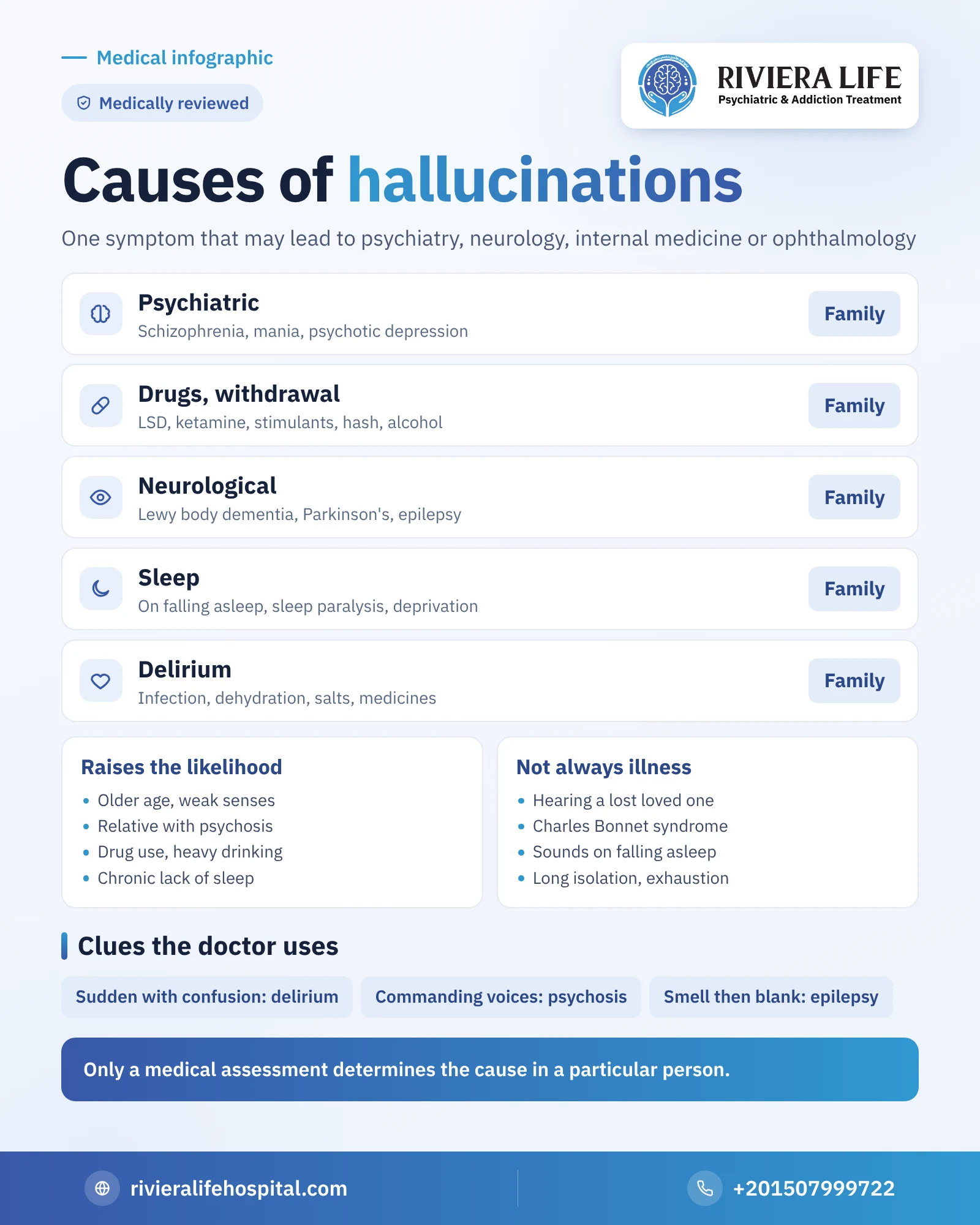
Drugs and hallucinogens
Substances differ in the way they cause hallucinations, and in the type of hallucination itself:
- Classic hallucinogens: such as the paper drug (LSD) and magic mushrooms, which usually cause visual distortions and blending of the senses. Some users may get flashbacks of these disturbances weeks or months after stopping. The details are on the paper drug page.
- Dissociative drugs: such as ketamine, which give a feeling of detachment from the body and a distorted sense of time and place.
- Stimulants: such as methamphetamine, known as shabu and ice, and cocaine. With high doses or days of continuous wakefulness, a psychosis may appear with voices, suspicion and a feeling of insects crawling under the skin. See the methamphetamine page.
- Hash: especially high-potency types and heavy early use, which may trigger a psychotic episode in those predisposed. The details are on the hash page.
- Synthetic drugs: such as strox and voodoo, whose composition is unknown and effect unpredictable, and which may cause agitation and acute hallucinations.
Withdrawal from alcohol and sedatives
The paradox is that stopping a substance may cause hallucinations just as using it does. In someone used to heavy drinking for a long time, hallucinations may appear within about a day or two of the last drink, often visual or tactile, and sometimes voices with relatively clear consciousness. In more severe cases, withdrawal may develop into delirium tremens after about two to four days, with confusion, fever, tremor and an irregular pulse, a serious medical condition. The details of the timeline are in the article on alcohol withdrawal symptoms. Sudden withdrawal from benzodiazepine sedatives after long use may follow a similar path.
Neurological causes
When hallucinations begin after middle age, or are mainly visual, the doctor thinks of the nervous system first:
- Dementia with Lewy bodies: repeated, detailed visual hallucinations are one of its distinctive signs, often images of people or small animals.
- Parkinson’s disease: hallucinations appear as the disease progresses, and some of the medicines that treat it by raising dopamine may increase them.
- Alzheimer’s and other types of dementia: especially in the advanced stages.
- Epilepsy: temporal lobe seizures may begin with a sudden foul smell, a strange taste, or a feeling that the scene is abnormally familiar.
- Migraine: it may be preceded by shimmering zigzag visual patterns moving across the field of vision, which usually go within less than an hour.
- Brain injuries: tumors, strokes and head injuries, especially if the hallucinations come with weakness or a new headache.
Sleep: when the dream slips into wakefulness
Fleeting images and sounds at the moment of falling asleep or waking are common in healthy people, such as hearing someone call your name as you doze off. Linked to them is sleep paralysis, when the mind wakes before the muscles regain movement, so the person feels someone’s presence in the room or a weight on their chest for frightening seconds. These experiences repeat more in narcolepsy and in severe sleep deprivation; after a few continuous days without enough sleep, anyone may start seeing movement at the edges of their vision or hearing voices.
General medical causes and delirium
Delirium is a state of acute confusion that appears within hours or days, in which attention and consciousness are disturbed, and visual hallucinations are common. It is one of the most important causes of hallucinations in older people and hospital patients, and its causes include:
- Infection and high fever, including urinary tract infections and chest infections in older people.
- Dehydration and salt imbalance, especially sodium.
- Severe low blood sugar, and thyroid disorders.
- Liver or kidney failure and the build-up of toxins in the blood.
- Inflammation of the brain or the meninges.
- After major operations, anesthesia and long stays in intensive care.
Medicines are a chapter of their own: Parkinson’s medicines, medicines with an anticholinergic effect, high-dose cortisone, and some opioid painkillers and sleeping pills may all cause hallucinations in some patients, and the likelihood rises with age and with many medicines taken together.
Loss of the senses
When a person loses most of their sight because of macular degeneration, glaucoma or diabetic retinopathy, they may begin seeing shapes and colors, even faces, people and whole scenes, usually knowing they aren’t real. This is Charles Bonnet syndrome, which is neither a psychiatric illness nor a sign of dementia. Similarly, some people who have lost a large part of their hearing may hear familiar music or songs with no source.
Grief, isolation and severe stress
Not every cause is an illness. After the death of a life partner or a parent, many bereaved people hear the voice of the departed, smell their scent or sense their presence, and these experiences often carry more comfort than fear, and ease with time. Passing hallucinations may also appear in conditions of long isolation or severe physical exhaustion. What calls for assessment here is when the experience becomes distressing or repeated, or comes with other symptoms.
Factors that raise the likelihood of hallucinations
Some circumstances don’t cause hallucinations alone, but make their appearance easier:
- Older age, especially with weak sight or hearing and many medicines.
- A first-degree relative with a psychotic disorder.
- Drug use, especially in adolescence, or chronic heavy drinking.
- Chronic lack of sleep and continuous night shifts.
- Exposure to harsh trauma in childhood or adulthood.
- Chronic illnesses affecting the liver, kidneys or brain.
- Long social isolation.
How does the doctor tell the causes apart?
There are clues that help the doctor favor a family of causes before any test, but they are leanings, not fixed rules:
| Observation | Leans towards |
|---|---|
| Sudden onset within hours with confusion and fluctuating consciousness | Delirium from a physical cause, a medicine or withdrawal |
| Voices that comment or command, with clear consciousness and gradual onset in youth | A psychotic disorder |
| Repeated detailed images in an older person with fluctuating attention or slow movement | Dementia with Lewy bodies or Parkinson’s |
| A sudden smell or taste for seconds followed by blankness | An epileptic seizure |
| A feeling of insects under the skin with wakefulness and nervousness | Stimulants or alcohol withdrawal |
| Images the person knows aren’t real, with severely weak sight | Charles Bonnet syndrome |
The signs the family sees that help in this distinction are set out in the article on hallucination symptoms, and how each cause is treated in the article on hallucination treatment.
How can Riviera Life help you?
When a psychiatric disorder, substance use or withdrawal lies behind hallucinations, it needs a team that combines psychiatry and addiction treatment. At Riviera Life in Sheikh Zayed, our consultants start with an assessment that rules out physical causes, then set a plan suited to the real cause, in complete confidentiality and with a free first consultation on +201507999722.
More from the hallucinations guide
- Hallucinations: the complete guide
- Hallucination symptoms and signs
- Types of hallucinations by sense
- Treating hallucinations by cause
- Causes of psychosis: genetics, drugs, trauma, sleep and protective factors
- Drug-induced psychosis: the causative substances, signs, duration and treatment
- Talking to yourself: when is it normal and when does it point to hallucinations?
- Magic mushrooms: what they are, how they affect the brain and whether they cause addiction
Questions many people ask
There is no single most common cause for everyone: in young people substance use and psychotic disorders lead, while in older people delirium from infection and medicines, weak senses and neurological disease come first.
Yes. Staying awake continuously for several days may cause seeing movement or hearing voices even in healthy people, and these symptoms usually disappear once sleep is restored.
Some medicines may, such as Parkinson's medicines, anticholinergic medicines, high-dose cortisone and some painkillers and sleeping pills, especially in older people. Don't stop any medicine without consulting the doctor.
Sudden hallucinations in an older person are often linked to delirium caused by an infection such as a urinary tract infection, dehydration or a new medicine, and need an urgent examination because they usually improve when the cause is treated.
Yes, high fever may cause passing hallucinations in children. But hallucinations with a temperature call for an urgent medical examination to rule out an infection affecting the brain.