A hallucination is seeing, hearing, smelling or touching something that does not exist outside your mind, with a momentary certainty that it is completely real. It is a symptom, not an illness in its own right; it may be a sign of a mental disorder such as schizophrenia, or of a neurological problem such as Parkinson’s and dementia, or the effect of a drug or of alcohol withdrawal, or the result of a high fever or long sleep deprivation, and it sometimes passes in completely healthy people.
This page gathers what you need to know: what hallucinations are, who they affect, why they happen, how the doctor looks for their cause and treats it, and when they become an emergency. The aim is for you to understand what is going on; determining the cause can only be done through a direct medical assessment.
What are hallucinations?
A hallucination is a complete sensory perception that happens without a real external stimulus. The voice the person hears is not the echo of a thought in their head; it comes to them with tone and clarity, as the voice of a person standing in the room would, and the same goes for an image, a smell or a sensation on the skin. That is what makes the experience confusing: the brain itself is the source of the sensation, but it presents it to its owner as coming from outside.
Many people confuse hallucinations with two phenomena close to them:
- Illusion: a misinterpretation of something that really exists, such as seeing a coat hanging in the dark and thinking it is a man standing there, then the confusion disappears when the place is lit. This happens to almost everyone.
- Delusion: a fixed, unrealistic belief, such as certainty that the neighbors are plotting; it is a disturbance of thinking, not of perception, although it often accompanies hallucinations in psychosis.
How common are hallucinations?
Hallucinations are more common than people imagine. Large population surveys indicate that roughly one in every twenty adults has had at least one hallucinatory experience in their life, without this necessarily meaning an illness. Fleeting images and sounds at the moment of slipping into sleep or waking from it are an experience known to a much larger number of people, and they are usually not worrying.
The proportion rises considerably within certain groups: more than half of people with schizophrenia hear voices at some stage, visual hallucinations appear in a large proportion of patients with Lewy body dementia and advanced Parkinson’s disease, and they recur in older people with severe visual impairment and in patients held in intensive care because of delirium. This distribution alone explains why it is not enough to say that someone is hallucinating; we must ask why.
Types of hallucinations in brief
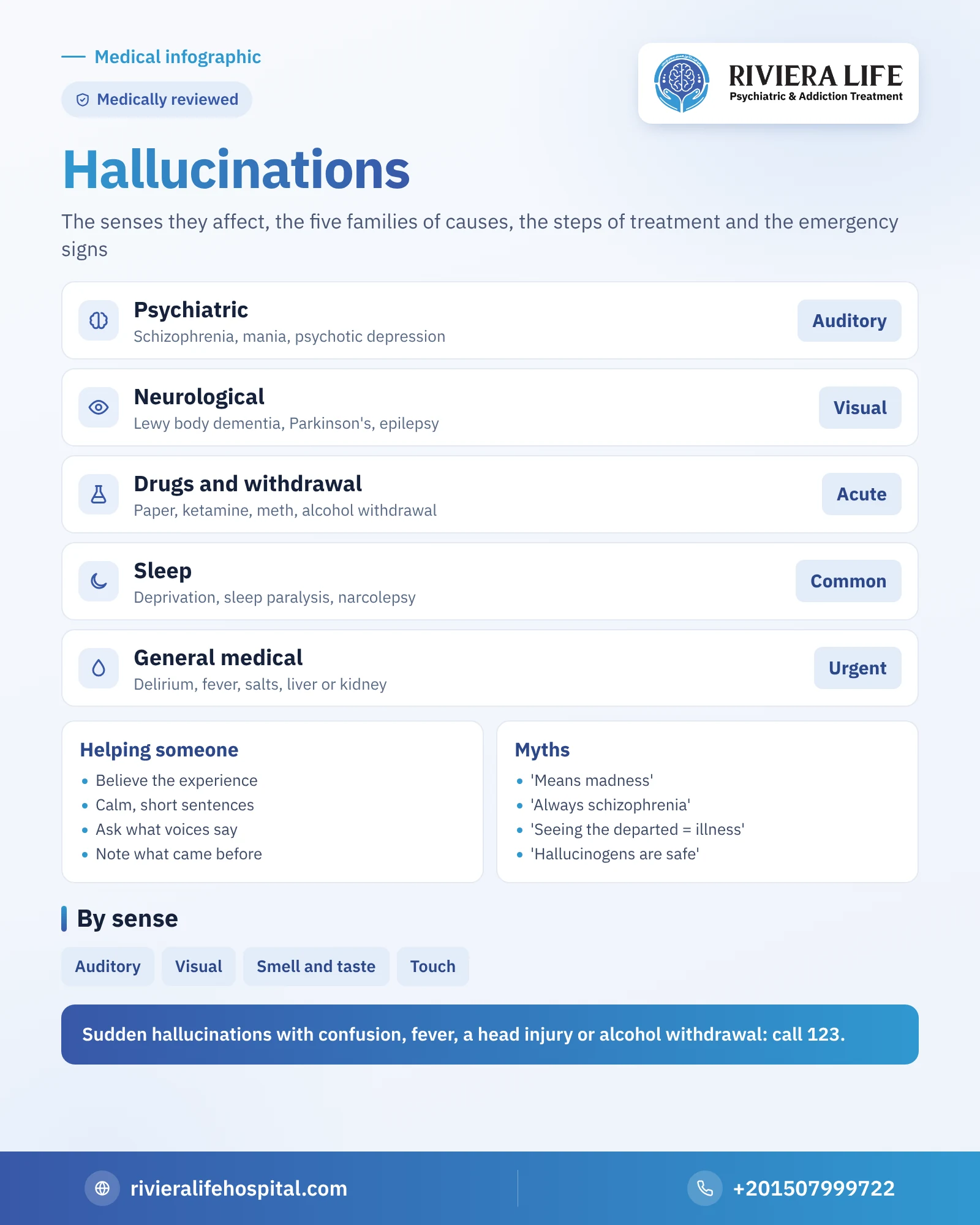
The simplest division of hallucinations is by sense: auditory, the most linked to mental disorders; visual, the most linked to physical causes, drugs and delirium; then olfactory, gustatory, tactile and bodily-sensation hallucinations. There are other divisions by timing, such as hallucinations at the onset and end of sleep, and by whether the person keeps their insight, meaning they realize that what they see is not real, as happens in Charles Bonnet syndrome in people with poor vision. We explain each type, its examples and its significance in the article Types of hallucinations.
The main signs in brief
A person rarely says outright that they are hallucinating. What the family usually notices is behavior that reveals the experience: talking to oneself as if in a conversation, suddenly turning toward the source of a sound no one else hears, covering the ears, staring at an empty corner, scratching the skin violently as if something is crawling on it, or refusing food because its taste is “poisoned”.
The accompanying symptoms change the meaning completely: hallucinations with confusion and fever are one thing, with tremor and sweating after stopping drinking another, and with gradual withdrawal and strange ideas a third. The details, with a checklist to help you decide when to seek an assessment, are in the article Symptoms of hallucinations.
The causes of hallucinations in brief
The causes of hallucinations can be grouped into five large families:
- Psychiatric causes: schizophrenia and the spectrum of psychotic disorders, severe manic episodes, severe depression with psychotic symptoms, and sometimes post-traumatic stress disorder.
- Neurological causes: Lewy body dementia, Parkinson’s disease and some of its medicines, Alzheimer’s disease in its advanced stages, epilepsy, migraine, and brain tumors and strokes.
- Drugs and withdrawal: hallucinogens such as paper, ketamine, stimulants such as shabu and ice, hash in some users, then sudden withdrawal from alcohol or sedatives.
- Sleep: severe sleep deprivation, sleep paralysis and narcolepsy.
- General medical and sensory causes: delirium resulting from infection, fever, electrolyte imbalance and liver or kidney failure, the effects of some medicines, and loss of vision or hearing.
Each of these families has its own way of appearing and its own risk factors, and we detail them in the article Causes of hallucinations.
How does the doctor look for the cause of hallucinations?
There is no test that measures the hallucination itself; what is needed is to uncover what lies behind it. The doctor begins with precise questions: When did it start? Did it appear suddenly within hours or gradually over months? Which sense is affected? Does the person know it is not real? What medicines or substances do they take, and when was the last dose? Is there a fever, a head injury or a vision problem? Then come the physical and neurological examination and the mental state examination.
Depending on the picture, they may order blood tests including liver and kidney function, electrolytes, sugar and thyroid, a drug screen, and a urine test to look for infection, especially in older people, and may order a brain scan, an EEG or an eye and hearing examination. A sudden onset with clouded consciousness directs the doctor first toward an urgent physical cause, while a gradual onset with a clear consciousness opens the door to a deeper psychiatric assessment. In all cases, the final diagnosis is made only by a doctor after a full assessment.
Treatment of hallucinations: an overview
The first rule is that hallucinations are treated by treating their cause. Fever hallucinations disappear with treatment of the infection, alcohol-withdrawal hallucinations need medical detox under supervision, medicine-induced hallucinations usually improve by adjusting the dose or replacing the medicine, and hallucinations from poor vision ease with eye care and reassuring the patient.
When the cause is a psychotic disorder, however, antipsychotics are the cornerstone, and cognitive behavioral therapy for psychosis, strategies for coping with voices and family support are added to them. There is an important warning: some patients, such as those with Lewy body dementia, are highly sensitive to antipsychotics, which is why no medicine is given before the cause is known. The stages, the options and when hospital admission is needed are explained in the article Treatment of hallucinations.
Hallucinations and drugs: two faces of one problem
In psychiatric hospitals and emergency departments, substance use remains one of the most common causes of acute hallucinations in young people. Some substances were designed in the first place to change perception, such as the paper drug, which produces visual distortions and moving colors and shapes, and ketamine, which gives a sense of detachment from the body and from reality.
Some produce hallucinations with excess or continuous use, most notably methamphetamine, which may push the user into a psychotic episode with voices, suspicion and a feeling of insects under the skin, and high-potency hash in those with a predisposition. In the opposite direction comes withdrawal: suddenly stopping alcohol after long drinking may cause hallucinations within a day or two, and may develop into dangerous delirium tremens.
That is why the doctor asks about substance use in every case of hallucinations, and when a mental disorder and addiction occur together, they are treated together in one plan. You can find details of these substances on the pages paper drug, ketamine, methamphetamine and hash, and about withdrawal in the article Alcohol withdrawal symptoms.
How do you deal with someone who is hallucinating?
When your son or father tells you he hears someone calling him or sees strangers in the house, the natural first reaction is denial: “There’s no one there.” But this sentence does not convince someone who hears the voice clearly, and it may make him stop telling you. It is more useful:
- To believe that he is going through an experience that is real to him, without confirming that what he sees exists. A sentence like “I don’t hear it, but I can see it’s bothering you” achieves both.
- To speak calmly and in short sentences, and reduce noise and strong lighting around him.
- To ask about the content of the voices: are they ordering him to do something? This question does not increase the danger; it reveals it.
- To write down when the hallucinations appear, and what preceded them in terms of medicines, lack of sleep or substance use, because these notes are valuable to the doctor.
- Not to postpone the assessment on the grounds that it will pass, especially if the hallucinations are new.
If the cause is a chronic disorder such as schizophrenia, the schizophrenia guide explains the family’s role in the long term.
The difference between a hallucination and an illusion
The word “illusion” (wahm) in everyday Arabic is used for many things, so families get confused. Medicine distinguishes between three different experiences, and telling them apart changes what the doctor asks and what they prescribe.
- Hallucination: a disturbance of perception. The person hears a voice or sees a person and there is no external source, and they feel the experience as completely real.
- Illusion in the sense of a sensory deception: a wrong interpretation of a stimulus that really exists, such as the rustle of a curtain being taken for a whisper. It usually disappears with a closer look or with light.
- Illusion in the sense of a delusion: a false idea that the person clings to despite the evidence, such as believing that someone is following them. It is a disturbance of thinking, not of the senses.
The two experiences can occur together. Someone who hears voices threatening them may build on them a belief that a group is pursuing them, so the hallucination feeds the delusion and the delusion in turn strengthens it. This combination is common in psychosis, but it does not always mean schizophrenia.
The practical test doctors use is a simple question: is there anything real outside that could explain what happened? If there isn’t, we are dealing with a hallucination. To learn about each sense separately you can read Types of auditory, visual and tactile hallucinations, and excessive suspicion of others is covered in the article Paranoia.
Common myths about hallucinations
Myth: someone who hallucinates is mad. Fact: a hallucination is a symptom with many causes, including fever, lack of sleep, poor vision and intense grief, and many of those who experience it do not suffer from any mental disorder.
Myth: hallucinations always mean schizophrenia. Fact: schizophrenia is only one of the causes. Sudden visual hallucinations in an older person, for example, usually point to a physical or medicine-related cause before any psychiatric possibility.
Myth: seeing a deceased person after losing them is evidence of illness. Fact: hearing the voice of the departed or sensing their presence is an experience many bereaved people go through; it usually eases with time and is considered part of normal grief.
Myth: what is happening is possession or the evil eye, and its treatment lies outside medicine. Fact: the family may draw on spiritual support as it wishes, but delaying the doctor may miss an urgent cause such as an infection, a dangerous withdrawal or a psychosis that needs early treatment.
Myth: hallucinogens are a safe experience that ends when the effect ends. Fact: they may trigger a psychotic episode in those with a predisposition, and some users may get flashbacks of visual disturbances weeks or months later.
The hallucinations guide: each aspect in its own article
We have devoted an article to each major question about hallucinations, answering it in depth without repetition:
- Causes of hallucinations: the five families of causes, from psychiatric and neurological to drugs, sleep and general illnesses, and the risk factors.
- Symptoms of hallucinations: the signs the family sees, the accompanying symptoms that reveal the cause, and when to seek an assessment.
- Types of hallucinations: auditory, visual, olfactory, gustatory, tactile and sleep hallucinations, and how doctors classify them.
- Treatment of hallucinations: the steps of assessment, treating the cause, medicine classes, psychotherapy, and when hospital admission is needed.
When are hallucinations an emergency?
Some hallucinations can wait for a clinic appointment within days, and some cannot wait a single hour.
Seek urgent help immediately if you see
Call the ambulance on 123 or go to the nearest emergency department, and do not leave the person alone in these situations.
- New, sudden hallucinations with confusion or not knowing the place and time
- Hallucinations with a high temperature, a stiff neck or a severe headache
- Hallucinations after a head injury, or with weakness in a limb or difficulty speaking
- Voices ordering them to harm themselves or others, and they seem to be responding to them
- Hallucinations after taking a drug, with chest pain, a very high temperature, seizures or agitation
- Tremor, sweating, confusion and hallucinations after suddenly stopping alcohol or sedatives
Remove sharp tools and medicines from the place, speak calmly, and avoid cornering or holding them as much as possible. You can also call the hotline of the General Secretariat of Mental Health and Addiction Treatment on 16328 or 0220816831 for guidance.
When should you seek help?
Any new hallucination deserves a medical assessment, even if it seemed minor or passed quickly, because its cause may be easily treatable if discovered early. And if the hallucinations are linked to substance use or to psychological symptoms such as withdrawal, suspicion and mood swings, a psychiatric assessment is the right step. At Riviera Life in Sheikh Zayed, consultant psychiatrists and addiction specialists carry out the assessment in complete confidentiality, the first consultation is free, and you can reach us around the clock on +201507999722.
Medical sources and referencesThe information in this article is based on reliable scientific sources