Alcohol withdrawal symptoms usually begin six hours to a day after the last drink, as tremor, sweating, anxiety and insomnia, peak within two to three days, and then settle for most people within about a week. But alcohol withdrawal differs from withdrawal from most substances in one essential point: it can progress to seizures or delirium tremens, an emergency that threatens life. That is why someone who drinks large amounts every day shouldn’t be left to stop suddenly on their own. This article sets out the timeline of symptoms, the danger signs, who is most at risk, and how withdrawal is managed safely.
Who goes through alcohol withdrawal?
Withdrawal doesn’t happen to someone who drinks on an occasion and then stops, but to someone whose body has become used to alcohol regularly — daily or almost daily — for weeks or months. The larger the amount and the longer the period, the more severe the symptoms. Withdrawal can also appear when the amount is cut down sharply, not only when stopping completely, such as moving from a bottle a day to two glasses. Some families notice that the person wakes up shaking and then “calms down” after the first morning drink; this is in fact an early sign of withdrawal, not just a liking for morning drinking.
Why does withdrawal happen?
Alcohol constantly calms the brain, so the brain responds by adapting: it reduces its response to the calming system and raises the activity of the stimulating systems so it can keep working. When alcohol suddenly disappears, the stimulating systems remain at full activity with nothing to balance them, so the nervous system becomes like a car with the accelerator pressed and the brakes released at the same time. This is where tremor, a fast heart rate, sweating and anxiety come from — and, in severe cases, seizures and delirium.
The timeline of alcohol withdrawal
The following timings are approximate; stages may overlap or skip one another, and not everyone goes through all of them:
| Time after the last drink | What may happen |
|---|---|
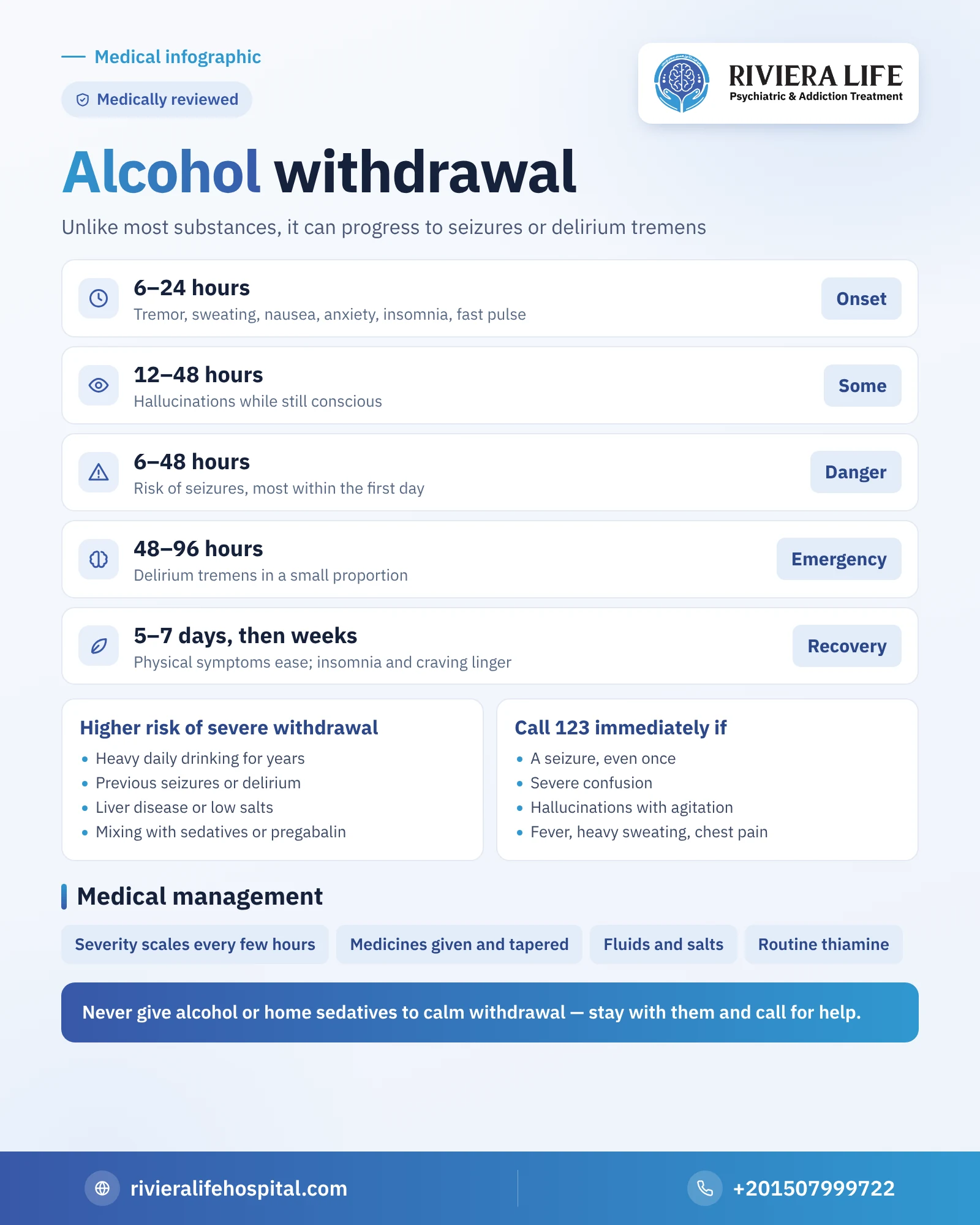
| 6–24 hours | Tremor in the hands, sweating, nausea, headache, anxiety, insomnia, a fast heart rate |
| 12–48 hours | Visual, auditory or tactile hallucinations while still conscious; the person usually knows they aren’t real |
| 6–48 hours | Risk of seizures, most of them during the first day |
| 48–96 hours | Risk of delirium tremens in a small proportion of patients |
| 5–7 days | Physical symptoms recede gradually in most cases |
| Weeks to months | Disturbed sleep, anxiety, mood swings and a craving to drink |
Mild and moderate symptoms
Most people who go through withdrawal stop at this stage, which is unpleasant but not dangerous if it is followed medically. It includes:
- A tremor in the hands that gets worse when stretching them out or holding a cup.
- Heavy sweating, especially at night, and a slight rise in blood pressure and pulse.
- Nausea, vomiting and loss of appetite.
- Anxiety, irritability and oversensitivity to light and sound.
- Severe insomnia and broken nightmares.
The problem is that the person may explain these symptoms as tiredness or a cold, or calm them with a fresh drink, and so stay in an endless circle. If they repeat over several days, they are one of the clear signs of physical dependence, as our article on alcohol addiction symptoms explains.
Seizures during withdrawal
Withdrawal seizures usually take the form of a generalized seizure: loss of consciousness and stiffening of the whole body, then relaxation, and one or more seizures may repeat in a short period. Most happen during the first or second day, sometimes before anyone has noticed any other symptom. More dangerously, a seizure may be the first step towards delirium tremens in some patients. And someone who has had a previous withdrawal seizure is more likely to have another at the next attempt.
Delirium tremens: the most dangerous stage of withdrawal
Delirium tremens is a state of acute disturbance of consciousness that affects a small proportion of those going through alcohol withdrawal, and usually begins two to four days after the last drink. The patient loses awareness of place and time, sometimes doesn’t recognize their family, and sees things that aren’t there, such as insects on the walls, with severe agitation, heavy sweating, a high temperature, a fast heart rate and swinging blood pressure. This isn’t a passing psychological state but a medical emergency that can lead to death if it isn’t treated in hospital, and it may last several days.
When does withdrawal become an emergency?
Call an ambulance immediately on 123 if you see
Especially during the first four days after the last drink, or if the person has mixed alcohol with sedatives or pregabalin.
- A seizure or loss of consciousness, even once
- Severe confusion, and not recognizing the place or the people
- Hallucinations with agitation that won’t settle
- A high temperature with heavy sweating and tremor in the whole body
- A very fast heartbeat or chest pain
- Persistent vomiting that prevents drinking fluids
Don’t give the person alcohol to calm them, or any sedative pills from home without a doctor. Stay with them and move sharp objects away, and if they have a seizure, lay them on their side once it ends and don’t put anything in their mouth.
Who is most at risk of severe withdrawal?
The risk of seizures and delirium tremens is higher in those who:
- Have been drinking large amounts every day for years.
- Have had a withdrawal seizure or delirium tremens before.
- Have tried stopping and going back many times, because each untreated withdrawal may make the next more severe.
- Have liver disease, a shortage of salts such as potassium and magnesium, or malnutrition.
- Are older, or have heart disease or a current infection.
- Mix alcohol with sedatives, pregabalin or sleeping pills.
Why isn’t withdrawal at home recommended?
The scene that repeats itself: a firm decision to stop, then a first day that passes with difficulty, then a sudden seizure on the second day in front of a family that doesn’t know what to do. Home doesn’t provide blood pressure, pulse and temperature checks every few hours, and doesn’t allow the right medicine to be given at the right time. And some patients turn on their own to sedative pills from the pharmacy or a friend, adding a new danger. That is why, after the assessment, the doctor decides whether the case allows outpatient withdrawal under follow-up, or needs full admission.
How is alcohol withdrawal managed medically?
The medical team begins by assessing the amount and length of drinking, previous withdrawals and accompanying illnesses, and uses validated scales to measure the severity of symptoms every few hours. On the basis of this measurement, the doctor decides to use medicines from the benzodiazepine family or others to calm the nervous system and prevent seizures, then tapers them gradually over days. The patient is given fluids, salts are corrected and vital signs are monitored. Importantly, these medicines are given by medical decision and under monitoring, because using them haphazardly with alcohol is dangerous in itself. Our article on alcohol addiction treatment explains what comes after this stage.
Thiamine and why doctors care about it
Many heavy drinkers have a shortage of thiamine, or vitamin B1, because of poor nutrition and weak absorption. This shortage can cause a neurological condition called Wernicke’s encephalopathy, whose signs include confusion, unsteady walking and disturbed eye movements, and which may leave permanent damage to memory if it isn’t treated. That is why doctors give thiamine routinely at the start of alcohol withdrawal, even before any sign appears.
What comes after the first week?
The end of the tremor and sweating doesn’t mean the body and mind have regained their balance. Many people in recovery face weeks or months of broken sleep, anxiety, mood swings and a sense of emptiness, with a craving to drink that grows stronger in the evening or in situations linked to drinking. This is the stage in which many relapses happen, and it needs a follow-up plan no less important than the withdrawal itself. In our guide to quitting alcohol we set out what people usually go through in the first months and how they deal with it.
How can Riviera Life help you?
At Riviera Life, alcohol withdrawal is carried out under round-the-clock medical supervision, with an assessment that determines the risk of seizures and delirium from day one, followed by a direct move into psychotherapy and rehabilitation. The first consultation is free and confidential. For the general picture of alcohol and its effects, visit our page on alcohol.
More from our alcohol guide
- Alcohol: the complete guide
- Alcohol addiction treatment: stages and medicines
- Quitting alcohol, from withdrawal to recovery
- The harmful effects of alcohol on the body and mind
- The difference between delirium and psychosis: a medical emergency or a mental disorder?
Questions many people ask
Physical symptoms settle for most people within about five to seven days, but insomnia, anxiety and craving may continue for weeks or months in a milder form.
Yes, in severe untreated cases, especially with delirium tremens or repeated seizures. That is why someone who drinks heavily every day is advised to stop under medical supervision.
It is an acute disturbance of consciousness that usually appears two to four days after the last drink, with confusion, hallucinations, fever and a fast heart rate, and it needs urgent treatment in hospital.
Usually yes, if they appear after a night without drinking and settle after the first drink. This shows the body has become dependent on alcohol and needs a medical assessment.
No. Mixing sedatives with alcohol, or using them without calculated doses, can depress breathing. Only the doctor decides on the right medicine and follows its effect.