Hallucination symptoms can’t be seen directly, since the sound or image happens inside the person’s head alone. What the family sees is their effect on behavior: talking to oneself, turning suddenly, covering the ears, fear with no visible cause, and repeated scratching of the skin. And more important than the hallucination itself is what accompanies it; confusion and fever mean one thing, tremor after stopping drinking means another, and gradual withdrawal with strange ideas means a third. This article helps you observe carefully and know when an assessment is necessary, without being a tool for diagnosing yourself or others; diagnosis is the doctor’s job.
What does hallucination look like from the inside?
Someone going through a hallucination isn’t living an “imagination”, but a perception with the weight of reality. The voice comes from a specific direction, from behind the door or from the ceiling of the room, and has a man’s or a woman’s tone, and may be familiar. The image has a shadow and movement. So the reactions are entirely logical from their point of view: if they hear someone insulting them, they will get angry, and if they see a stranger in the kitchen, they will be afraid. Understanding this point changes how the family deals with them: behavior that seems strange is a natural reaction to an unnatural experience.
Some people keep their insight and know that what they see isn’t real, as often happens with people with poor eyesight or on waking from sleep, and some are completely convinced of it. This difference is one of the first things the doctor asks about.
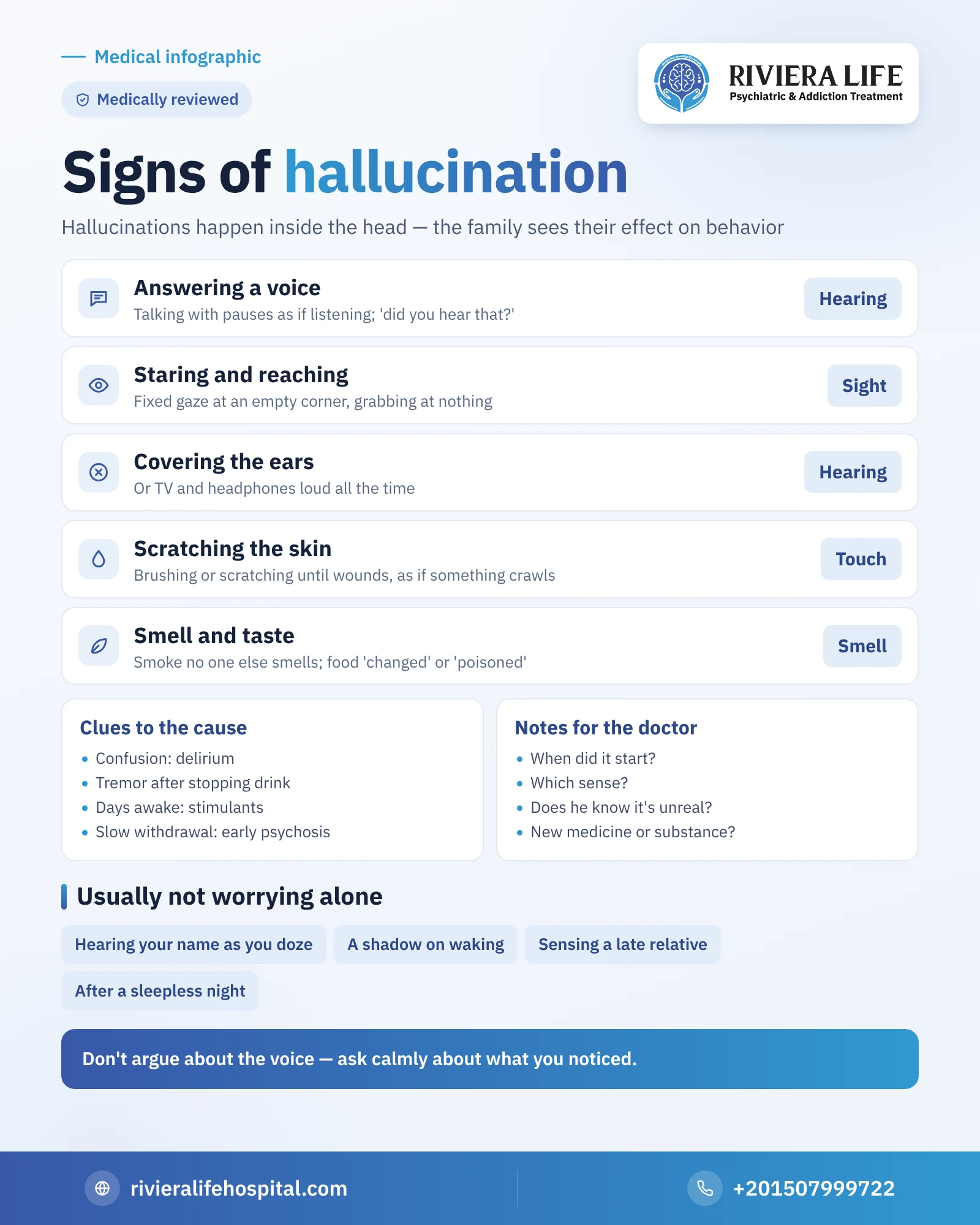
Signs noticed by those around the person
- Talking in a low or loud voice as if answering someone, with pauses as if listening.
- Turning suddenly toward the source of a sound, or asking repeatedly: “Did you hear that?”.
- Covering the ears, or constantly playing the TV or headphones loudly.
- Staring fixedly at an empty corner or the ceiling, or reaching out to grab something that isn’t there.
- Sudden laughter for no reason, or crying and fear that others can’t explain.
- Scratching or brushing the skin violently until wounds appear, as if something were crawling on it.
- Sniffing the air or clothes insistently, and complaining of a smell of smoke or burning no one else smells.
- Refusing food or drink on the grounds that its taste has changed or that it is poisoned.
- Closing windows and curtains, or searching the home for people.
A single sign from this list doesn’t mean the person is hallucinating; talking to oneself, for example, is a common habit for many. What matters is the change from what is usual, the repetition of the sign, and its combination with others. And the person often hides their experience out of fear of being called mad, so they only complain of insomnia, headaches or an annoying neighbor, and here calm observation over several days helps more than a direct question in a moment of tension.
The accompanying symptoms: the real key
Hallucination is like a fire alarm; its sound is almost the same whatever the cause of the fire. That is why the doctor focuses on what accompanies it:
| What accompanies the hallucination | What it may mean |
|---|---|
| Confusion, not knowing the time or place, swinging between drowsiness and agitation | Delirium from a physical cause needing emergency care |
| Fever, vomiting, a stiff neck or severe headache | An infection or inflammation that may affect the brain |
| Tremor, sweating and a fast pulse after stopping drinking or sedatives | Withdrawal needing medical supervision |
| Staying awake for days, irritability, dilated pupils and intense suspicion | Stimulant use |
| Withdrawal from people, falling behind in study, and strange ideas they cling to | The start of a psychotic disorder |
| Excessive activity, little sleep without tiredness, and rapid speech | A manic episode |
| Deep sadness, guilt and blaming voices | Severe depression with psychotic features |
| Increasing forgetfulness and slow movement in an older person | A neurological cause such as dementia or Parkinson’s |
These are likelihoods that help you describe the case to the doctor, not diagnoses. The causes themselves are detailed in our article on the causes of hallucinations.
Signs that may precede obvious hallucination
In psychotic disorders specifically, hallucinations are often preceded by a period of milder changes. The person may complain that ordinary sounds have become louder and more irritating, that colors look different, that they hear their name in the noise of the street, or that they glimpse shadows at the edges of their eyes. This may be accompanied by disturbed sleep, growing suspicion and withdrawal. This stage is a golden opportunity for early assessment, and the details specific to schizophrenia are in our article on schizophrenia symptoms.
Hallucination in children and teenagers
The imaginary friend a young child plays with isn’t a hallucination, since the child knows it is their own creation and controls it. The same goes for nightmares and night terrors. What calls for attention is hallucination that appears with a high fever, which needs an urgent check-up, or a child whose behavior changes and who is intensely afraid of things they see or hear. And with teenagers specifically, ask calmly about drug use, because hashish and stimulants are among the most common causes of new hallucinations at this age.
Hallucination in older people
When your elderly father suddenly starts seeing children playing in the living room or thieves on the roof, the first thing to think of isn’t a psychiatric illness but delirium. A simple urinary tract infection, dehydration or a new medicine is sometimes enough to produce this picture in older people, and it usually disappears when the cause is treated. And if the hallucinations have been recurring slowly for months, with poor eyesight, it may be Charles Bonnet syndrome, and with forgetfulness and slow movement the cause may be dementia or Parkinson’s.
When is a hallucination passing and not worrying?
There are experiences that usually don’t call for worry if they happen on their own: hearing someone call you as you doze off, seeing a shadow at the moment of waking, sensing the presence of a relative who recently died, or seeing movement at the edges of the eye after a long night without sleep. The practical rule is that the experience needs an assessment if it recurs, troubles the person, affects their sleep and work, or comes with other symptoms.
A checklist of notes before visiting the doctor
These questions don’t diagnose, but they make your visit to the doctor more useful. Write down their answers as far as you can:
- When did the hallucination first appear? Suddenly or gradually?
- Which sense is affected: hearing, sight, smell or touch?
- Does the person know it isn’t real?
- Does it appear at a certain time, such as at night, on falling asleep or in the dark?
- What do the voices say, and do they order him to do anything?
- Has he started a new medicine, taken a substance, or stopped drinking or sedatives?
- Is there fever, a head injury, or a change in sight or hearing?
- How have his sleep, mood and memory been in recent weeks?
Signs that call for emergency care
Seek urgent help immediately if you see
Call an ambulance on 123 or go to the nearest emergency department, and don't leave the person alone.
- New hallucination with confusion, severe drowsiness or not recognizing those around them
- Hallucination with a high fever, a stiff neck or seizures
- Hallucination after a fall or head injury
- Voices ordering him to harm himself or others
- Hallucination and agitation after taking a drug, with chest pain or very high temperature
- Tremor, sweating and hallucinations after suddenly stopping alcohol
How do you ask him about what he sees or hears?
Choose a calm time, and start with what you noticed, not with an accusation: “I’ve noticed you’re not sleeping well, and that you turn around a lot as if someone were calling you. Is something bothering you?”. Don’t mock and don’t argue about whether the voice exists, and don’t promise to keep the matter from the doctor. And if he refuses to talk, keep your notes and ask for a consultation with the doctor yourself. The treatment steps after assessment are the subject of our article on hallucination treatment.
How can Riviera Life help you?
If the hallucination is linked to psychiatric symptoms or to drug use or withdrawal, assessment at Riviera Life begins by ruling out physical causes and then sets the right plan. The first consultation is free and completely confidential on +201507999722, around the clock.
More from our hallucination guide
- Hallucination: the complete guide
- The causes of hallucinations and risk factors
- Types of hallucination by sense
- Hallucination treatment by cause
- Psychosis: the complete guide
- Talking to yourself: when is it normal, and when does it point to hallucination?
Questions many people ask
Hallucination usually shows in behavior: talking as if answering someone, turning suddenly, covering the ears, staring into space, and scratching the skin violently. Repetition and change from what is usual matter more than a single sign.
Not necessarily; many people talk to themselves. It becomes notable if the person seems to be answering a voice and listening to it, or if it comes with fear or a change in behavior and sleep.
No. The child knows their imaginary friend is their own creation and controls it, and it is a normal phenomenon in childhood. What deserves a check-up is hallucination with fever, intense fear or a clear change in behavior.
Confusion and not knowing the place or time, fever, a head injury, voices ordering harm, and hallucination after taking a drug or stopping alcohol. These are cases that need emergency care.
Yes, many hide it out of fear of stigma or because the voices tell them to. Calm observation and talking without mockery or accusation encourage them to open up.