Food addiction is a common term describing some people’s feeling of losing control in front of certain foods, eating despite being full, then feeling guilty and returning to the same thing. But it isn’t an official medical diagnosis, and science is still debating it. The recognized diagnosis closest to it is binge eating disorder. This article explains the difference between them, the signs that deserve attention, why this pattern happens, why harsh deprivation isn’t the solution, and how it is treated by specialists.
What is food addiction? And what does science say about it?
The idea is that some foods, especially processed ones rich in sugar, fat and salt together, may activate the brain’s reward system in a way similar to what addictive substances do, pushing some people to compulsive consumption. Researchers have developed questionnaires to study this idea, the best known being the “Yale Food Addiction Scale”, and these are research tools, not a means of diagnosis.
On the other hand, other scientists consider the problem more behavioral than “addiction to a substance”, and that describing food as addictive may be misleading because we can’t abstain from eating. The honest conclusion: the suffering is real, but its precise scientific name is determined by the specialist after assessment.
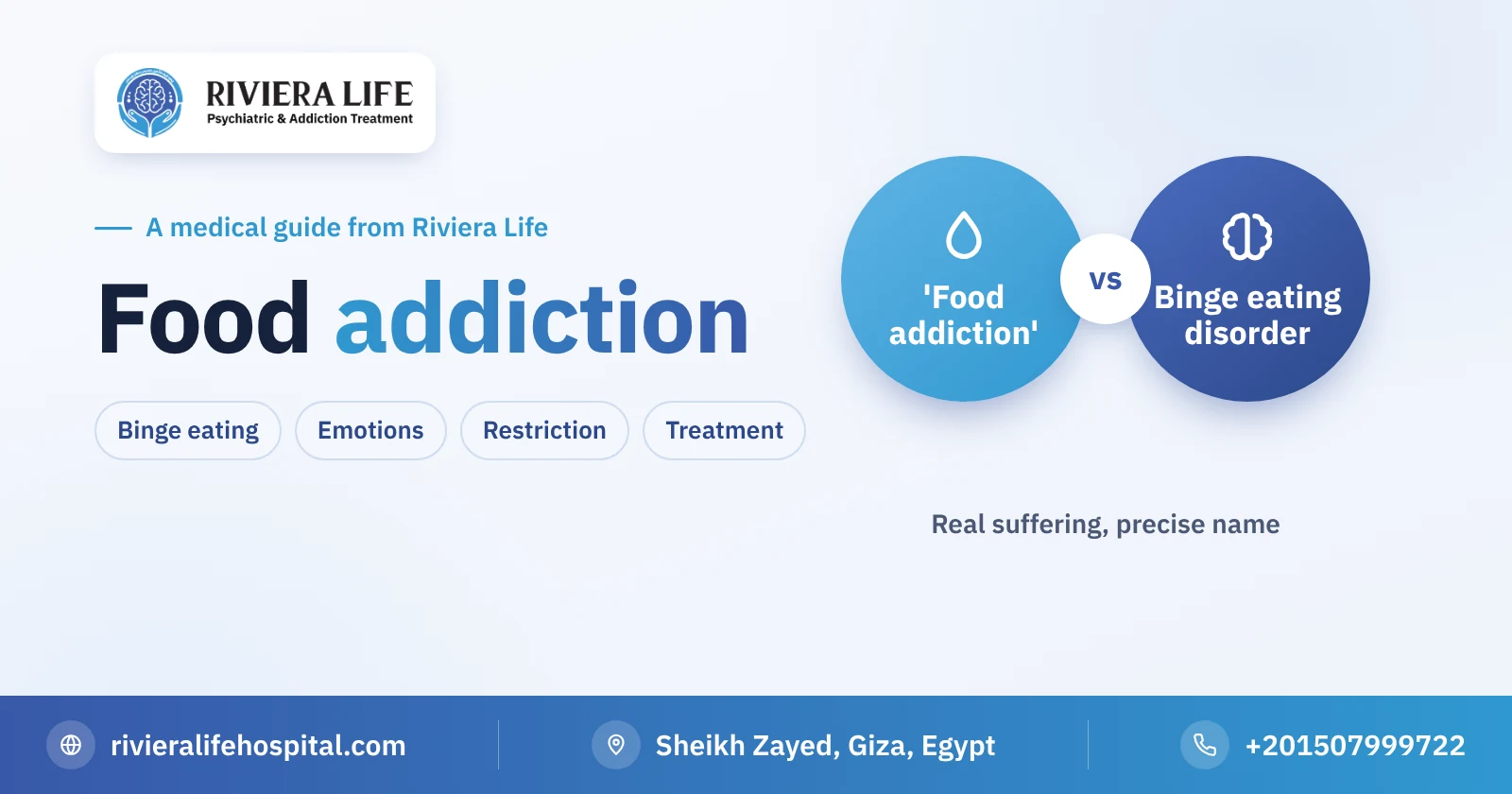
The difference between food addiction and binge eating disorder
Binge eating disorder is an eating disorder recognized in the American diagnostic manual (DSM-5), and has specific criteria. It overlaps with what people call “food addiction” but isn’t the same thing:
| Point of comparison | “Food addiction” | Binge eating disorder |
|---|---|---|
| Medical recognition | An unofficial research concept | An official diagnosis in DSM-5 |
| Core of the problem | A compulsive craving for particular foods | Repeated eating episodes with loss of control |
| After eating | Guilt and a wish to repeat | Severe distress and shame, without regular compensation by vomiting or otherwise |
| Who diagnoses | Not officially diagnosed | A psychiatrist or eating disorder specialist |
What matters is that the name doesn’t stand in the way of seeking help: if you are suffering, the specialist determines what suits you.
Signs that deserve attention
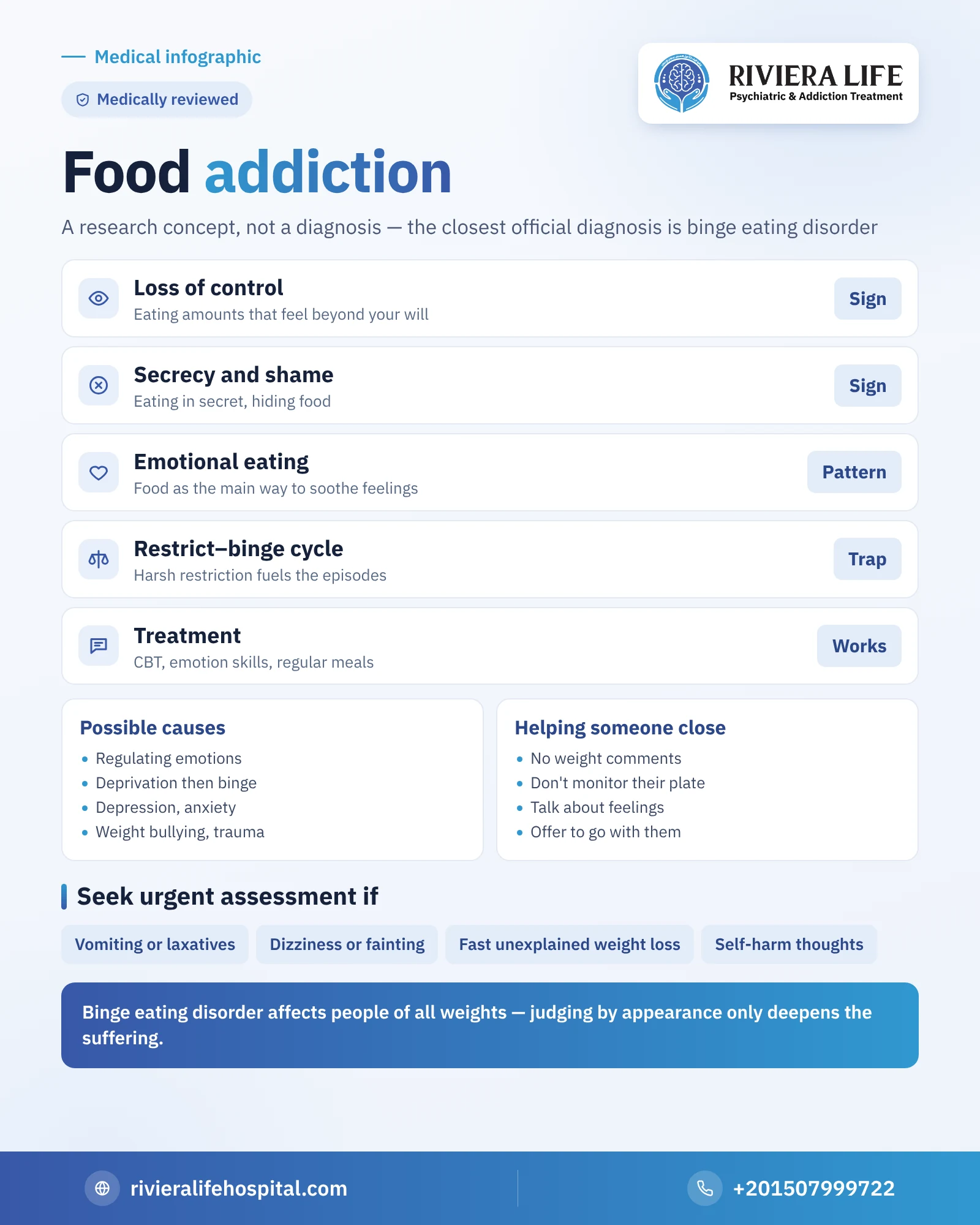
- Eating amounts you feel are beyond your will, even after being full.
- Eating in secret or hiding food out of shame.
- Constantly thinking about food in a way that crowds out your other thoughts.
- Eating to cope with sadness, stress or boredom repeatedly.
- A strong feeling of guilt or self-disgust after eating.
- Repeated attempts at control that end in returning to the same pattern.
- Avoiding social occasions for fear of eating in front of others.
Why does it happen? Causes and risk factors
- Regulating emotions: food is a quick, available way to calm distress, and with repetition it becomes the first response to any difficult feeling.
- The deprivation–binge cycle: severe restriction raises hunger and craving, so an eating episode comes, then guilt, then stricter restriction. This is a known loop in eating disorders.
- Depression and anxiety: strongly linked with binge eating disorder. See depression and anxiety.
- Difficult experiences: trauma and weight-related bullying in childhood.
- Genetic factors: eating disorders tend to appear in some families more than others.
- Environment: processed foods available everywhere, and advertising that links eating with happiness.
Emotional eating: when is it normal?
Eating a piece of sweets after a difficult day is human and doesn’t call for worry. Emotional eating becomes a problem when it is almost the only way of dealing with feelings, when it recurs in amounts with which you feel a loss of control, and is followed by clear psychological pain.
Psychological and physical harms
The psychological harms are usually the heaviest: shame, isolation, declining self-confidence, and depression may worsen. Physically, repeated episodes may cause stomach discomfort and disturbed sleep, and over time may be linked to health problems such as sugar disturbances and blood pressure, matters the doctor assesses for each case.
And it is important to remember that binge eating disorder affects people of different weights, and judging a person by their appearance is unfair and increases their suffering.
Why isn’t a harsh diet the solution?
The obvious solution many turn to is severe deprivation and banning whole foods. But this restriction often feeds the same cycle and increases episodes. That is why treatment focuses on regular meals and restoring a normal relationship with food before any other goal, and the nutritional details are set by a clinical dietitian in coordination with the doctor, not a plan published online.
Treatment of food addiction and binge eating disorder
- Cognitive behavioral therapy: the most studied treatment for binge eating disorder, which helps break the deprivation–binge cycle and identify triggers.
- Emotion regulation skills: practical alternatives for dealing with distress without food.
- Interpersonal psychotherapy: focuses on the relationships and stresses that precede episodes.
- Medical assessment: checking the physical condition and following any complications.
- Nutritional counseling: with a dietitian to build a regular, flexible eating pattern.
- Medicines: the doctor may decide on a medicine in some cases, to treat binge eating or accompanying depression or anxiety, a purely medical decision after assessment.
How do you help someone close?
Avoid commenting on their weight or monitoring what they eat in front of others, as this increases shame and hiding. Talk about your concern for their psychological state, not their appearance, and offer to go with them to a specialist. At home, keep shared meals calm and free of comments about food. You can also use our article on how the family deals with a psychiatric patient.
When do you need an urgent medical assessment?
Seek an assessment quickly if signs appear pointing to a more severe eating disorder, such as compensating after eating by vomiting or laxatives, severe restriction with dizziness or fainting, fast unexplained weight loss, or thoughts of self-harm. In case of fainting or suicidal thoughts, call an ambulance on 123 or go to the nearest emergency department.
The right hospital for food addiction treatment: how to choose
The right hospital for food addiction treatment is the one that deals with the problem as a psychological condition needing careful assessment, not as a weight issue. Ask before you choose:
- Does the doctor distinguish between emotional eating, binge eating disorder and other eating disorders?
- Does it offer structured cognitive behavioral therapy to break the deprivation–binge cycle?
- Does it treat accompanying depression and anxiety?
- Does it avoid harsh regimes and promises of quick numbers?
- Does it involve the family in a supportive way free of blame?
- Is there long follow-up that prevents a return to episodes?
Beware of any party that promises to rid you of the problem for good in days or with a guaranteed result.
How Riviera Life meets these standards
At Riviera Life these standards take the following form:
- Psychiatry consultants: a careful assessment that determines the nature of the problem and what accompanies it.
- Structured psychotherapy: sessions that treat the roots of compulsive eating, not just its outward signs.
- Treating accompanying conditions: depression and anxiety within one plan.
- A family program: teaching those close how to support without hurtful comments.
- Round-the-clock supervision: when a stay is needed for psychological reasons.
- Follow-up after discharge and protected privacy: in a hospital licensed by the Ministry of Health with fourteen years of experience.
Start with a step that costs you nothing: a free first consultation about your relationship with food, on +201507999722 at any hour, or at our premises in Sheikh Zayed, Giza.
Read also
- Depression treatment: psychotherapy and medicines
- How to lower cortisol: managing the stress hormone
- Dopamine and addiction: how does the reward system work?
- Treating shopping addiction and regaining control
- Eating disorders: the complete guide
- Anorexia nervosa: what goes on inside the person and how the family can help
- Bulimia nervosa: the cycle of shame and secrecy and the road to treatment
Questions many people ask
The suffering is real, but the term itself is a research concept not approved as a diagnosis. The closest official diagnosis is binge eating disorder, which a specialist determines.
Occasional overeating happens to everyone, while binge eating disorder is repeated episodes with a feeling of loss of control and severe distress afterwards.
Usually not, as severe deprivation may increase episodes. Treatment focuses on regular meals and psychotherapy under specialist supervision.
A psychological assessment is preferable if loss of control recurs or is accompanied by shame, isolation or depression, because psychotherapy is the most effective treatment.
Look for a careful psychological assessment that distinguishes emotional eating from binge eating disorder, structured cognitive behavioral therapy, treatment of accompanying depression and anxiety, and no harsh diets or quick promises. Riviera Life in Sheikh Zayed meets these criteria.