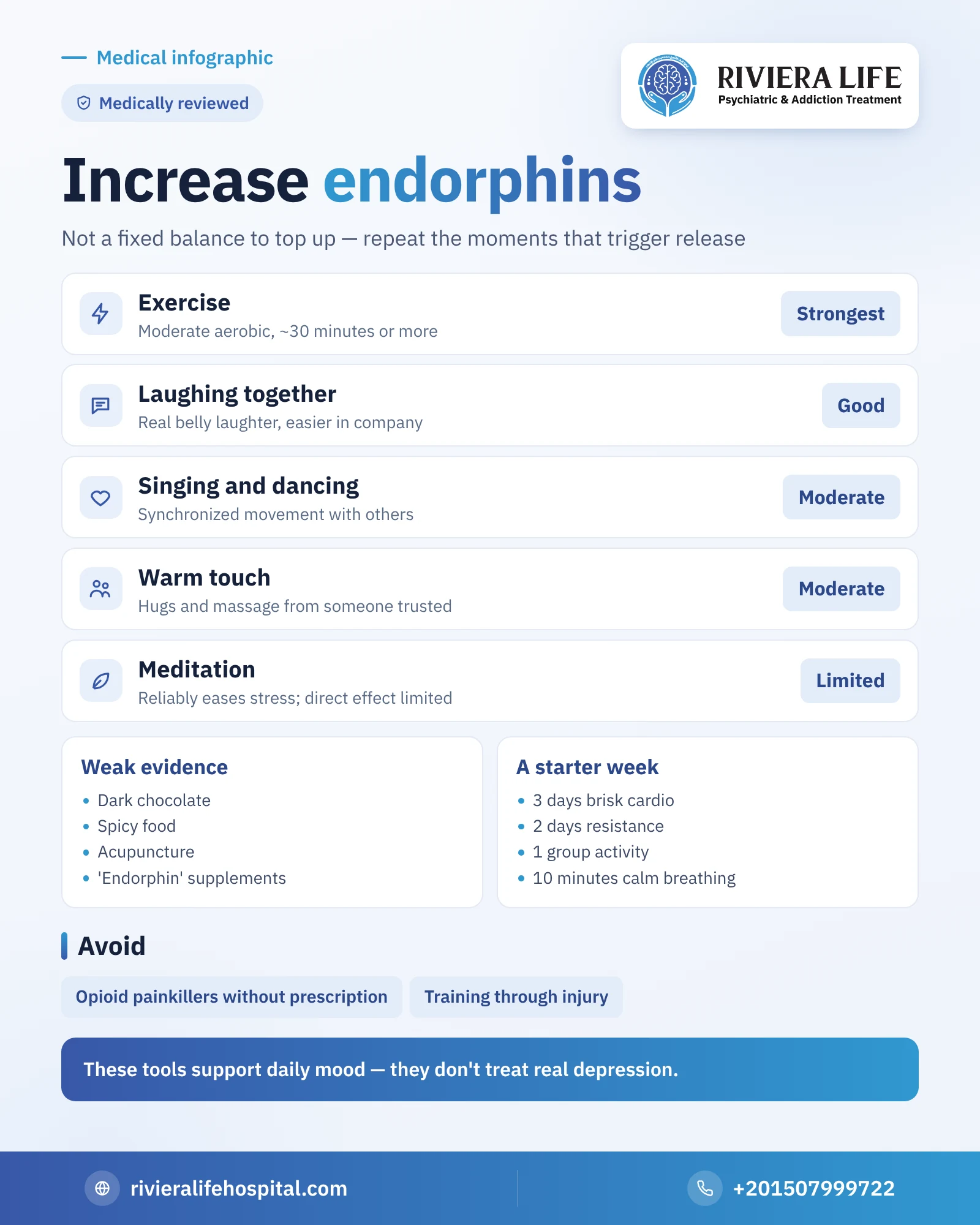
If you are asking how to increase endorphins naturally, the most consistent method in the evidence is regular movement, especially moderate aerobic exercise lasting about half an hour or more. It is followed by laughing with others, singing and dancing in a group, music and gentle touch, all of which have reasonable but weaker evidence. Chocolate, spicy food and acupuncture are often mentioned, but the evidence for them is limited. This article ranks the methods by strength of evidence, explains what can and can’t be expected from them, and suggests a practical week to start with.
Before you start: what does raising endorphins actually mean?
Endorphins aren’t a fixed balance in the bank that you top up once and it stays. They are a short response the body releases in particular situations, then break down within a short time. So the realistic goal isn’t to “raise the level” permanently, but to repeat in your day the situations that trigger their release, so their effects on mood, pain and stress add up over time. There is no routine test that measures the result; the real measure is how you feel, sleep and work after weeks. To learn about the functions of endorphins and where they are made, see the complete guide to endorphins.
Exercise: the method with the strongest evidence
Exercise is the trigger scientists have studied more than any other. Research suggests that release increases with moderate to relatively intense aerobic exercise, and when it lasts long enough, not with a slow five-minute walk. Practical examples include:
- Brisk walking that makes you talk with slight difficulty but doesn’t leave you panting.
- Light jogging, cycling or swimming.
- Resistance exercises with suitable weights in consecutive rounds.
- Football or any team sport, which has the added advantage of company.
The World Health Organization recommends about 150 to 300 minutes a week of moderate activity for adults, or the equivalent in vigorous activity. Start with less than that if you aren’t used to it, increase gradually, and consult your doctor first if you have heart disease or uncontrolled blood pressure.
What about “runner’s high”?
Some runners describe a feeling of lightness, calm and reduced pain after a long distance. This feeling was long attributed to endorphins, but more recent studies suggest that endocannabinoids, other substances the body makes, take a strong part in it. Don’t worry if you don’t reach this high; most of exercise’s benefits for mood appear without the person feeling them as a clear high.
Laughing with others
In experiments carried out by researchers in social psychology, participants’ ability to tolerate pain rose after watching comedy in a group, an indirect indicator of internal opioid activity. The important idea here is that real laughter that shakes the belly has a stronger effect than a smile, and that it comes more easily in company. A session with friends where you laugh from the heart may help more than a funny clip you watch alone on your phone.
Singing, dancing and music
Activities that combine synchronized movement with others, such as singing in a choir, group dancing or even clapping at a concert, have been linked in small studies to higher pain tolerance and a stronger sense of closeness to the group. Listening to music you love, especially passages that give you chills, activates reward centers. The evidence here is moderate, but these are safe, enjoyable means that cost nothing.
Touch and warm relationships
Hugging, patting and massage from someone you trust are linked to the release of internal opioids and oxytocin together, and this is part of what makes company ease pain and stress. Research suggests that long isolation increases the sense of pain and distress. So investing in one or two warm relationships isn’t a luxury, but part of your health. Intimacy between spouses also stimulates these substances within a healthy, safe relationship.
Meditation and calm breathing
Meditation is often mentioned as a way to raise endorphins; more precisely, its consistent benefit is easing stress and calming the nervous system, which helps mood and sleep. Its direct effect on endorphins has limited evidence. You can start with ten minutes a day of slow breathing or guided meditation, and consider any effect on mood a gain regardless of the mechanism.
Sleep, sun and food: indirect support
There is no strong evidence that sleep, sun exposure or a particular type of food raises endorphins directly, but these habits create the ground on which the previous methods work. Lack of sleep increases the sense of pain the next day and reduces the desire to move, and an exhausted body doesn’t exercise well. Going out in daylight encourages walking and improves the regularity of the body clock. And a balanced diet gives the energy needed for activity. So consider them a first step: regular sleep of roughly seven to nine hours for adults, half an hour outdoors, and regular meals, then add movement and company to them.
What is often said and has weak evidence
| The method | What is said | What we know |
|---|---|---|
| Dark chocolate | Raises endorphins instantly | The pleasure of the taste is real; the direct chemical effect isn’t clearly proven |
| Spicy food | The burn releases endorphins | A logical idea in terms of pain, but studies in humans are few |
| Acupuncture | Releases natural painkillers | Conflicting results; it may help some pain conditions in some people |
| “Endorphin-boosting” supplements | A natural alternative to painkillers | There isn’t enough evidence, and they may interact with other medicines |
Dangerous ways to avoid
Some people, knowingly or not, chase the same feeling in ways that harm them: opioid painkillers without a prescription such as tramadol, repeated physical risk-taking, or excessive exercise despite injuries. Opioid painkillers in particular mimic endorphins so strongly that the brain reduces its natural production, and the person enters the circle of dependence, as the article on endorphins and addiction explains. And if you feel you can’t stop exercising even with pain and injury, this is a sign worth talking to a specialist about.
A practical week to start
You don’t need to change your whole life. Try this simple framework and adjust it to your circumstances:
- Three days: half an hour of brisk walking, light jogging or swimming.
- Two days: simple resistance exercises at home for twenty minutes.
- At least once: a group activity with laughter, sport or singing.
- Daily: ten minutes of calm breathing, and music you love on your way.
- At the end of the week: notice your sleep, mood and energy, and don’t measure success by a single feeling.
To complete the picture, the same methods also support other transmitters such as dopamine, as the article on how to increase dopamine explains.
When are these methods not enough?
Exercise, laughter and relationships are powerful tools for improving daily mood, but they aren’t a treatment for real depression, severe chronic pain or dependence on painkillers. If sadness and loss of pleasure continue for more than two weeks, or pain stops you moving at all, or you depend on a medicine and are increasing its dose, consult a doctor. You will find the signs of depression and ways to treat it on the depression page.
How does Riviera Life help you?
In our rehabilitation programs, physical activity and group activities are part of the daily plan, alongside the psychological and medical treatment determined by the consultant psychiatrists. And if you don’t know whether what you are going through is passing exhaustion or a condition that needs treatment, the first consultation is free and confidential on +201507999722.
More from the endorphins guide
- Endorphins: the complete guide
- Endorphins and addiction
- How to increase serotonin
- How to lower cortisol
- Improving mood and happiness without drugs: scientifically proven natural ways
Questions many people ask
Research suggests that moderate or more intense aerobic exercise lasting roughly half an hour or more is linked to clearer release; what matters is regularity, not reaching a specific number.
The pleasure of the taste is real and may improve mood momentarily, but the direct chemical effect on endorphins isn't clearly proven, and overdoing it has other harms.
There isn't enough evidence for supplements that actually raise them, and some products marketed for this may interact with other medicines, so consult the doctor before taking any of them.
Exercise and social activities support mood and help as part of treatment, but they aren't enough on their own to treat real depression that needs a psychiatrist's assessment.
Not everyone feels it, and recent studies suggest substances other than endorphins take part in it. Most of exercise's benefits for mood and sleep appear without a clear sense of a high.