
The residential addiction treatment program is the highest level of structured care: the patient lives inside the hospital day and night, away from the substance and its triggers, while a team of doctors and therapists works with them on all aspects of the addiction at once. Its length isn’t set in advance by a fixed number of days, but by the patient’s own progress. On this page: who needs residential treatment, what happens inside it stage by stage, how it differs from other programs, and how the family prepares for the patient’s admission and discharge. And if you are wondering how addiction is actually treated in a rehab facility, this page answers you from admission to discharge.
What distinguishes residential treatment from simply being admitted to hospital?
Admission for a crisis, such as an overdose or acute agitation, usually ends when the condition stabilizes. Residential treatment, on the other hand, is an integrated treatment program that continues after stabilization: individual and group psychotherapy, rehabilitation, work with the family, and preparation for return. The idea is that the patient finds a “therapeutic community” to live in with clear rules, where they practice a life without drugs before testing it outside. Residential treatment comes as one stage within a broader plan, which the guide to drug addiction treatment explains from assessment to follow-up.
Who needs residential treatment?
The doctor usually recommends it if one or more of the following applies to the patient:
- Severe dependence, mixing more than one substance, or daily use for years.
- Withdrawal expected to be dangerous, as with alcohol or sedatives.
- Previous attempts that failed in outpatient treatment or after detox alone.
- A home that doesn’t provide safety: available substances, family members who use, or constant conflict.
- A severe accompanying psychiatric disorder, or thoughts of self-harm.
- Health problems that need daily follow-up during stopping.
When is the case an emergency before any program?
Some situations don’t wait for an assessment appointment: loss of consciousness or difficulty waking, slow breathing, seizures, agitation that threatens the patient and those around them, or serious talk of suicide. In these cases call the ambulance on 123 first, and the talk of a treatment program comes after the condition stabilizes.
How does the assessment begin?
Admission is preceded by an assessment on five axes: the history of use and substances, the physical condition and tests, the psychological assessment, the family, social and work circumstances, then drafting a written treatment plan that sets measurable goals. This plan isn’t fixed; team meetings review it periodically and adjust it according to the patient’s progress.
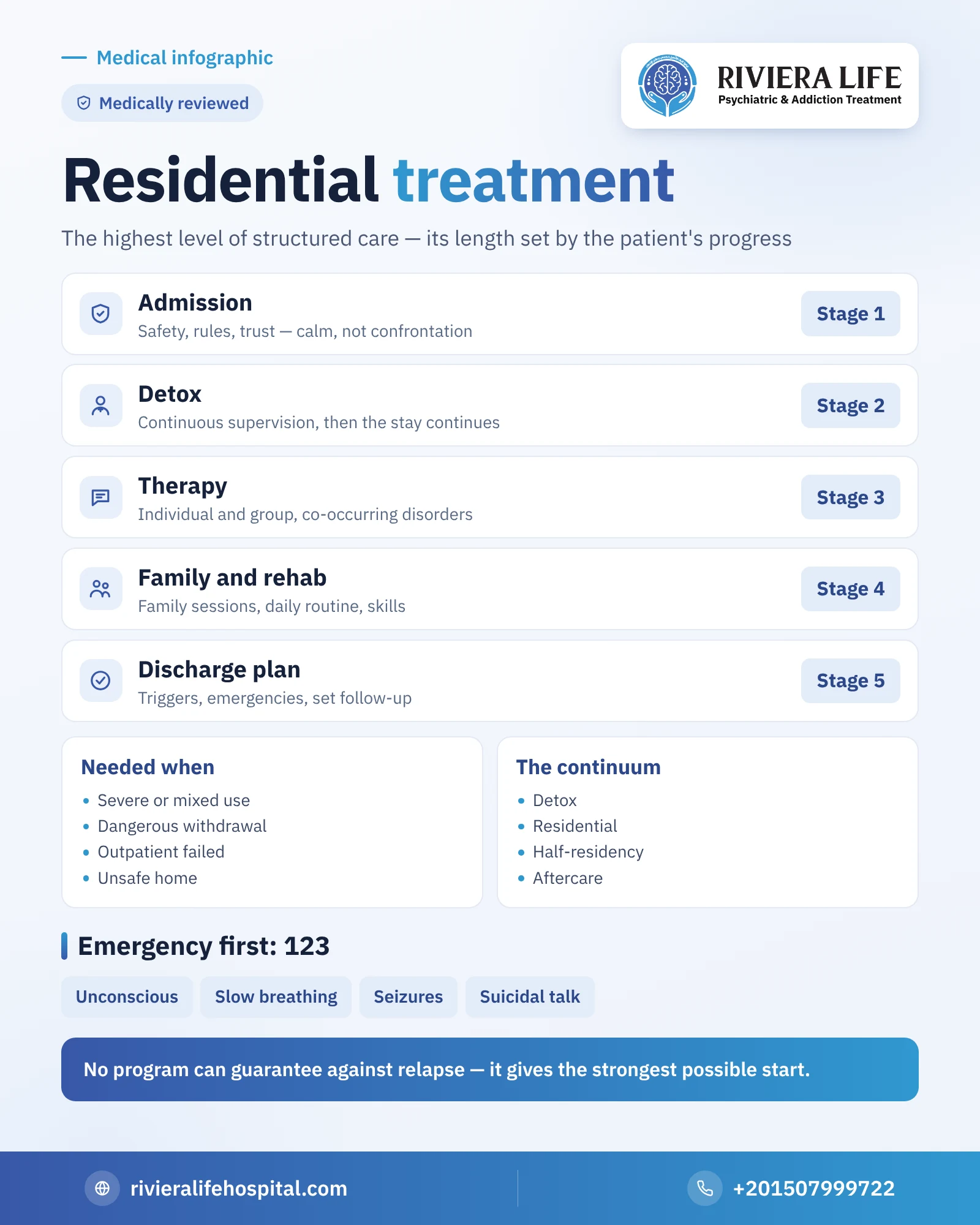
The stages of the program from admission to discharge
Admission and building safety
Introducing the patient to the place and its rules, securing their belongings, and beginning a relationship of trust with the team. Many patients come in angry or afraid, and the first days are managed calmly, not with confrontation.
Detox and medical stabilization
Managing withdrawal under continuous supervision, as in the 7-day detox program, but without discharge after it being an option; the stay continues to the following stages.
Individual and group psychotherapy
Individual sessions that look into the patient’s own reasons for use, and therapeutic groups in which they learn from others’ experiences and practice honesty.
Treating co-occurring disorders
Depression, anxiety, trauma and personality disorders are diagnosed and treated in parallel with the addiction, as the dual diagnosis program details.
The family and rehabilitation
Family sessions, rebuilding a daily routine, and activities that give the patient back the work and communication skills that weakened with use.
Relapse prevention and preparing for discharge
A written plan for triggers and emergencies, a gradual discharge where appropriate, and a scheduled transition to follow-up.
How does a day of addiction treatment in a rehab facility go?
The morning starts with measuring vital signs and taking prescribed medicines, then an educational session about addiction and the brain. Midday is for group therapy and individual sessions, the afternoon for physical or rehabilitation activity, and the evening for a review meeting and contact with the family at set times, then sleep at a fixed time. The schedule looks simple, but it rebuilds what addiction destroyed: regularity, sleep, and dealing with others without a substance.
How long does residential treatment last?
There is no single length that guarantees recovery. A few weeks may be enough for one patient, while another needs months. Programs with an announced length, such as the 28-day program, are useful organizing frameworks, but the decision to discharge is based on clear indicators: medical stability, reduced craving, and having a follow-up plan and a safer home.
Residential treatment compared with other programs
| The program | Overnight stay | Main goal |
|---|---|---|
| Detox | Inside the hospital for a short period | Getting through withdrawal safely |
| Residential treatment | Inside the hospital throughout the program | Comprehensive treatment in a protected environment |
| Half-residency | At home at night | Intensive treatment by day while applying skills in life |
| Aftercare | At home | Follow-up and relapse prevention after the program |
Often the best path is a connected chain: residential treatment, then half-residency, then follow-up.
Medicines within the program
No medicine treats addiction on its own, but medicines play specific roles: easing withdrawal symptoms, reducing craving or protecting the patient from relapse in some types of addiction such as opioids and alcohol, and treating accompanying depression, anxiety and insomnia. The doctor chooses what suits each case and follows it daily, and you will find an explanation of the best-known preventive option in the naltrexone treatment program.
The cost of residential treatment
There is no single price; the cost changes with the length, the severity of the case, medicines, tests and the type of accommodation. The exact price is determined by the assessment, and it is best to ask for a written statement of what it includes before starting. You will find the cost factors explained in the article on the cost of addiction treatment centers in Egypt.
How does the family prepare?
- Agree on who communicates with the team so messages don’t conflict.
- Be honest in the assessment with everything you know about the substances and behavior.
- Don’t promise the patient discharge on a set date before the team decides.
- Prepare the home for the return: no substances, no large amounts of cash, and a clear routine.
- Attend family sessions even if you feel the problem is “his”.
Does residential treatment prevent relapse?
No program can guarantee that, and anyone who promises you otherwise is selling you an illusion. What residential treatment does is give the patient the strongest possible start, reveal their accompanying problems, and hand them over to organized follow-up. Success is measured by improved health, relationships, work and the ability to ask for help early, not by abstinence alone.
To know when outpatient treatment is enough and when residential treatment is necessary, see addiction treatment without admission or with residence?
And anyone who needs a private room and greater privacy during residence will find what changes in the program and what stays the same on the VIP addiction treatment page.
The right hospital for residential addiction treatment: how to choose
The right hospital for residential treatment is the one that provides a real therapeutic environment, not just a place of isolation. Ask:
- Is there a multidisciplinary team of psychiatrists, therapists and nurses?
- Is medical supervision continuous day and night?
- Is the daily schedule written and does it combine individual and group therapy and rehabilitation?
- Are accompanying psychiatric disorders treated within the program itself?
- Is the discharge date set by medical indicators rather than a fixed date in advance?
- Are the patient’s dignity and privacy respected, without punishment or humiliation?
And avoid places that promise guaranteed cure rates or ending addiction in days.
How Riviera Life meets these standards in residential addiction treatment
This is what the patient and their family find at Riviera Life in practice:
- Official license: a hospital licensed by the Ministry of Health.
- An integrated team: consultants in psychiatry and addiction treatment and specialist therapists.
- Constant supervision: round-the-clock medical care throughout the stay.
- Extended experience: fourteen years and thousands of recovered cases.
- Dual treatment: assessing and treating accompanying psychiatric disorders together with the addiction.
- The family is present: a family program during the stay.
- After discharge: organized aftercare.
- Complete confidentiality: for everything concerning the patient and their family.
Before deciding on residential treatment, talk to our team in a free first consultation on +201507999722 at any hour. We are located in Sheikh Zayed, Giza Governorate.
And if you are looking for an addiction treatment hospital in Egypt that offers residential treatment with round-the-clock medical supervision, start with a free consultation to assess the case.
Read also
- The half-residency addiction treatment program
- The 28-day program: is it enough for recovery?
- The aftercare program
- How do you persuade an addict to enter treatment?
- Addiction treatment in Sheikh Zayed and 6th of October: residence and follow-up close to home
- An addiction treatment hospital in Cairo: how to choose a licensed, safe place