
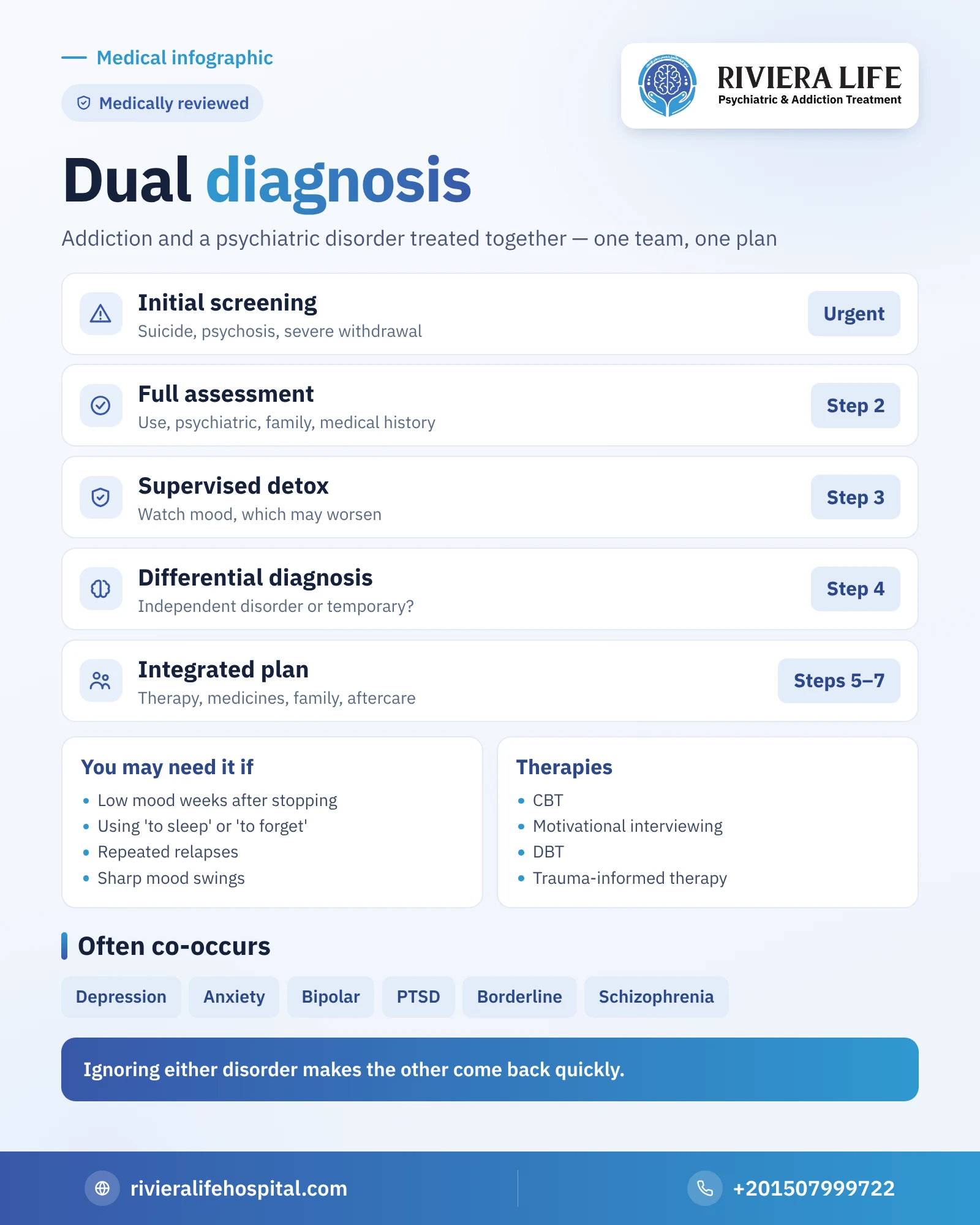
The dual diagnosis program for addiction treatment is a treatment path dedicated to those who suffer from an addiction and a psychiatric disorder at the same time, such as depression, anxiety, bipolar disorder or post-traumatic stress disorder. Its basic idea is that the two disorders are treated together, with one team and one plan, not each in a separate place. This matters because ignoring one of them makes the other come back quickly. On this page: when you need the program, how substance symptoms are told apart from mental illness, the treatment stages, the role of medicines and the family, and how Riviera Life Hospital provides it.
What does dual diagnosis mean?
Dual diagnosis means that a substance use disorder or addiction comes together in a person with another psychiatric disorder. The relationship between them runs in more than one direction: anxiety may start first, so the person turns to pregabalin or hash to calm down, or use may start first, so ice sets off psychosis or heroin leaves a deep depression. And often each feeds the other until it is hard to know which started. If anxiety is the most prominent complaint, the article on anxiety and addiction explains how the substance and anxiety feed each other and how they are treated together.
Among the disorders that recur with addiction: depression, anxiety, bipolar disorder, post-traumatic stress disorder, borderline personality and schizophrenia. Each has a separate guide explaining its symptoms and treatment in detail. To understand where this program sits in the overall plan, see the addiction treatment guide with its four stages.
When do you need the dual diagnosis program?
- Sadness, anxiety or panic attacks that last weeks after stopping the substance and don’t calm down.
- Openly using the substance “so I can sleep”, “so I can calm down” or “so I can forget”.
- Repeated relapses despite commitment to previous programs.
- Sharp mood swings: periods of excessive activity and little sleep, followed by periods of collapse.
- Suspicion, voices or strange thoughts that appear with use or continue after it.
- Nightmares and repeated painful memories of a traumatic event that preceded the start of use.
- Talk of death or self-harm.
Why isn’t treating the addiction alone enough?
Imagine a young man who has been using tramadol for years because he suffers social anxiety that leaves him unable to speak in front of people. He finishes detox successfully, and leaves clean, then faces his first work meeting. The anxiety is still as it was, and the substance that used to soothe it is gone. Here relapse is almost expected.
The opposite is also true: treating depression with medicines while the patient continues with alcohol or hash makes the medicine less effective, and may confuse the diagnosis itself. That is why medical guidelines agree that integrated treatment of the two disorders together is better than treating each separately.
How are substance symptoms told apart from mental illness?
This is among the program’s most delicate tasks. Stimulants may cause a psychosis resembling schizophrenia, withdrawal from sedatives may resemble an anxiety disorder, and stopping opioids brings a temporary depression. That is why the team doesn’t rush to make a final diagnosis, but observes the patient for a period after stopping, and gathers the history from the family: were these symptoms present before use? Do they appear in periods of abstinence? The answer determines whether the patient needs long psychiatric treatment or whether the symptoms will go away with recovery.
Stages of the dual diagnosis program
- Initial screening: assessing urgent risk, such as suicidal thoughts, psychosis or severe withdrawal.
- Comprehensive assessment: the history of use and the psychiatric, family and medical history, and psychological tests when needed.
- Detox: under medical supervision, with monitoring of the psychological state, which may worsen in this period.
- Differential diagnosis: after the substance’s effect has gone, to distinguish an independent disorder from temporary symptoms.
- An integrated plan: shared goals that the psychiatrist, the addiction doctor and the therapist work on together.
- Psychotherapy and rehabilitation: individual and group sessions, and building a daily routine and social skills.
- Aftercare: following up medicine, mood and relapse prevention after discharge.
Call an ambulance on 123 immediately if you see
Don't leave the patient alone, and move medicines and sharp tools away from them until help arrives.
- Open talk of suicide or an attempt at self-harm
- Severe agitation or aggression with suspicion and voices others don’t hear
- A seizure while stopping the substance
- Deep drowsiness or slow breathing after mixing sedatives, alcohol or opioids
Which therapeutic methods are used?
- Cognitive behavioral therapy: to link thoughts and feelings with the craving to use and change them.
- Motivational interviewing: to strengthen the motive of a patient who may see the substance as a “treatment” for their psychological problem.
- Dialectical behavior therapy: useful with impulsivity, emotional swings and self-harm.
- Trauma-informed therapy: for those whose use started after a traumatic experience.
- Therapy groups and psychoeducation: to understand the relationship between the two illnesses.
Are medicines used in the program?
Yes in many cases, but with careful selection. The patient may need medicines for the psychiatric disorder such as antidepressants, mood stabilizers or antipsychotics, and may need medicines specific to the addiction itself, as with opioids and alcohol. The doctor avoids as far as possible medicines that can be misused, carefully reviews interactions between medicines, and follows up commitment to them, because stopping them suddenly is among the best-known causes of relapse in this group.
Inside the hospital or as outpatient follow-up?
Residence inside the hospital is usually the first choice when there is a risk of suicide, psychosis, severe withdrawal, or previous failed outpatient attempts. After stabilization, it is possible to move to the half-residency program then to outpatient follow-up. As for the program’s duration, there is no single duration that suits everyone; it is set by the severity of the two disorders and the patient’s response.
What is the family’s role?
The family needs to understand that irritability or withdrawal may be a symptom of a psychiatric illness, not stubbornness, to learn to notice the early danger signs of both disorders, and to help with commitment to medicine without turning the house into a monitoring ground. The family rehabilitation program works on these skills in an organized way.
The right hospital for dual diagnosis treatment: how to choose
The right hospital for dual diagnosis treatment is the one that treats both disorders under one roof with a team that speaks one language, not an addiction center that refers the patient to an outside psychiatrist or the reverse. Ask:
- Is there a consultant psychiatrist within the team, not just intermittent visits?
- Is the final diagnosis postponed until the substance’s effect has gone?
- Is safe residence available for someone with suicidal thoughts or psychosis?
- Are psychiatric medicines reviewed to avoid what can be misused?
- Does the patient receive specialized psychotherapy for both disorders?
- Is there follow-up after discharge for mood and medicine together?
And beware of any place that promises a guaranteed cure or ending both disorders within a few days.
How Riviera Life meets these standards in dual diagnosis treatment
Here is how these criteria are met at Riviera Life:
- A hospital for psychiatry and addiction together: licensed by the Ministry of Health, so both disorders are treated in one place.
- One plan for two disorders: the consultants in psychiatry and addiction set it together.
- Round-the-clock supervision: for cases carrying a risk of suicide, psychosis or severe withdrawal.
- Extended experience: fourteen years and thousands of recovered cases.
- A program for the family: explains the nature of the two disorders and teaches the right support.
- Aftercare: to follow up medicine and mood and prevent relapse.
- Complete confidentiality: protecting the patient from the stigma of both psychiatric illness and addiction.
For addiction accompanied by a psychiatric disorder, start with a free first consultation or call at any time on +201507999722. The hospital is in Sheikh Zayed, Giza.
Dual diagnosis treatment needs a team that brings psychiatry and addiction treatment together under one roof, and this is what distinguishes an addiction treatment and psychiatric hospital from a standalone clinic.
Read also
- Depression treatment: psychotherapy and medicines
- Bipolar disorder treatment
- Relapse treatment program
- The Matrix program for addiction treatment
- Depression and addiction: the relationship and how they are treated together
- Schizophrenia and addiction: smoking, hash, stimulants and integrated treatment
- ADHD and addiction: why the risk rises and how it is treated
- Bipolar disorder and addiction: how they intertwine and how they are treated together
- Borderline personality and addiction: the cycle between them and how they are treated together
- PTSD and addiction: self-medication and the road to simultaneous recovery
- Social anxiety and addiction: when the temporary solution becomes a second problem
- Anxiety and addiction: a mutual cycle and how they are treated together
- OCD and drugs: when the substance turns from a solution into part of the problem