
The aftercare program is the stage that starts after intensive treatment ends and the patient goes out to their life: individual and group sessions, medical follow-up, a written relapse prevention plan, and support for the family. Its goal is to protect what was achieved inside the hospital in the months when relapse is more likely. No program can guarantee “recovery without relapse”, but aftercare clearly reduces the risk, and makes detecting any setback early and intervening in it faster. Here we explain the program’s components, the relapse prevention plan, the warning signs, the family’s role, and what happens if a relapse occurs.
Why doesn’t treatment end at the hospital door?
Inside the hospital there is no substance, no using friends and no pressures of work and debts. At home all of that returns in a single day, while the new skills are still fresh. Addiction changes the way the brain deals with reward and stress, and this change doesn’t disappear when withdrawal ends. That is why medical references describe addiction as a chronic condition that needs extended follow-up, just as a diabetes patient needs follow-up after their sugar is controlled for the first time.
When does the aftercare program start?
Planning for it starts before discharge, not after it. In the last days of full residence or the 28-day program, the dates of the first sessions are set, what the team knows about the patient’s triggers is written down, and everyone agrees on who calls whom in danger. The first week after discharge mustn’t pass without any appointment.
What are the program’s components?
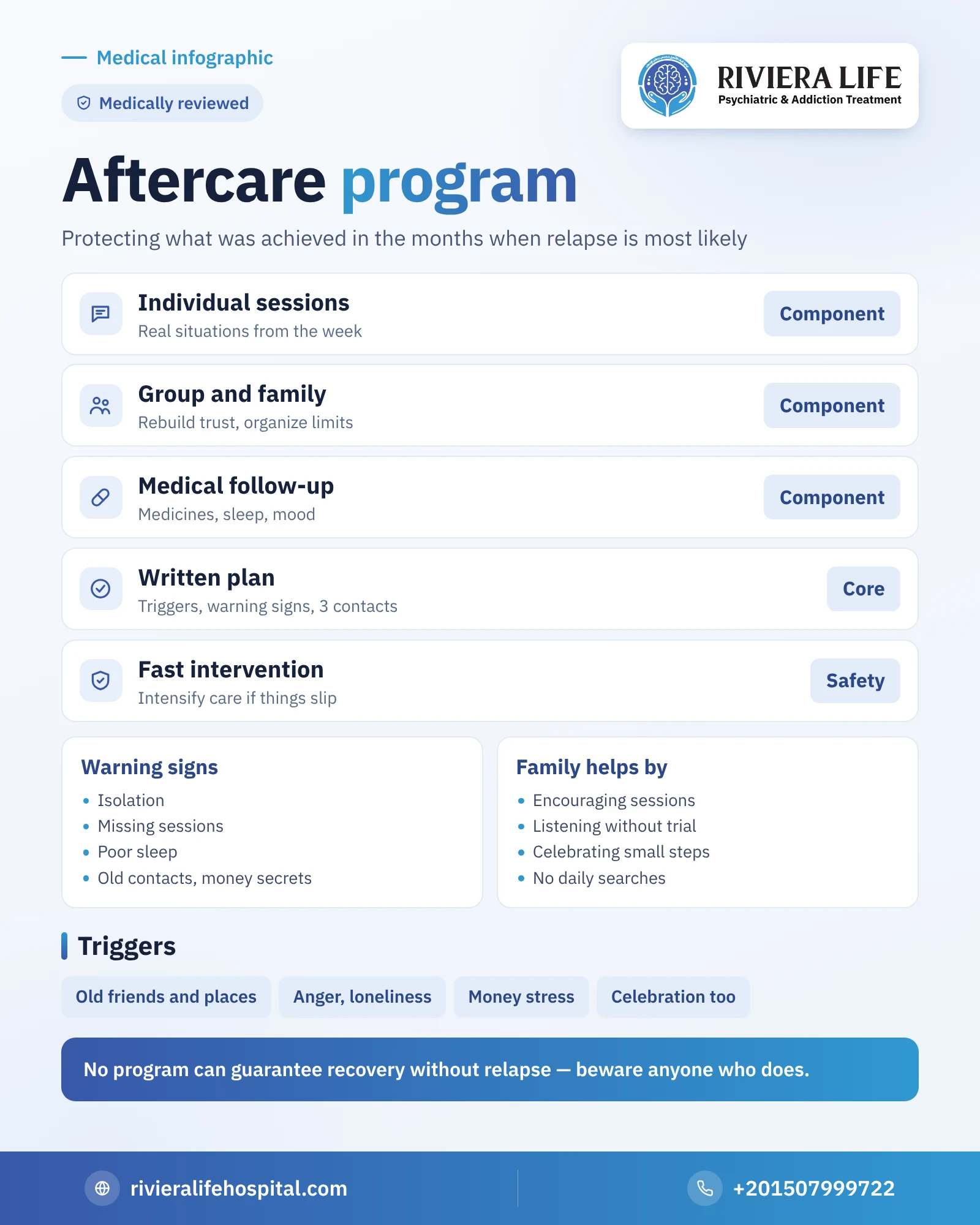
- Individual sessions: to review the week and deal with real situations the patient faced.
- Group therapy: with people in recovery at different stages, in which they learn from their experiences and are asked about their commitment.
- Medical and psychiatric follow-up: for prescribed medicines and for sleep, mood and accompanying disorders.
- Family therapy: to repair trust and organize limits.
- Support groups: such as the twelve-step program for those it suits.
- Periodic tests: when agreed on, as a tool of reassurance, not accusation.
How long does aftercare last?
There is no single duration for everyone; it changes according to the severity of the addiction, previous history and the psychological state. The practical rule is that sessions are close together at first then spaced out as stability is established. Research links continuing treatment for a sufficient period with better results, which is why it is preferable not to close the file suddenly at the first feeling of improvement.
The relapse prevention plan: what does it include?
It is a paper the patient writes with their therapist and keeps, and it usually includes:
- A list of their personal triggers: people, places, feelings and times.
- The early warning signs they know about themselves.
- At least three names to call when the urge is strong.
- Ready alternative activities for hours of free time and boredom.
- What to do if they use once: whom to tell, and how to return to the team immediately.
What are the most common relapse triggers?
Old friends and places of use are the well-known triggers, but they aren’t the only ones. Negative feelings such as anger, sadness and loneliness, financial pressures and disagreements, and boredom and free time all push towards the substance. And surprising to many, positive feelings are also a trigger: celebration, getting money, or the feeling that “it’s over and I can control it”.
Signs that precede relapse
Relapse rarely starts with sudden use; it is usually preceded by noticeable changes: isolation, missing sessions, disturbed sleep, renewed contact with people from the past, small new secrets about money or going out, and repeated talk that treatment is “no longer necessary”. Noticing these signs and talking about them early is the essence of aftercare.
How does the recovering person deal with a sudden urge?
An urge is a wave that rises then falls, and usually doesn’t last long if it isn’t responded to. The recovering person practices leaving the place immediately, calling one of the names on their plan, moving or walking, and breathing exercises, then discussing the situation in the next session instead of hiding it. And if strong urges recur, this is information the doctor needs to adjust the plan, and preventive medicine, as in the naltrexone program, may be an option for some cases.
The family’s role in aftercare
The family can be the strongest protective factor or the strongest pressure factor. What helps: encouraging attendance of sessions, listening without judgment, following up without daily searches, and celebrating small progress. What harms: giving large sums of money without arrangement, treating the recovering person like a child, constantly reminding them of the past, and expecting complete trust from the first day. The family rehabilitation program offers practical training in this balance.
What happens if a relapse occurs?
Relapse doesn’t mean treatment has failed, but that the plan needs adjusting. Dealing with it starts with a medical safety assessment, especially after a period of abstinence, because tolerance falls and the risk of overdose rises with opioids and sedatives. Then sessions are intensified, what preceded the relapse is examined, and a temporary return to half-residency or residence may be suggested. And if relapses recur, there is the relapse treatment program designed for these cases.
Daily life after treatment: work, sleep and the body
Returning to work
A gradual return is usually better than full immersion from the first day, while protecting session appointments from work pressure.
Sleep
Disturbed sleep is common in the first months and is among the triggers of relapse. A fixed bedtime and reducing stimulants and screens at night help, and if insomnia continues the solution is with the doctor, not the pharmacy.
Food and physical activity
Regular meals and simple physical activity improve mood and sleep and ease tension, and give the day a new structure instead of emptiness.
Can aftercare be followed from home or from another city?
Yes, for a large part of it. Many individual and family sessions can take place through remote addiction treatment, especially for those who live far away or work difficult hours. But this needs fixed appointments that aren’t easily cancelled, a family that knows its role, and a clear route to the hospital if danger signs appear. Some in-person visits remain useful for reviewing medicines and doing the agreed tests.
How do you know aftercare is doing its job?
The good indicators: regular attendance, better handling of pressures, stable sleep, calmer relationships at home, a return to work or study, and most importantly, the recovering person asking for help early when they feel danger instead of hiding it.
The right hospital for an aftercare program: how to choose
The right hospital for aftercare is the one that knows the patient well and follows them with a written plan, not a passing call every so often. Ask:
- Are aftercare appointments set before leaving the intensive program?
- Is there a written and updated relapse prevention plan?
- Does follow-up include the psychiatrist and medicines, not only sessions?
- Does the family have a place in the program?
- Is there quick contact when the urge is strong or a relapse happens?
- Can treatment be intensified immediately if the case slips back?
And beware of any program that promises a guarantee of no relapse.
How Riviera Life meets these standards in aftercare
If you are looking for aftercare that meets all of the previous criteria, here is how Riviera Life meets them:
- Official license: a hospital licensed by the Ministry of Health.
- Real continuity: the team that treated the patient follows them after discharge.
- Consultant supervision: the consultants in psychiatry and addiction review medicines and accompanying disorders throughout the follow-up period.
- Extended experience: fourteen years and thousands of recovered cases.
- Family support: a program for the family that continues with aftercare.
- Fast intervention: contact around the clock, and residence under continuous medical supervision when needed.
- Complete confidentiality: for the recovering person and their family.
The stage after discharge starts with a call: call us night or day on +201507999722, and your first consultation will be free. The hospital is in Sheikh Zayed, Giza.
Follow-up after discharge is part of the program itself at Riviera Life addiction treatment hospital, not a separate service requested later.
Read also
- Relapse treatment program
- Half-residency addiction treatment program
- Home addiction treatment program
- Family rehabilitation program
- Dealing with a recovering addict: a family guide after leaving hospital
- Does an addict return to normal after treatment? An honest answer for the family
- The stages of recovery from addiction: from early abstinence to growth
- Group therapy: its types, therapeutic factors and when it suits you
- Meditation in addiction treatment: the MBRP program, its exercises and when to postpone it