Yes, ketamine causes addiction, but its road to it differs from that of heroin or tramadol. It usually doesn’t bind the body to violent physical withdrawal, but binds its user to the experience of detachment itself, then raises the amount needed to reach it remarkably fast. It usually begins with trying it on a night out, then becomes a means of escaping stress, then a daily habit hard to break even when bladder pain appears. This article explains how ketamine addiction develops step by step, why it is discovered late, and when use becomes an illness that needs treatment.
Does ketamine really cause addiction?
This question comes up often because ketamine is a well-known anesthetic, and because some who tried it once or twice felt no desire to return to it. But doctors treat ketamine use disorder as a real condition with clear diagnostic criteria: loss of control over amount and timing, a pressing craving, and continuing despite health and social harm. Medical reports describe patients who use it daily for years, in amounts exceeding what is needed to anesthetize a patient in the operating room.
The difference is that the addiction here is psychological at its core. The user doesn’t return because his body shakes or vomits, but because he has got used to switching off his feelings and distancing himself from his reality, and no longer knows another way to do that.
What makes ketamine addiction different?
Ketamine combines three features that make slipping into it easy. The first is its short action, as the main effect after snorting wears off within about an hour, so the person repeats the dose several times in one night. The second is fast tolerance, as the effect of the same amount weakens within weeks of repeated use. The third is its falsely reassuring reputation, as the word “medicine” silences the inner warning in many young people. You will find the general picture of the substance and its effect on the brain on our ketamine page.
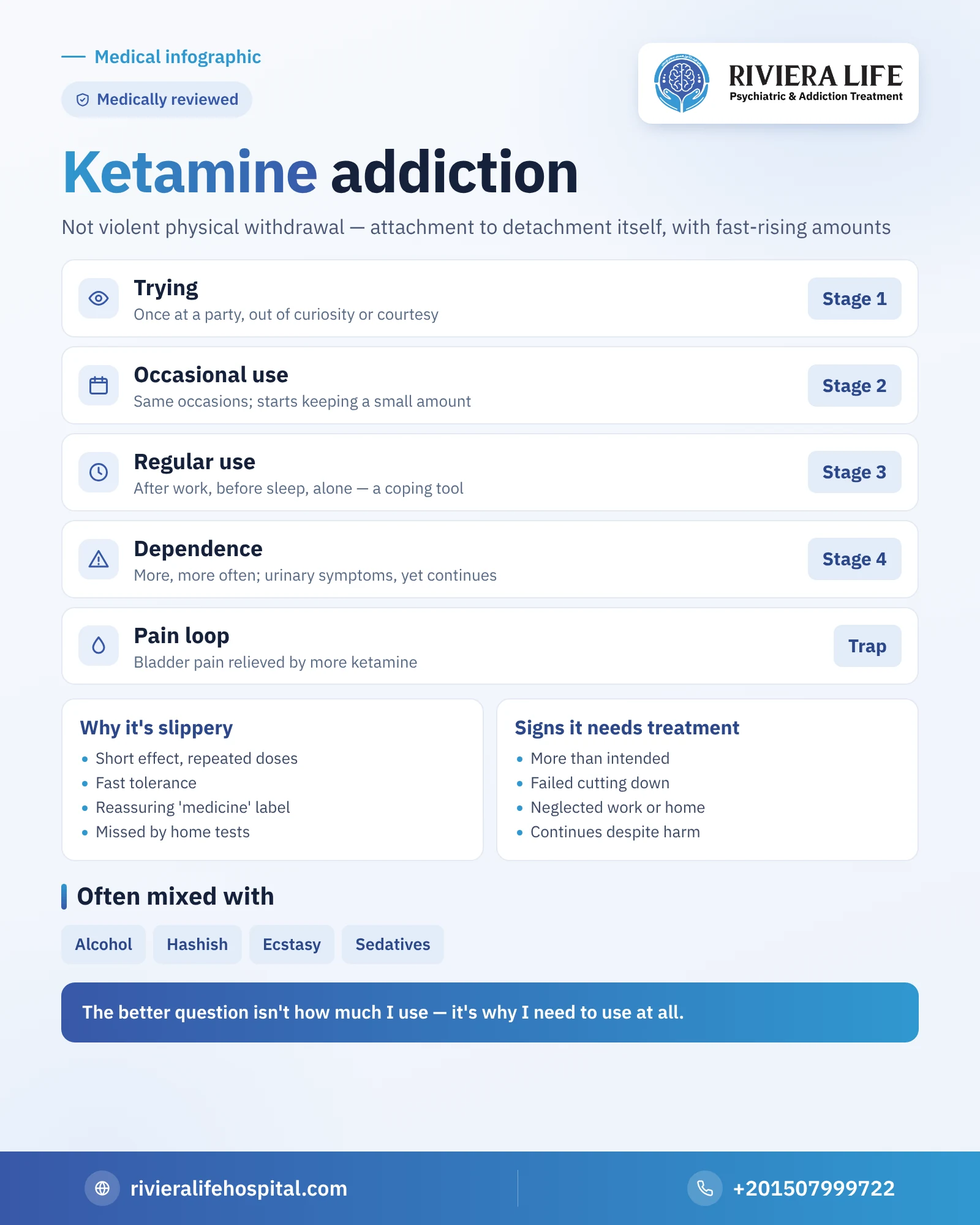
The stages of ketamine addiction
Addiction doesn’t happen in a day, but usually passes through successive stations the person himself may not notice:
Trying
Once at a party or with friends, out of curiosity or courtesy. Many describe the first experience as strange and not necessarily pleasant, which makes them think they are far from danger.
Occasional use
The person returns to ketamine at the same occasions, and begins keeping a small amount with him. Here it turns from something offered to him into something he looks for.
Regular use
Ketamine enters ordinary days: after work, before sleep, or under stress. Use begins alone, a decisive sign, because the substance is no longer part of a night out but a tool for dealing with oneself.
Dependence
The amount increases and the timing gets closer, anxiety and distress appear when the substance is absent, and urinary symptoms begin to appear. Even so, use continues, and may even increase, and here the addiction is complete.
Tolerance: why does the amount rise quickly?
When ketamine repeatedly blocks the glutamate receptors in the brain, the brain gradually adapts and its response to the substance weakens. The result is that the person needs a much larger amount to reach the same state. Some patients recount that within months they moved from a small amount a week to several times that daily. Every increase in amount means more strain on the bladder and the brain, which makes tolerance a warning sign, not just a detail.
Psychological dependence: the escape that becomes a prison
Ketamine gives a feeling of distance from worries, as if problems are happening to someone else. For someone living with chronic anxiety or untreated sadness, this feeling seems very comforting at first. But the brain learns quickly that the shortest route to relief is the substance, so other ways of coping weaken, such as talking to others, exercising or even natural sleep. Over time the person discovers that his postponed feelings return stronger after each session, so he needs another session. The reasons that make a particular person more prone to this road are the subject of our article on causes of ketamine addiction.
The loop of pain and the substance
One of the cruelest things about ketamine addiction is that it may create pain and then offer itself as its treatment. Repeated use causes inflammation of the bladder wall, with pain, burning and a frequent urge to urinate. Because ketamine is a strong painkiller, some patients turn to a new dose to silence this pain, so the inflammation increases, then the pain increases, then the dose increases. Breaking this loop needs medical treatment for both the pain and the addiction. Details of what happens to the bladder and kidneys are in our article on the harms of ketamine.
Can ketamine be used “in moderation”?
Many users say they are in control, and that they use it only at weekends. The problem is that this feeling of control is the very one that accompanies the first stages of almost every addiction. The limit the person sets for himself moves slowly: one night out becomes two, and the small amount becomes “normal”. With ketamine specifically there is no amount known to be safe for the bladder in the long term, and the user doesn’t even know the concentration of what he uses. So the more precise question isn’t how much I use, but why I need to use at all.
Ketamine with other substances
Ketamine addiction is rarely limited to one substance. Many patients combine it with alcohol, hashish or ecstasy at nights out, and some may use sedatives to sleep after a long night. This multiplicity complicates the picture because each substance has its own effect and withdrawal, it increases the risk of poisoning and depressed breathing, and it needs an assessment that identifies all substances before setting the treatment plan.
What about therapeutic ketamine?
Some patients treated for resistant depression with esketamine ask: will I become addicted? The approved treatment is given in a medical facility, at a set dose, at spaced intervals, with monitoring after each session, and the patient doesn’t keep the medicine at home. These controls were set precisely because the substance is open to misuse. That is why the doctor watches for any signs of a wish to increase or repeat the dose, and usually excludes those with a history of active addiction or follows them more cautiously. The real danger begins when a person tries to imitate the treatment himself with a substance from the street.
Why is ketamine addiction discovered late?
A ketamine user doesn’t show glaring signs all day, as its effect is short and disappears within hours. Also, common home tests usually don’t detect it because it needs a special test. And many families confuse the urinary symptoms with an ordinary urinary tract infection, so the patient moves between antibiotics without mentioning the real cause. That is why months may pass before the picture becomes clear, and you will find the signs that deserve attention in our article on ketamine addiction symptoms.
When does use become an illness that needs treatment?
Doctors don’t wait for the person to reach the point of collapse. It is enough for some of these signs to come together within about a year: using larger amounts or for longer than intended, failed attempts to cut down, spending a long time getting the substance and recovering from its effect, neglecting work, study or home, and continuing despite clear psychological or physical problems. The presence of two or three of these signs deserves a specialist assessment.
Ketamine addiction is treatable
The good news is that stopping early gives the bladder a great chance to improve, and that structured psychotherapy succeeds with many patients in breaking the pattern of escape. There is no medicine approved specifically for ketamine addiction, but treatment combines care for symptoms after stopping, treatment of accompanying depression and anxiety, urological follow-up, and rehabilitation that builds real alternatives to the substance. Our article on ketamine addiction treatment explains these stages in detail.
More from our ketamine guide
- Ketamine: the complete guide
- Ketamine withdrawal symptoms
- Causes of ketamine addiction
- Ketamine addiction treatment
Questions many people ask
There is no fixed period, but tolerance may appear within weeks of repeated use, and use turns into dependence in some people within months.
It is psychological at its core, with a pressing craving and anxiety when the substance is absent, while the physical withdrawal symptoms are usually milder than with other substances.
Because the brain adapts quickly to the substance so the same amount has less effect, and some patients also use the substance to relieve the bladder pain it causes.
The treatment is given in a medical facility at set doses with monitoring, and the patient doesn't take it home, and these controls greatly reduce the risk of misuse.
Yes, especially with early stopping, structured psychotherapy and bladder follow-up, and many patients regain their lives fully.