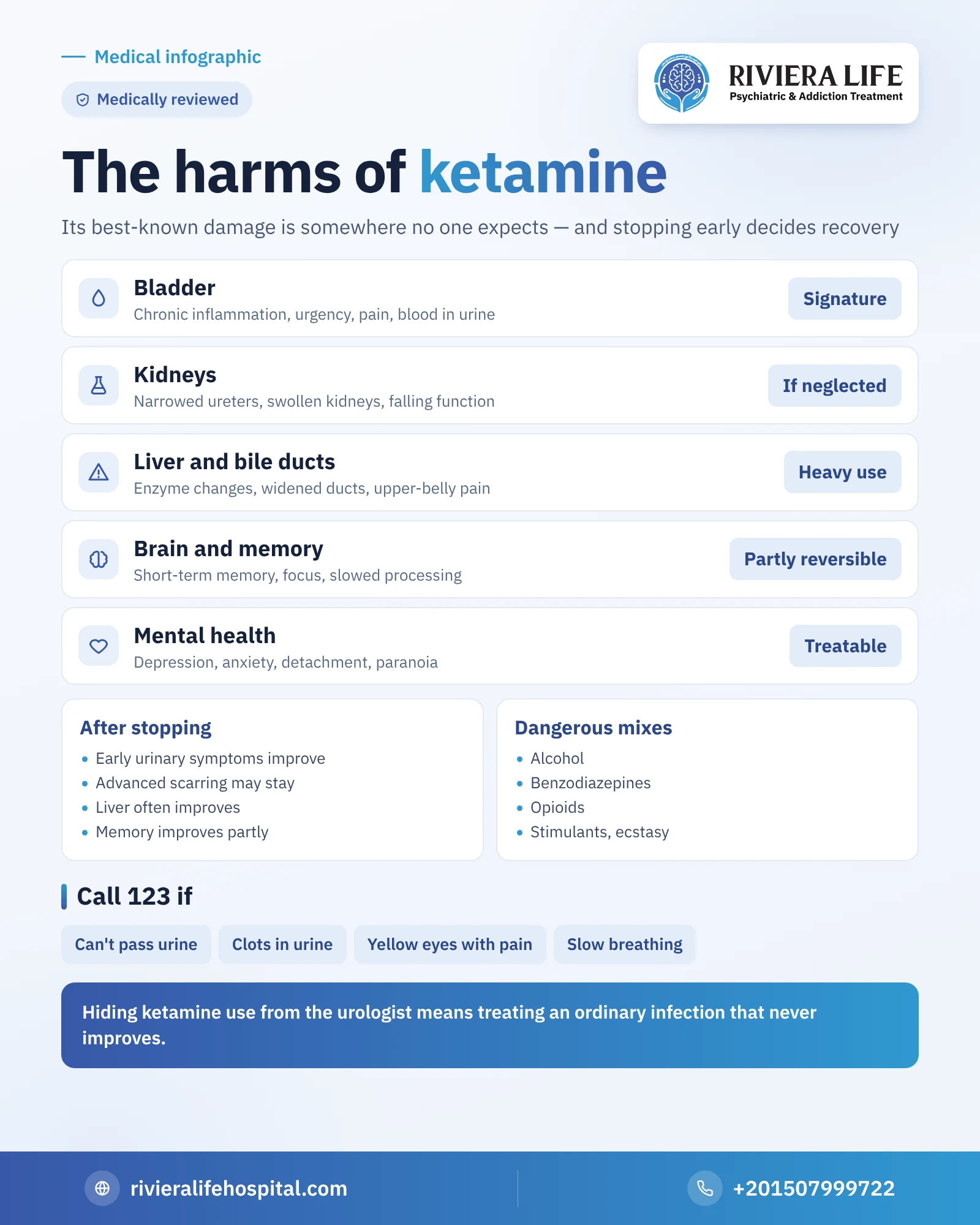
The best-known and most dangerous harm of ketamine happens in a place no one expects: the bladder. Repeated use may cause a chronic inflammation of its wall that makes the person urinate every quarter of an hour with pain and burning, and the damage may extend to the ureters and kidneys. Added to that is its effect on the liver and bile ducts, and on memory and mood, as well as the risks of accidents and choking while under its influence. In this article we go through each organ separately, and clarify what can improve after stopping and what may remain.
Short-term harms during the effect
In the first hours after use, the harms usually come from loss of control over the body rather than damage to a particular organ:
- Falls, injuries and fractures the person doesn’t feel because of the weakened sense of pain.
- Nausea and vomiting that may be inhaled if the person is semi-conscious.
- A raised heart rate and blood pressure, a greater risk for someone with heart disease.
- Confusion, panic and hallucinations that may drive dangerous behavior.
- Inability to move or call for help, which leaves the person exposed to exploitation and assault.
The harms of ketamine on the bladder
Doctors know this condition as ketamine cystitis, and it is among the harms most specifically linked to this substance. It is thought that ketamine and its breakdown products leave with the urine and irritate the inner lining of the bladder, causing chronic inflammation and ulcers, and over time the wall scars and loses its elasticity so the bladder’s capacity shrinks. The symptoms appear as:
- Very frequent urination and a sudden urgency that can’t be postponed.
- Pain and burning while urinating and pain in the lower abdomen.
- Blood in the urine.
- Urine leakage in advanced cases.
The likelihood and severity of these symptoms increase with the amount and frequency of use, and in some users they may begin after only months.
How is bladder damage diagnosed?
The doctor starts by asking the patient about the number of times he urinates by night and day and the severity of the pain, and may ask him to keep a urination diary for several days. Then a general urine test and culture are done to rule out bacterial infection, and an ultrasound to measure the bladder’s capacity and wall thickness and check the kidneys. In some cases the urologist needs a cystoscopy to see the lining directly. The most important thing at this step is for the patient to mention ketamine use frankly, because hiding it leads to treating an ordinary infection that doesn’t improve, and wastes precious time in which the bladder could have recovered.
The harms of ketamine on the kidneys
When the inflammation and scarring extend to the ureters, the two tubes that carry urine from the kidneys to the bladder, they may narrow or become partly blocked. Urine may also flow back from a small, stiff bladder. In both cases urine collects in the kidneys so they swell, a condition called hydronephrosis, and if it continues without treatment kidney function may decline. That is why the doctor usually requests an ultrasound and kidney function tests for every patient with urinary symptoms and a history of ketamine use.
The harms of ketamine on the liver and bile ducts
Doctors have noticed in some heavy users a disturbance in liver enzymes, and widening of the bile ducts resembling an obstruction. This condition is often linked to episodes of severe pain in the upper abdomen, which some users call “K-cramps”, and it may be accompanied by nausea. In many cases these changes improve after stopping, but they need follow-up with tests and scans, and they shouldn’t be relieved with ketamine itself, as some patients do.
The harms of ketamine on the brain and memory
Repeated use affects everyday thinking functions. What heavy users complain about most is weak short-term memory, meaning forgetting what was said or happened a short while ago, difficulty concentrating and slow processing of information. Some studies point to changes in the structure and function of the brain in those who use it daily for long periods, though the full picture is still being researched. The reassuring news is that part of this decline improves after stopping, especially in those who stop early.
And the matter isn’t limited to memory. Many patients describe slowness in making decisions, difficulty organizing their day, and a feeling that their thoughts are “foggy” even on days they don’t use. These complaints directly affect study and work, and make the patient less self-confident, so his tendency to isolation increases. A neuropsychological assessment after a period of abstinence helps to know what has improved and what needs additional rehabilitation.
Psychological harms
- Depression and low mood, especially in the days following use.
- Anxiety and panic attacks.
- A persistent feeling of detachment from oneself or from reality even outside times of use.
- Suspicious and persecutory thoughts and hallucinations in some heavy users.
- Worsening of any pre-existing psychiatric disorder.
Harms to the heart, nose and other organs
Ketamine raises blood pressure and heart rate, which may be dangerous for someone with high blood pressure or heart disease. Repeated snorting irritates the lining of the nose and causes congestion and bleeding. Injection adds the risk of abscesses and the transmission of infection when equipment is shared. Loss of appetite and repeated vomiting lead to weight loss and malnutrition.
The danger of mixing ketamine with other substances
The danger doubles when ketamine comes together with alcohol, benzodiazepines or opioids, because these substances depress breathing and consciousness, increasing the likelihood of losing consciousness, choking on vomit and stopped breathing. Mixing it with stimulants or ecstasy also doubles the strain on the heart and confuses perception further. The problem is that the powder in circulation may already contain other substances the user doesn’t know about.
Ketamine and hashish: what happens when they are combined?
Some users combine ketamine and hashish thinking that the second “softens” the first or eases what comes after. In reality both change perception, so ketamine’s dissociative effect comes together with hashish’s anxiety and suspicion, and the combination may turn into a panic attack or severe confusion in which the person struggles to understand what is around him.
The main risks of combining them:
- Vomiting and nausea while unconscious, with the possibility of choking on vomit.
- Disturbed balance and coordination, so injuries and accidents increase.
- Greater weakness in memory and concentration in the long term.
- A higher risk of psychosis in someone predisposed to it, as hashish alone raises it.
Hashish doesn’t protect the bladder or kidneys from ketamine’s harms, and doesn’t reduce its risks; it may even hide from the person the size of what he is taking. And turning to another substance to ease the effect of the first entrenches a pattern of using more than one substance. Tell your doctor everything you use so he can set an appropriate treatment plan. For more on hashish read the harms of hashish on the brain and body, and on how ketamine dependence begins read ketamine addiction: how it starts and how it develops.
Harms during pregnancy
There is no safe use of ketamine outside medical supervision during pregnancy. The substance crosses to the fetus, and repeated use exposes the mother to urinary complications, accidents and malnutrition, all of which affect the pregnancy. Any pregnant woman using ketamine needs joint follow-up between the gynecologist and the addiction doctor without delay.
Harms to daily life
Away from the organs, ketamine leaves a mark on everything around the patient. The constant need for the bathroom makes work, study and travel a burden, weak memory shakes performance, spending on the substance drains money, and isolation drives away friends and family. Many patients describe that the hardest thing isn’t the pain, but the feeling that their life has narrowed until it revolves around the substance and the bathroom.
Do the harms of ketamine go away after stopping?
| Harm | After stopping |
|---|---|
| Early urinary symptoms | Usually improve within weeks to months |
| Advanced bladder scarring | May remain, and sometimes needs surgical intervention |
| Liver and bile duct disturbance | Improves in many cases with follow-up |
| Memory and concentration | Improve partly or fully depending on the duration of use |
| Depression and anxiety | Improve with psychological and medication treatment |
The decisive factor is timing. Stopping completely is the most important treatment for the bladder, and the earlier it comes, the greater the chance of recovery. Our article on ketamine addiction treatment explains how urological care is integrated into the treatment plan.
When do you need the emergency department?
Call an ambulance on 123 immediately if you see
Some ketamine complications are emergencies that can't wait.
- Urinary retention with severe lower abdominal pain
- A lot of blood or blood clots in the urine
- Severe pain in the side with fever or vomiting
- Yellowing of the eyes or skin with abdominal pain
- Loss of consciousness or slow breathing after use
To learn the signs that reveal addiction before the harms reach this stage, see our article on ketamine addiction symptoms.
More from our ketamine guide
- Ketamine: the complete guide
- Ketamine addiction symptoms
- Ketamine withdrawal symptoms
- Ketamine addiction treatment
- GHB: its dangers with alcohol and how to protect yourself from having your drink spiked
- Ketamine and sex: absent awareness and consent, bladder damage and recovery
- Pink cocaine (tusi): what it contains and why it is an unpredictable danger
Questions many people ask
A chronic inflammation of the bladder wall linked to repeated ketamine use, causing frequent painful urination and blood in the urine, and the bladder's capacity may shrink with it.
In early cases symptoms usually improve after stopping completely, but advanced scarring may remain and may need surgical intervention.
Yes, the damage may extend to the ureters, obstructing urine drainage and leading to swelling of the kidneys and a decline in their function if neglected.
It may be linked to liver disturbance and widening of the bile ducts in heavy users, and it needs tests and scans, not relief with the substance itself.
Yes, combining them increases the likelihood of losing consciousness, choking on vomit and depressed breathing.