Khat addiction symptoms don’t resemble the usual picture of addiction: no injections, no disappearing, no staggering. What the family usually sees is a man or young man who never misses his daily session whatever happens, spends money on it that the household needs, stays up until dawn, eats little, and whose mood swings between the cheerfulness of the afternoon and the silence of the evening, then becomes sharply irritable if the bundle is missing. These signs together, not each one alone, are what indicate that chewing has gone beyond the limits of a habit. This article explains the signs that can be noticed at home, and how to tell an occasional chewer from someone who has lost control.
Why is khat addiction hard to see?
In communities used to khat, the daily session is considered normal, practised by the father, the neighbor and the work colleague. So the chewer doesn’t see himself as addicted, and nor does his family in the first years. Added to this, khat doesn’t cause visible intoxication: the person talks, works and drives, and the symptoms of stopping aren’t physically painful like opioids. All this makes addiction creep in silently, drawing attention only when losses pile up: money that isn’t enough, declining health and a tense marriage. In Egypt, however, where khat is banned and rare, the first sign may be the bundles of leaves themselves, their smell or their remains.
The daily session: the clearest sign
The first thing the family notices is the session turning from an occasion into a fixed appointment that can’t be touched. Its forms include:
- He chews almost every day, including days of illness, travel and family occasions.
- The session starts earlier and ends later over the months, so what was two hours became five.
- He arranges his whole day around the time of buying the bundle and the time of the session.
- He chews alone if he can’t find company, after the session had been basically social.
- He looks for “stronger” or fresher leaves, or increases the amount to feel the same effect.
Physical signs you can see with your own eyes
Some signs reveal repeated chewing even if the person doesn’t talk about it:
- A bulge in one cheek during the session, and brown or greenish staining of the teeth.
- A dry mouth, intense thirst and drinking a lot of water, soft drinks and tea.
- Dilated pupils and a fast pulse during chewing hours.
- Weight loss, and repeated complaints of constipation or hemorrhoids.
- A look of morning exhaustion and puffiness under the eyes from staying up.
You will find a detailed explanation of what long chewing does to each body system in the article on the harms of khat.
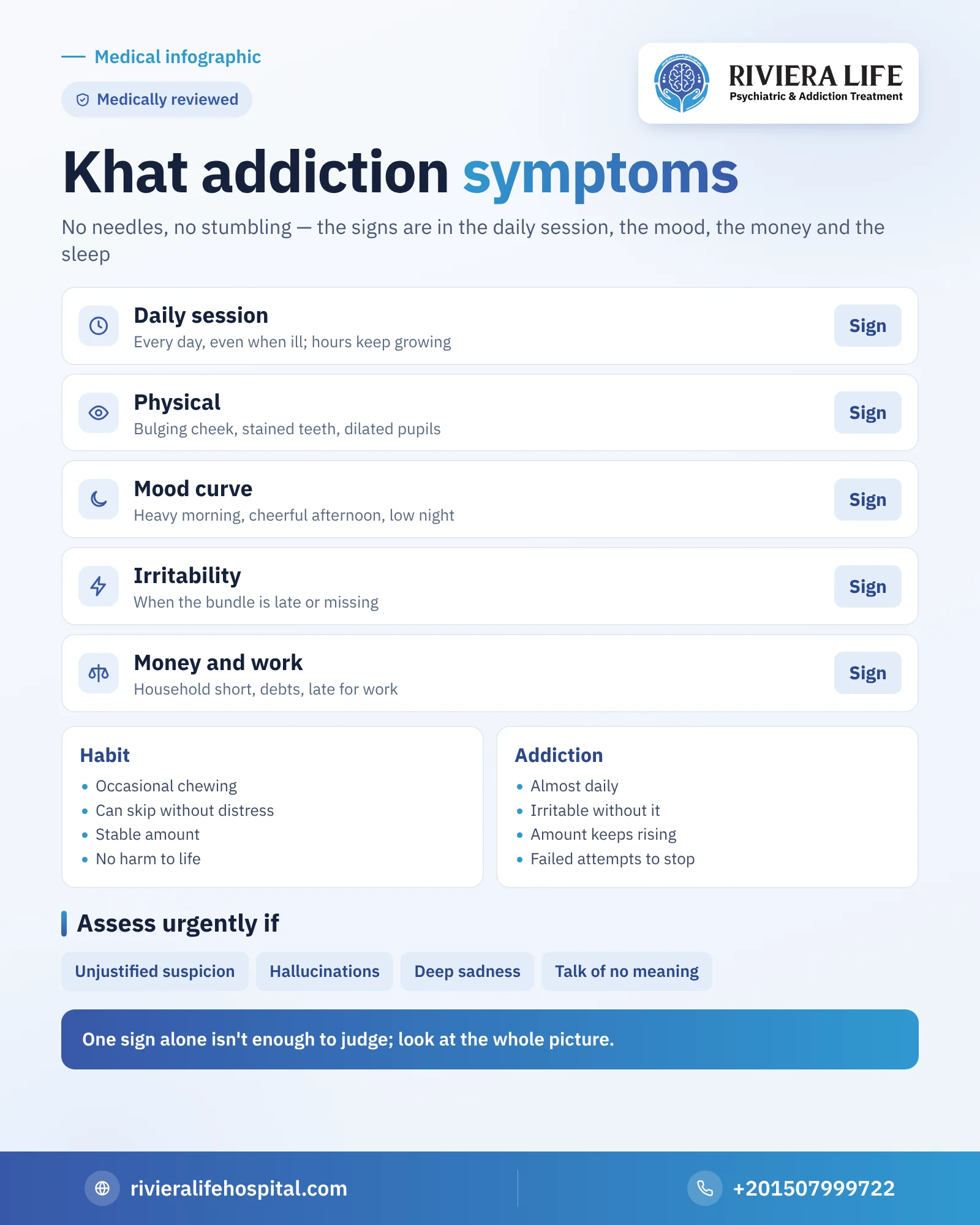
A mood that swings with the hours of the day
One of the most precise signs is that a chronic chewer’s mood follows a predictable daily curve:
In the morning
Sluggishness and heaviness, late waking, little desire to talk or work, and sometimes irritability and grumbling at any request.
In the afternoon
Shortly after chewing starts he turns into another person: cheerful and talkative, planning big projects, and seeming confident and energetic.
In the evening and night
As the session ends his mood drops, so he falls silent and withdraws, sinks into thinking and worry, and then can’t sleep until late hours.
This repeated daily swing, not the cheerfulness alone, is what usually catches the family’s eye.
Irritability when khat is missing
A simple test reveals a lot: what happens if the bundle is late or unavailable? In someone whose chewing has turned into dependence, irritability out of proportion to the situation appears, with tension and restlessness, and he may leave the house at an unsuitable time to look for it, or start a fight over a trivial matter. On days when he is forced not to chew, such as traveling to a country that bans it, he becomes sluggish, sad and very sleepy. This picture is the mild beginning of what is known as withdrawal, and its details are in the article on khat withdrawal symptoms.
Money and work
Khat is bought daily, and isn’t stored because it loses its effect quickly, which makes its cost fixed and unending. Signs of financial concern include:
- A noticeable part of income going to the daily bundle, with household expenses falling short.
- Borrowing, selling things or postponing obligations to cover the price of khat.
- Anger or evasion if asked about money.
- Repeated morning lateness for work, or leaving a job that conflicts with session time.
Sleep and appetite
Insomnia is an almost constant sign in someone who chews daily: he sleeps near dawn and wakes at midday, or sleeps a few broken hours. Appetite switches off during session hours, so he skips dinner, eats little and gradually loses weight. If you notice the person has started using a sleeping pill or sedative to be able to sleep after the session, this sign alone deserves attention.
Psychological signs that can’t wait
Some signs don’t concern addiction alone, but mean the psychological state needs a quick assessment:
- Unjustified suspicion of the wife, family or neighbors, or a feeling that someone is watching him.
- Hearing voices or seeing things others don’t, especially after staying up long.
- Deep sadness and losing interest in everything, or talk that life has no meaning.
- Sharp outbursts of anger unusual for him.
The list of depression symptoms helps you understand the low that may be hiding behind the daily session.
The line between habit and addiction
Not everyone who chews khat is addicted, and the difference doesn’t lie in the chewing itself but in control over it and its price:
| Habit | Addiction |
|---|---|
| Chews on occasions or particular days | Chews almost daily without exception |
| Can skip the session without much distress | Becomes irritable or sluggish if the bundle is missing |
| The amount and duration are roughly fixed | The amount and hours increase over time |
| Doesn’t affect money, work or family | Continues despite clear losses in money, health and relationships |
| Stops easily when traveling or ill | Has tried to stop several times and gone back each time |
If three or more signs from the second column apply over a year, it has most likely gone beyond a habit and deserves a specialist assessment.
What isn’t enough on its own to judge?
Some families worry over a single sign and rush to judgment. Stained teeth may come from smoking or tea, insomnia may come from work pressures, and weight loss has many medical causes. And chewing khat at a wedding or family visit once a month doesn’t mean addiction. What makes addiction likely is several signs coming together and continuing for months, with a clear inability to stop despite the losses. So watch the whole picture before confronting, and write down what you notice with dates, which also helps the doctor when the time for assessment comes.
When khat comes together with other substances
Some chewers add other stimulants to prolong staying up, such as Captagon, or take sleeping pills and sedatives after the session to get some sleep. Then signs more severe than usual appear: agitation or staying up for several nights in a row, heavy drowsiness and slurred speech in the morning, or medicines whose source the family doesn’t know. This mixing makes a medical assessment more urgent, because the risk of complications rises clearly.
How do you start the conversation?
Start with what you saw, not with judgments: “I noticed you haven’t slept before dawn this week” is closer to the heart than “you’re an addict”. Talk in the morning after he has fully woken, not at the end of the session when he is tense. And suggest a health check of blood pressure, teeth and stomach as an acceptable way in. At Riviera Life in Sheikh Zayed, the journey starts with a free, confidential first consultation in which the doctor assesses the case without judgment, then comes the plan explained in the article on khat addiction treatment.
More from the khat guide
- Khat: the complete guide
- The harms of khat to the body, mind and family
- Khat withdrawal symptoms
- Khat addiction treatment
Questions many people ask
Look for several signs together: daily chewing that doesn't stop even when ill, more hours, spending that harms the household, irritability if the bundle is missing, and failed attempts to stop.
No. Someone who chews on occasional events and stops easily isn't considered addicted. Addiction means loss of control and continuing despite clear harm.
Because the stimulant lifts mood during the session hours and is followed by a drop in the evening, and with staying up late the morning comes heavy, so the same curve repeats daily.
Yes, especially when the bundle is late or missing for someone used to it daily, and chronic lack of sleep also increases agitation and quick anger.
When unjustified suspicion, hallucinations, deep sadness or talk that life has no meaning appear; these need an urgent psychological assessment, not waiting.