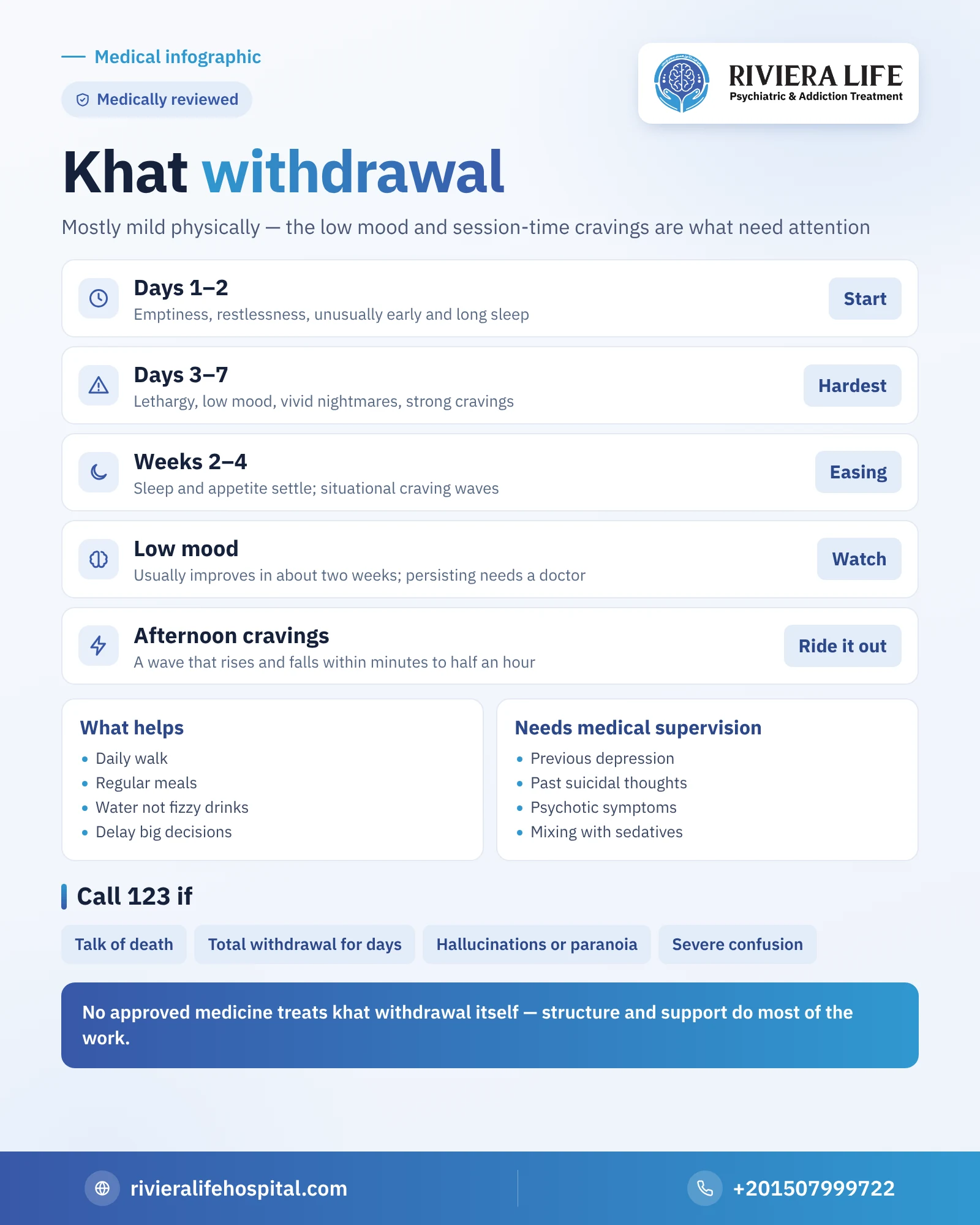
Khat withdrawal symptoms usually begin on the first day after the last session, are at their most intense over roughly the first three days, then ease gradually over one to two weeks for most people who stop. The most prominent are heavy lethargy and a desire to sleep, low mood that may reach depression, disturbing nightmares, and an urgent craving to chew that flares at the usual session time. Withdrawal is usually not physically dangerous, but the low mood needs serious follow-up. This article explains the sequence of symptoms day by day, what helps get through them, and when seeing a doctor becomes necessary.
Does khat really have withdrawal symptoms?
Yes, even though many deny it. The common idea is that khat “doesn’t pull” because stopping it doesn’t cause bone pain, diarrhea or heavy sweating like opioids. This is partly true, as withdrawal here is more psychological and behavioral than physical. But someone who has chewed daily for months or years feels a clear change in energy, mood and sleep on stopping, and studies describe it as a mild to moderate withdrawal resembling in its features the withdrawal from other stimulants, though much calmer.
Why do the symptoms appear?
Cathinone, the active substance in khat, pushes the brain to release dopamine and noradrenaline every day at roughly the same time. With repetition the brain adapts to this regular stimulation, so its own production of, or sensitivity to, these transmitters falls outside session times. When khat suddenly disappears, the brain finds itself at a lower level of stimulation than usual, which shows as lethargy, low mood and loss of pleasure. Added to this is the learning factor: the brain has linked the afternoon hour, the place and the company with reward, so it triggers the craving whenever one of these cues appears.
The khat withdrawal timeline
The following periods are approximate, and vary according to the number of years of chewing, daily hours and the psychological state before stopping:
Days one and two
The person notices the difference at the hour he used to start chewing. He feels emptiness, restlessness and irritability, then in the evening tends to go to sleep early, unusually for him. He may sleep very long hours and wake up heavy.
Days three to seven
This is often the hardest period. Clear lethargy and reluctance to do the simplest tasks, low mood and irritability, nightmares or very vivid dreams, and a strong craving to chew, especially in the afternoon. Some patients say they feel that “the world has no color”.
Weeks two to four
Physical symptoms mostly recede, sleep starts to become regular, and appetite returns. But cravings may remain and appear as waves linked to situations, such as seeing old friends or passing the session place.
After the first month
For most people, withdrawal is over by now, and intermittent cravings remain on occasions. But for someone whose depression was hidden behind the session, low mood may continue, and here the cause isn’t withdrawal but a condition that needs separate treatment.
Lethargy and sleepiness: the body reclaims its debts
After years of staying up until dawn, the body demands the sleep it missed. That is why someone who has recently stopped complains of a strong desire to sleep in the daytime, heaviness in movement and slowed thinking. This isn’t laziness or weak will, but an expected part of recovery. The common mistake is trying to drive away sleepiness with large amounts of coffee or energy drinks, swapping one stimulant for another and delaying the regulation of sleep.
Depression and low mood
Low mood is the most important khat withdrawal symptom and the one most deserving of attention. It may appear as sadness and crying, loss of interest in work and family, a sense of guilt and failure, or irritability and annoyance with everything. For most people this improves within about two weeks. But if it becomes severe, lasts longer than that, or thoughts that life isn’t worth it appear, it needs a psychiatrist without delay. The list of depression symptoms helps you distinguish between passing sadness and depression that needs treatment.
Call an ambulance on 123 immediately if you see
Khat withdrawal is rarely physically dangerous, but low mood may become severe. You can also call the mental health hotline 16328.
- Talk of death or of life being worthless
- Complete withdrawal and refusing food and speech for days
- Hallucinations, paranoia or suspicions that push toward violence
- Severe confusion or loss of consciousness
If you are going through these thoughts now, you aren’t alone, and this stage passes with the right help. Talk to someone you trust today, and call one of the two numbers.
Nightmares and disturbed sleep
Many who stop talk about very vivid, disturbing dreams in the first weeks, and some dream that they are chewing khat and then wake anxious. This is probably linked to the return of sleep stages that staying up late used to cut short. At the same time, sleep may swing between very long hours and broken nights. Consistency is the treatment here: one wake-up time every day, daylight in the morning, and avoiding long naps after the afternoon. Taking sleeping pills on your own isn’t advised, because the aim is not to replace one dependence with another. Our insomnia guide explains effective non-drug alternatives.
Urgent cravings and the session hour
Craving for khat has its hour. Many patients say they don’t think about it all morning, then the thought strikes as the afternoon approaches, or straight after lunch, or when a phone rings from one of the session companions. This craving comes as a wave, rising and then falling within minutes to about half an hour if it isn’t responded to. Among the things that help ride out the wave:
- Setting a fixed alternative activity for the session hour before it comes, not after.
- Leaving the place linked to chewing, or changing the route that passes the khat market.
- Calling a supportive person at the very moment of craving.
- A written reminder of the reasons for stopping, read during the wave.
Other physical changes after stopping
Alongside lethargy, someone who stops may notice a headache in the first days, a mild feeling of cold or shivering in some, and a strong return of appetite that may come with weight gain. Bowel movements may change, so chronic constipation gradually improves. Blood pressure and pulse readings fall in many, which blood pressure patients themselves notice. To learn which harms start improving after stopping and which need treatment, see our article on the harms of khat.
What helps get through withdrawal?
Most people get through khat withdrawal without medicines, if they organize their first days well:
- Movement: a daily walk, even half an hour, lifts mood and improves sleep.
- Regular meals: three balanced meals after years of skipping dinner.
- Water instead of fizzy drinks: excess sugar and caffeine increase the swings.
- Telling the family: so they understand the irritability and sleepiness and don’t treat them as defiance.
- Postponing big decisions: mood in the first week isn’t a true measure of life.
When does withdrawal need medical supervision?
It is better for stopping to happen with medical follow-up if there is previous depression or past suicidal thoughts, psychotic symptoms that appeared with chewing, or if khat is mixed with other stimulants or with sleeping pills and sedatives, as the latter have a withdrawal that may be dangerous. Heart and blood pressure patients also need their medicines reviewed after stopping, because readings may change. The doctor may prescribe treatment for depression or anxiety when needed, but there is no approved medicine that treats khat withdrawal itself.
Khat withdrawal compared with withdrawal from other stimulants
Khat withdrawal resembles in its features the withdrawal from amphetamines and Captagon: lethargy, a lot of sleep, depression and cravings. But it is usually milder and shorter, because khat reaches the brain slowly and at a lower concentration. This difference doesn’t mean stopping is easy, as the real difficulty with khat is more social and behavioral than chemical, which is what the program explained in our article on khat addiction treatment addresses. And if you aren’t yet sure that chewing has turned into addiction, start with our article on khat addiction symptoms.
More from our khat guide
Questions many people ask
Symptoms peak in the first days and ease for most people within one to two weeks, while intermittent cravings tied to situations may remain for some weeks longer.
Physically it is usually mild to moderate and not life-threatening, but low mood may become severe in someone with previous depression, and then it needs medical follow-up.
Because the body is making up for years of staying up late, and because the brain has lost the daily stimulation it was used to, so it shows as sleepiness and lethargy that improve as sleep becomes regular.
There is no approved medicine for khat withdrawal itself, and the doctor may prescribe treatment for depression or anxiety if needed, while the foundation is organizing the day and support.
Because the brain has linked the time, place and company of the session with reward, so it triggers the craving when they appear, and the wave eases within minutes if the person doesn't respond to it.