Khat is a plant whose fresh leaves are chewed for long hours, and these leaves carry two stimulant substances chemically close to amphetamine: cathinone and cathine. In Yemen and the Horn of Africa chewing it seems a daily social habit that no one pays attention to, but medicine deals with it as a stimulant substance capable of causing psychological dependence and of harming the mouth, stomach, heart and sleep, and excess may push towards psychotic episodes.
In Egypt khat is a legally banned substance. On this page we explain what khat is, how it works in the brain, what it does to the body over time, how it is linked to synthetic cathinones such as flakka, and when the daily session becomes a problem that deserves treatment.
What is khat?
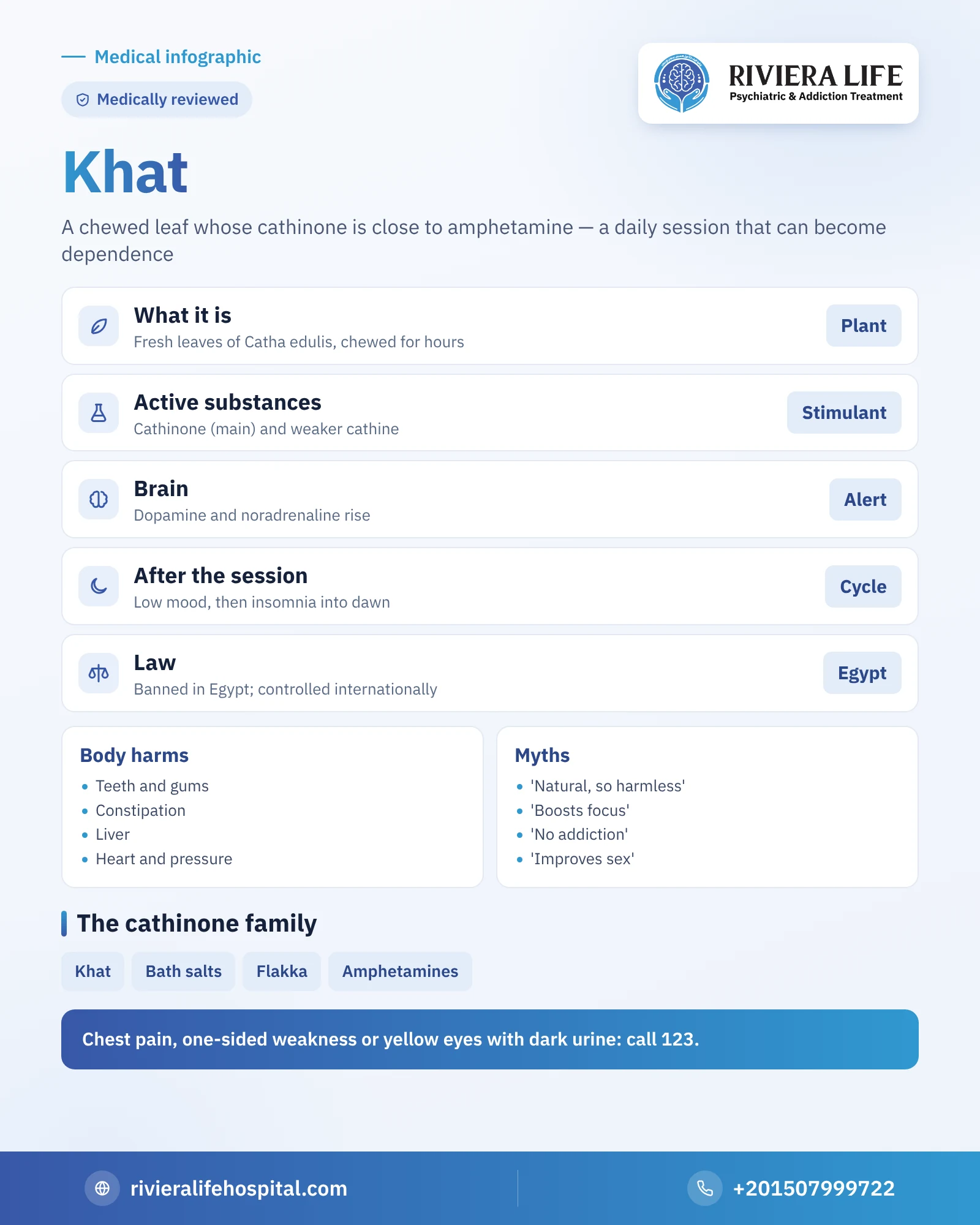
Khat is an evergreen shrub whose scientific name is Catha edulis, growing in the highlands stretching from East Africa to the southwest of the Arabian Peninsula. Farmers pick the small branches and young leaves, which are tied in bundles and sold almost the same day, because their value to the consumer is linked to their freshness. The strongest substance in the leaf breaks down a short time after picking, which is why wilted leaves lose most of their effect.
Khat isn’t usually swallowed. The chewer puts the leaves in the side of the mouth and chews them slowly, so they gather in a lump inside the cheek, the lining of the mouth absorbs part of the active substances, and another part reaches the stomach with the saliva. The effect begins to be felt some time after chewing starts, then continues for hours.
Cathinone and cathine: how does khat stimulate the brain?
Cathinone is the main component responsible for stimulation, and its structure is very close to amphetamine, but it is weaker. Cathine has a weaker effect, and part of it forms from the breakdown of cathinone itself, which explains the weakness of old leaves. The two substances push nerve cells to release dopamine and noradrenaline, so the chewer feels alert, active and wanting to talk, their pulse and pressure rise, and their appetite and need for sleep decrease.
The practical difference between khat and stimulant pills is that its way of use slows the substance’s arrival in the blood and dilutes its concentration, so the effect comes calmer and less sharp. This slowness is what makes many consider it “harmless”, but it doesn’t cancel the fact that the active substance is a stimulant from the amphetamine family, and that long daily sessions accumulate their effect on the brain and body.
The khat session: a daily culture in Yemen and the Horn of Africa
In Yemen the khat session is known as the maqil or takhzin, and usually begins after lunch and extends until sunset or after it; friends and relatives gather in it, and matters of work, family and even disputes are discussed. In Somalia khat is called “qaad” or “jaad”, in Ethiopia “chat”, and in Kenya it is well known by names such as “miraa”. It is also chewed in Djibouti, and in some areas bordering Yemen in the south of the Arabian Peninsula despite its ban in most Gulf countries, and the habit has moved with migrant communities to other countries.
In Egypt the presence of khat is limited, and is mostly linked to individuals from communities who were used to it in their countries, or to smuggling attempts seized from time to time. The difficulty of stopping it can’t be understood without understanding this social dimension; for many, khat isn’t a substance a person uses alone, but a daily appointment with people, conversation and standing.
The short-term effects of khat
In the first hours of the session most chewers feel the following:
- Elation, energy, a feeling of confidence and a flood of thoughts and talk.
- Wakefulness and a decline in the sense of tiredness and hunger.
- A faster pulse, raised blood pressure and dilated pupils.
- Dry mouth, thirst, and drinking a lot of water, soft drinks or tea.
As the session nears its end the scene changes: silence, withdrawal and anxiety, repetitive thinking and low mood, then clear difficulty sleeping that may extend into the hours of dawn. The next day the person wakes late and heavy, and finds themselves waiting for the afternoon session to regain their energy, and so the circle closes.
Does khat cause addiction?
Yes, khat can cause dependence, though the dependence is mostly psychological and behavioral more than physical. Its sign is that the person can’t imagine their day without the session, gets anxious if the bundle is late, increases the number of hours or the amount over time, and continues despite clear problems in health, money or work.
On stopping suddenly after long daily use, mild to moderate withdrawal symptoms appear in most cases, the most prominent being:
- Lethargy, laziness and a feeling of heaviness in the body.
- Low mood, distress and irritability.
- Nightmares and disturbed sleep.
- An urgent craving to chew, especially at the usual session time.
These symptoms aren’t usually physically dangerous, but the low mood may intensify in someone with previous depression, and here the case needs a psychological assessment, not silent endurance.
The harms of khat to body and mind
The mouth and teeth
The lump staying in the cheek for hours daily leaves its mark: staining of the teeth, gum inflammation and recession, and white keratinized patches in the lining of the cheek on the chewing side. Some studies link long chewing with mouth tumors, and the evidence here is still under research, but any ulcer or patch in the mouth that doesn’t heal deserves an examination by a doctor.
Digestion and constipation
Khat inhibits bowel movement, so chronic constipation is common among chewers, along with hemorrhoids and stomach pain and inflammation. Repeated loss of appetite leads over time to weight loss and malnutrition, especially in someone who replaces meals with the session.
The liver
Medical reports have documented cases of hepatitis linked to khat, some of them severe. Some factors add to the concern, such as pesticide residues that may be sprayed on the shrubs, and combining khat with medicines or other substances.
The heart and blood pressure
Raising the pulse and pressure for hours every day isn’t neutral for someone with high blood pressure or arterial disease. Studies from the region have linked heavy chewing with an increased risk of heart attacks and strokes.
Sleep and the mind
Insomnia is the most common price, and it drags along exhaustion, tension and weak concentration. With very long sessions and continuous staying up, psychotic symptoms may appear: suspicion, paranoia and persecutory thoughts, and sometimes hallucinations, especially in someone predisposed to a psychiatric disorder. These symptoms usually subside with stopping and treatment, but they need medical intervention.
Khat and synthetic cathinones: from the leaf to bath salts
The cathinone found in khat is the chemical origin of an entire family of manufactured substances known as synthetic cathinones, some of which were sold under the name “bath salts”, and among them is flakka. These substances were designed in laboratories to be much stronger than natural cathinone, and are used in ways that deliver them to the brain all at once, so they are linked to severe agitation, a dangerous rise in temperature and acute psychotic episodes.
Chemical kinship doesn’t mean similar danger; chewing the leaf is one thing and using a manufactured powder of unknown concentration is something else entirely. To learn about this synthetic family in detail read the flakka page, and you can understand the origin these substances belong to on the amphetamines page.
In Yemen khat remains part of daily social life, and many don’t know when it turns into a problem that needs treatment; this is what the guide to addiction treatment in Yemen covers.
Khat and the law in Egypt
Khat is banned in Egypt, and possessing, importing or trafficking it is treated as dealing with narcotic substances, with the penalty differing according to the type of act and its quantity. Cathinone and cathine are also listed in the international schedules of controlled substances. The situation differs from one country to another: khat is permitted in countries such as Yemen, Ethiopia and Kenya, and banned in most Gulf countries and in a number of European countries and the United States. Anyone in Egypt who seeks treatment of their own accord finds the door open, as the law exempts a user who comes forward for treatment from having a criminal case brought against them. For any specific legal question it is advisable to consult a lawyer.
The khat guide: each aspect in a separate article
We dedicate an article to each aspect of khat that answers a single question in detail, and this is the first of them:
- Khat addiction treatment: why it is hard to leave the daily session, how withdrawal is managed and depression and insomnia are treated, and how to protect yourself when traveling to a country where khat is sold openly.
- Flakka: the most dangerous member of the synthetic cathinone family, and how it differs from the natural leaf.
- Amphetamines: the stimulant family whose members cathinone resembles in structure and effect.
Common myths about khat
The myth: khat is a natural plant, and what is natural doesn’t harm. The truth is that being a plant doesn’t change that its active substance is a stimulant close to amphetamine, and that opium and cocaine also come from plants.
The myth: khat increases focus and helps with studying and work. The truth is that the feeling of energy is temporary, followed by insomnia and exhaustion the next day, and many of the session’s hours go on talking, not on getting things done.
The myth: someone who chews khat can’t become addicted to it because they don’t suffer painful withdrawal. The truth is that psychological dependence is real, and shows in the inability to leave the daily appointment despite wanting to.
The myth: khat improves sexual performance. The truth is that the temporary feeling of energy doesn’t mean improvement, and many chronic chewers complain of weakened desire over time.
If a member of your family chews khat
Don’t start by mocking the habit or talking about shame, as the chewer often sees it as part of their identity and relationships. Start with what you see with your own eyes: insomnia, chronic constipation, the money that goes daily, irritability in the evening, or their absence from the family during session hours. Suggest a medical check of their blood pressure, teeth and stomach, as many accept talking about health before talking about addiction. And if strange suspicions or deep sadness appear on them after stopping, don’t postpone the consultation.
When is khat an emergency?
Call the ambulance on 123 immediately if any of these appear
Chewing khat rarely causes acute poisoning, but long sessions, combining it with other stimulants, or having heart disease may lead to serious complications.
- Chest pain or pressure, or severe irregular palpitations
- A sudden violent headache, weakness in one side of the body or difficulty speaking
- Severe agitation, hallucinations or paranoia that pushes towards violence or self-harm
- Seizures or loss of consciousness
- Clear yellowing of the eyes or skin with abdominal pain and dark urine
Until the ambulance arrives, move the person away from crowds and noise, stay with them calmly without arguing, and don’t give them sedatives from home.
When should you ask for help?
If your day has come to be built around the session, or you have tried to stop more than once and gone back, or chronic insomnia and depression or worrying thoughts have appeared in you, it is time for an assessment. At Riviera Life in Sheikh Zayed the consultants in psychiatry and addiction treatment assess your case in complete confidentiality, and put in place a plan that takes into account your circumstances, habits and country, and the first consultation is free. You will find the details of the plan in the article on khat addiction treatment.
Medical sources and referencesThe information in this article is based on reliable scientific sources