Khat addiction treatment doesn’t begin with a medicine, but with understanding that the patient isn’t only leaving a substance; they are leaving a daily appointment, friends and a sitting they have been tied to for years. So the plan rests on three pillars: easing the first days of withdrawal, treating the depression and insomnia that appear afterward, then rebuilding the afternoon and evening hours the session used to fill. A fourth pillar is added for those who live in or travel to a country where khat is sold openly. In this article we explain the steps of treatment as it actually happens, and how to choose the right place.
Why is khat hard to give up even though its withdrawal is mild?
Many patients say: “I stopped for days and didn’t suffer, so why did I go back?”. The reason is that khat’s strength doesn’t lie in physical symptoms, but in three intertwined bonds:
- The social ritual: the session is the place for news, deals and reconciliation between people, and staying away from it feels like withdrawing from society itself.
- The daily appointment: the brain learns that three in the afternoon, for example, means stimulation and pleasure, so the craving ignites at the same time every day.
- Getting used to artificial energy: after years, working or talking without khat becomes tiring, so the person thinks they can’t be themselves without it.
That is why stopping that relies on willpower alone fails, while planned stopping that treats these bonds one by one succeeds. You will find broader background on the plant and its active substance on our page on khat.
When does a khat user need specialist treatment?
Not everyone who chews khat at an occasion needs a treatment program. But a consultation becomes necessary if the session has turned into a daily requirement, if repeated attempts to stop have failed, if depression, chronic insomnia or suspicion and paranoia appear, or if khat is now combined with other stimulants such as captagon or with sleeping pills to overcome the sleeplessness it causes. Having heart or liver disease or high blood pressure makes the assessment more urgent.
Stages of khat addiction treatment
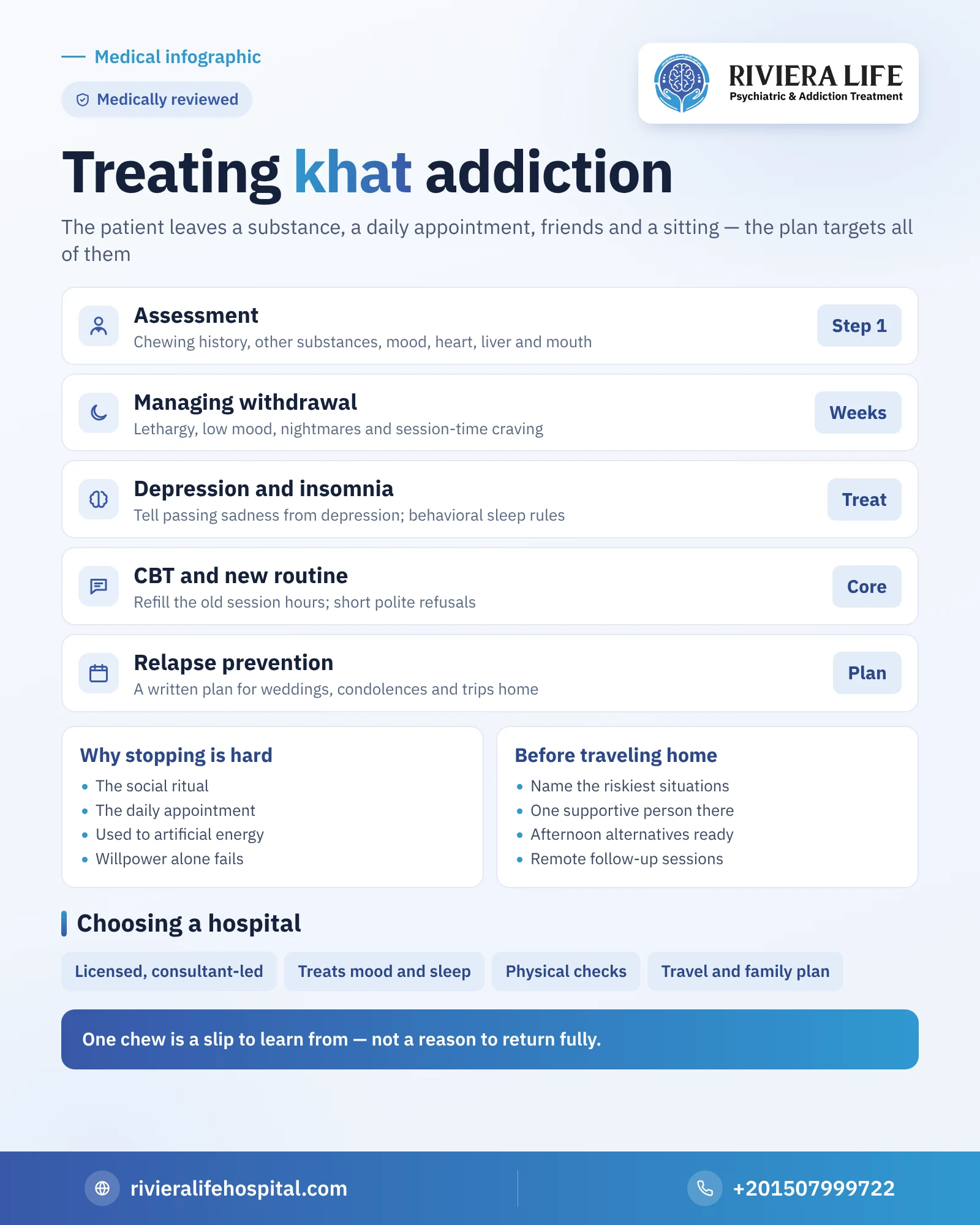
Treatment usually passes through successive stages, whose length varies from patient to patient:
- Assessment: the chewing history and number of hours, other substances alongside it, the psychological state, and checks of blood pressure, the heart, liver function and the health of the mouth and digestive system.
- Stopping and managing withdrawal: a few weeks in which the team follows mood, sleep and craving.
- Psychological and behavioral therapy: the heart of the program, lasting weeks to months.
- Rebuilding routine and preventing relapse: a practical plan for the old session hours and for occasions and travel.
- Follow-up after treatment: periodic meetings that gradually decrease as recovery stabilizes.
Managing withdrawal: the first days without the session
In the first days after stopping, the patient usually complains of severe lethargy and wanting to sleep during the day, low mood and irritability, disturbing nightmares at night, and a strong urge to chew as session time approaches. In most cases these symptoms don’t threaten life, and ease gradually over days to a few weeks.
The medical team’s role here isn’t to prevent the symptoms entirely, but to make them bearable and safe: organizing sleep and meals, daily movement, monitoring mood closely, and treating constipation or stomach problems that may change after stopping. Many patients are surprised that the hardest days aren’t the first ones, but those that follow, when the enthusiasm disappears and the emptiness remains, and this is where the next stage begins.
Treating depression and insomnia after stopping khat
Stopping khat sometimes reveals a depression that existed before it and was hidden behind the energy of the session, and sometimes low mood arises from the brain having grown used to daily stimulation. In both cases the psychiatrist distinguishes between temporary sadness that improves with time and a depression that needs organized treatment, and the list of depression symptoms helps you notice the difference. The doctor may prescribe suitable medicines for depression or anxiety when needed, and follow their effect, since there is no approved medicine that treats khat addiction itself; medicine is used only to treat the accompanying symptoms.
Sleep needs patience, because years of late nights disrupt the body clock. Treatment is built on fixed sleep rules: a single wake-up time, exposure to daylight, reducing the caffeine and soft drinks that used to accompany the session, and avoiding long naps. Cognitive behavioral therapy for insomnia is used, and you will find the medication and psychological options for mood set out in our article on depression treatment. Behavioral treatment for insomnia comes before considering sleeping pills, which are only used on the doctor’s decision and for a set period, so that one dependence isn’t swapped for another.
Cognitive behavioral therapy and changing the social routine
Cognitive behavioral therapy helps the patient spot the moments when craving ignites, and the thoughts that precede them, such as “I won’t get anything done without khat” or “my friends will think I’ve become too proud for them”. Then they practise answering these thoughts and behaving differently in that moment.
The most important side is filling the old session hours. Some of the ideas we work on with patients:
- Turning session time into another fixed activity: team sport, an educational course, or extra work.
- Keeping relationships while changing the place: meeting friends for lunch or at a café instead of the chewing sitting.
- Practising short, polite refusal phrases that need no long justification.
- Tracking the money that used to be spent daily and directing it to a tangible goal the patient can see.
Preventing relapse when traveling to a country where khat is sold
This point is specific to khat patients, as many return to Yemen, Ethiopia, Kenya or elsewhere in the holidays, where khat is available on every street and a bundle is offered as hospitality. Before travel we set out a written plan with them that includes:
- Identifying the riskiest situations in advance: weddings, condolences and visits to family elders.
- Choosing at least one person in the country who knows about the decision to stop and supports it.
- Preparing alternatives for the afternoon hours before arriving, not after.
- Remote follow-up sessions during the travel period, and a review session right after returning.
- Agreeing on what the patient does if they chew once: they count it as a slip to learn from and call their team, not a reason for a full return.
Treating Yemeni and Gulf patients in Egypt
Patients from Yemen, the Gulf states and the Horn of Africa come to Egypt seeking treatment away from the pressure of their daily surroundings and the eyes of acquaintances. Distance from the place where the sessions are held makes the first weeks much easier, but it needs planning for the return phase. So in the plan we take dialect and customs into account, involve the family even remotely, and arrange follow-up after the return home. The data of the patient and their family remain completely confidential.
The right hospital for khat addiction treatment: how to choose
The right hospital for khat addiction treatment is one that understands the patient needs psychological and behavioral treatment that reorganizes their daily life, more than they need detox. Ask before you choose:
- Is the hospital licensed, and is treatment supervised by consultants in psychiatry and addiction treatment?
- Does it assess and treat depression, insomnia and psychotic symptoms, not only the urge to chew?
- Does it check the heart, blood pressure, liver and mouth, the organs khat affects?
- Does it offer structured cognitive behavioral therapy and a plan for changing the social routine?
- Does it set a clear plan for preventing relapse when traveling to a country where khat is sold?
- Does it follow the patient after discharge and involve their family even if they are in another country?
And beware of any provider promising a guaranteed recovery rate or a final cure within days.
How Riviera Life meets these standards
At Riviera Life, these criteria take the following form:
- Official licensing: a hospital licensed by the Egyptian Ministry of Health.
- Long experience: fourteen years in addiction treatment, and thousands of recovered cases.
- Specialist consultants: psychiatrists and addiction specialists who treat the depression and insomnia that accompany stopping khat.
- Constant medical supervision: round-the-clock monitoring every day of the week during the stay.
- Treatment that rebuilds the day: behavioral sessions focused on the old session hours and social situations.
- A family program: sessions that help relatives give support, in person or remotely.
- Aftercare: follow-up after discharge and a dedicated plan for travel periods.
- Complete confidentiality: full privacy for patients coming from inside or outside Egypt.
The first consultation is free, and you can contact us around the clock on +201507999722, or visit us in Sheikh Zayed, Giza.
More from our khat guide
- Khat: the complete guide
- Flakka and synthetic cathinones
- Flakka addiction treatment
- Amphetamines
- The harms of khat: its effect on the mouth, digestion, liver, heart, sex and mind
- Khat addiction symptoms: signs the family sees and when a habit becomes addiction
- Khat withdrawal symptoms: the timeline, depression, nightmares and how to get through them
- The difference between khat and hashish: effects, risks, dependence and withdrawal
- How long khat stays in the body: urine, blood and hair, and does it show in a test?
Questions many people ask
There is no approved medicine that treats khat dependence itself. The doctor may prescribe medicines for depression or anxiety if needed, while the core treatment rests on psychological and behavioral sessions.
They peak in the first days and ease gradually over days to a few weeks. The craving tied to session time may last longer, and behavioral therapy treats it.
Not always. Many cases are treated with a regular outpatient program, but with severe depression, psychotic symptoms or khat mixed with other substances, a stay may be safer.
With a written plan before traveling that identifies the riskiest situations, a supportive person in the country, alternatives for the afternoon hours, and remote follow-up during the holiday and right after returning.
Look for official licensing, consultants who treat the depression and insomnia that follow stopping, physical checks for the heart, liver and mouth, structured behavioral therapy, a travel relapse plan and aftercare that involves the family. Riviera Life in Sheikh Zayed meets these criteria, with complete confidentiality.