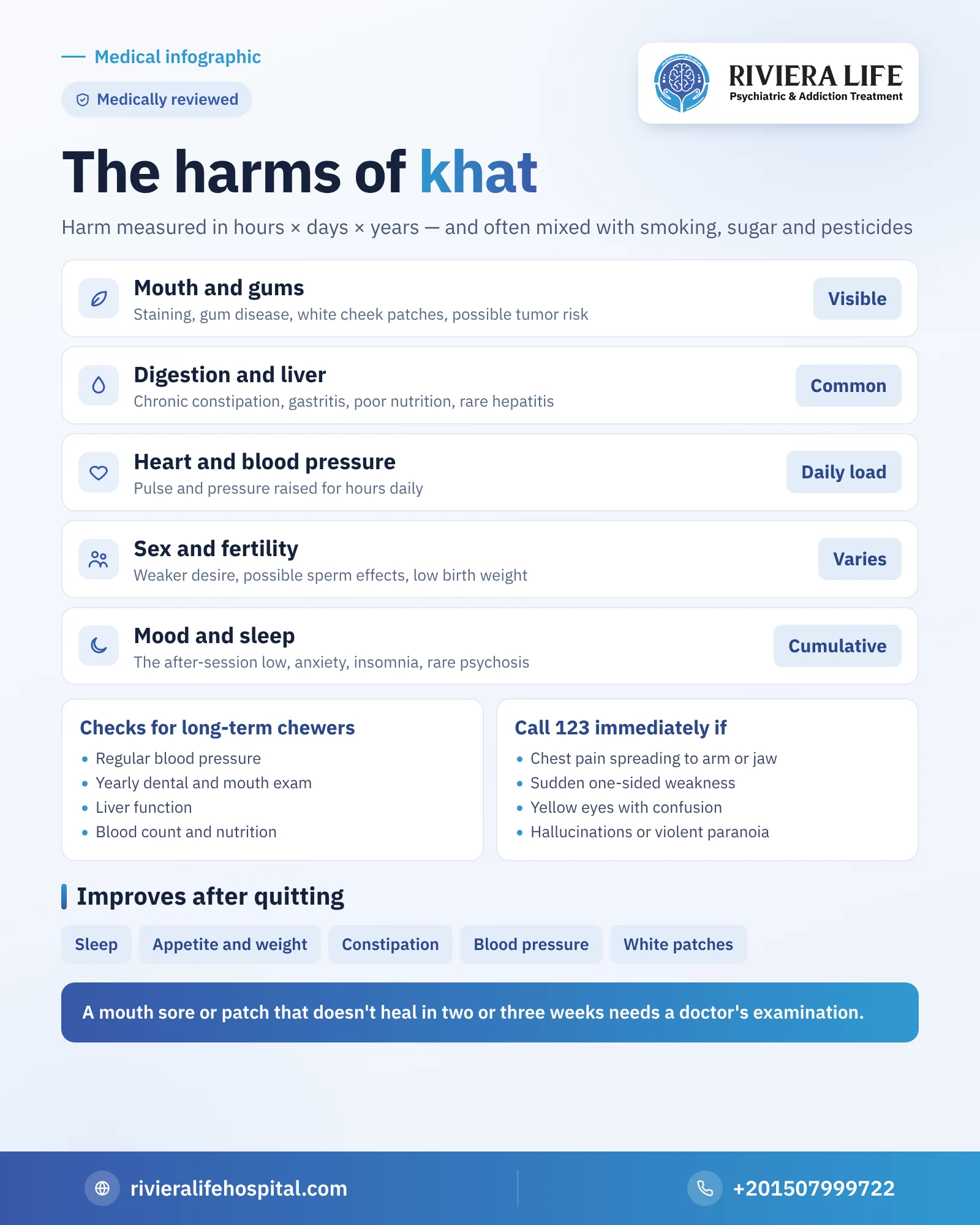
The harms of khat don’t appear in the first session or the tenth; they build up slowly with every hour the leaves stay in the cheek, and every night that sleep is delayed. The effect starts in the mouth and gums, then extends to the stomach, intestines and liver, raises blood pressure for hours every day, and may touch sexual desire, fertility and pregnancy, as well as mood, sleep and the household budget. In this article we go through the body’s systems one by one, distinguish between what is scientifically established and what is still being researched, and explain which of these harms improve after stopping.
Why do the harms of khat build up quietly?
The active substance in khat reaches the blood slowly and at a lower concentration than stimulant pills, which is why the chewer doesn’t feel an immediate danger. But the harm here isn’t measured by the strength of one session, but by the number of hours multiplied by the number of days multiplied by the number of years. A man who has chewed for four hours a day for twenty years has spent thousands of hours with his pulse raised, his mouth dry and his intestines slow.
Added to that is what usually accompanies a session: cigarettes or shisha, sweetened soft drinks, and residues of pesticides that may be sprayed on the bushes to speed their growth. So it is sometimes hard to separate the effect of khat alone from the effect of these habits, a point medical sources state frankly.
The mouth and gums: what does the cheek wad do?
Teeth and gums
Constant friction from the leaves and small twigs, together with the dry mouth khat causes, creates a suitable environment for gum problems. Dentists notice brown or greenish staining of the teeth in chronic chewers, gum inflammation and light bleeding when cleaning, receding gums on the side where the wad is stored, and sometimes wear on the tooth surfaces. Sugar in the accompanying drinks increases the risk of decay.
White patches on the inside of the cheek
One of the best-known signs of long-term chewing is a white, thickened patch on the lining of the cheek on the chewing side. Most of these patches are benign and may fade after stopping, but the doctor monitors them, because some white patches in the mouth in general can change over time.
Does khat cause mouth cancer?
This question hasn’t been settled. Some studies have linked long-term chewing with tumors of the mouth, head and neck, but many chewers also smoke, and smoking is a known cause of mouth cancer, so it is hard to separate the two effects. The cautious position, then: the risk is possible but not proven with certainty, and combining khat with smoking probably raises it. The practical rule is that any ulcer, patch or swelling in the mouth that doesn’t heal within two or three weeks needs examination by a doctor.
The digestive system: from constipation to poor nutrition
Khat activates the part of the nervous system that slows the intestines, which is why chronic constipation is one of the most common complaints among chewers, along with bloating, hemorrhoids and anal fissures. Many also complain of heartburn, upper abdominal pain and gastritis, made worse by swallowing the juice for hours and drinking a lot of soft drinks and tea during the session.
As for appetite, it all but switches off during the hours of chewing, and many chewers eat a quick lunch before the session and then eat almost nothing until night. Over the years this leads to weight loss, deficiencies in iron and some vitamins, and fatigue the person can’t explain.
The liver: signals worth noticing
Medical reports have been published of cases of hepatitis in khat chewers, some of which progressed to liver failure needing urgent treatment, some improving after stopping and then recurring on returning to chewing. The mechanism isn’t fully understood, and researchers suggest possibilities including a direct effect of the plant’s components or the effect of pesticides left on the leaves. The cases aren’t common, but they are serious when they happen, and their signs are: yellowing of the eyes or skin, dark urine, pain in the right side of the abdomen, and severe fatigue. Anyone who chews khat and takes medicines that affect the liver, or drinks alcohol, needs their liver function monitored.
The heart and blood pressure
In every session the pulse and blood pressure rise, and stay raised for hours. In a healthy young man this may have no clear effect, but in someone with high blood pressure, diabetes or a family history of heart disease, this daily rise becomes an extra burden on the arteries. Studies from Yemen and the Horn of Africa have linked heavy chewing with a higher likelihood of heart attacks, and some have linked it with stroke, with researchers cautious about the role of accompanying smoking. Someone taking blood pressure medicines may find their readings don’t settle as long as they chew daily, because the medicine is fighting a substance that raises blood pressure every afternoon.
Sexual and reproductive health
Some chewers believe khat strengthens desire, and they may feel energetic at the start of a session. But what doctors observe with chronic use is different:
- In men: complaints of declining desire and weaker erections over time, and limited studies point to a possible effect on sperm count and motility. The evidence here isn’t conclusive, but it points in one direction.
- During pregnancy: studies have linked a mother chewing khat with low birth weight, probably because of narrowing of the vessels that supply the placenta and the mother eating less on chewing days.
- During breastfeeding: the active substances pass into breast milk, so a breastfeeding mother is advised not to chew.
And the repeated late nights after a session leave their own mark on the marriage, no less than the physical effect.
Mental health: after the high
The other side of the cheerfulness at the start of a session is what chewers call the “low” or the “gloom” at its end: silence, repetitive thinking and low mood. With daily repetition this dip can turn into chronic anxiety or depression, and the reverse may be true for some, who turn to khat in the first place to escape a low mood. With overuse and constant late nights, suspicion, mistrust and persecutory ideas can appear, resembling what our article on paranoia explains, and sometimes a full psychotic episode, especially in those with a genetic predisposition or a previous mental disorder. These symptoms usually settle with stopping and treatment, but they aren’t something to wait out until they pass by themselves.
Sleep: the harm that feeds all the others
Insomnia after a session is almost the rule. The chewer falls asleep near dawn and wakes late and heavy, so their concentration at work or study weakens, they become more irritable with their family, and they wait for the afternoon session to get their energy back. Chronic lack of sleep itself raises blood pressure, increases anxiety and weakens immunity — in other words, it multiplies the other harms. Some turn to sleeping pills or sedatives to sleep after the session, entering a cycle of a stimulant by day and a sedative by night, one of the most dangerous cycles. Our guide to insomnia explains how sleep problems are treated without relying on pills.
Family, money and work
A daily session from the afternoon until sunset means the father or husband is absent from home in the hours when the family needs him most: the children’s homework, a shared dinner, and talking about household matters. Then he comes back silent or tense, or stays up until dawn. Many wives speak of feeling that khat is a “partner” taking their husband’s time and attention.
As for money, the daily bundle may seem small, but added up over a month or a year it takes a noticeable share of the family’s income, and may come at the expense of food or the children’s education. At work, the effect shows in morning lateness and weaker productivity in the first half of the day.
Tests needed by someone who has chewed khat for years
Many chewers accept talking about health more readily than talking about addiction. These are reasonable tests to discuss with the doctor:
- Regular blood pressure measurement, and an ECG when there are symptoms or risk factors.
- An examination of the teeth, gums and mouth lining at least once a year.
- Liver function tests, especially with fatigue or other medicines.
- A full blood count and an assessment of weight and nutrition.
- An assessment of mood and sleep with a psychiatrist if anxiety or depression is present.
Signs that call for an ambulance
Call an ambulance immediately on 123 if you see
Acute complications are rare, but they happen, especially in people with heart disease and high blood pressure, or when khat is mixed with other stimulants.
- Chest pain spreading to the arm or jaw, with a cold sweat
- Sudden weakness in one side of the body, a drooping face or slurred speech
- Severe yellowing of the eyes with confusion or abnormal drowsiness
- Hallucinations or paranoia driving towards violence or self-harm
Do the harms of khat go away after stopping?
The good news is that many of them improve. Sleep becomes regular within weeks, appetite and weight return, bowel movement improves, blood pressure readings fall for many, and the white patches in the cheek may fade. But receding gums and worn teeth need treatment by a dentist because they don’t recover on their own, and liver or heart damage, if it has happened, needs long follow-up.
To learn the signs that chewing has turned into addiction, see our article on khat addiction symptoms; the steps to stop and treatment are explained in khat addiction treatment. At Riviera Life we begin with a comprehensive health check before any plan, because what the check reveals is often the real motivation to stop.
More from our khat guide
- Khat: the complete guide
- Khat addiction symptoms
- Khat withdrawal symptoms
- Khat addiction treatment
- How long khat stays in your system: urine, blood, hair and whether it shows in a test
- The difference between khat and hashish: effects, risks, dependence and withdrawal
- Khat and sex: what happens to desire, erections, sleep and marriage
Questions many people ask
This hasn't been settled. Some studies have linked long-term chewing to mouth tumors, but accompanying smoking makes it hard to separate the two effects, and combining them probably raises the risk.
Yes. It raises the pulse and blood pressure throughout the hours of a session, an extra burden on people with high blood pressure and heart disease, and it may stop their readings settling despite medication.
Limited studies point to a possible effect on sperm, and some chronic chewers complain of weaker desire and erections over time, though the evidence isn't conclusive.
Chewing khat during pregnancy has been linked to low birth weight, and its substances pass into breast milk, so it is advisable to avoid it during pregnancy and breastfeeding.
Many improve, such as sleep, appetite, constipation and blood pressure, within weeks to months. Receding gums, worn teeth and any liver or heart damage need treatment and follow-up.