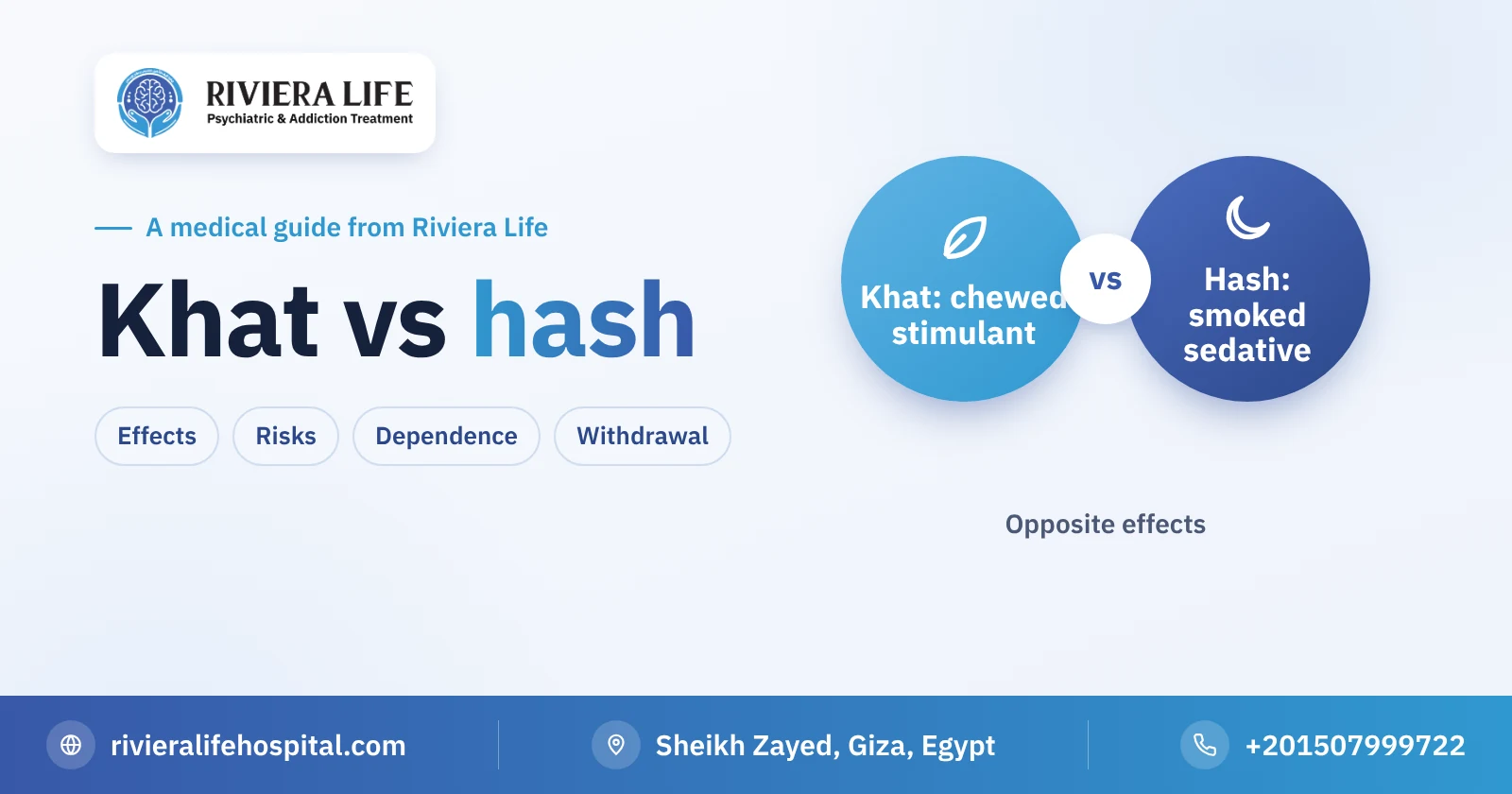
The difference between khat and hash is greater than those who put them in one basket think. Both are plants used to affect mood, but they are completely different substances. Khat is a leaf that is chewed and contains cathinone, a stimulant that raises activity and pulse and reduces sleep and appetite. Hash is a compressed resin from the cannabis plant, usually smoked, and its active substance THC sedates, distorts perception and slows thinking. This article compares them in effect, risks, dependence, withdrawal and treatment, without treating either as “lighter” in the sense of safe.
What are they in the first place?
Khat (Catha edulis) is a shrub that grows in Yemen and the Horn of Africa; its leaves and tender twigs are picked and chewed fresh, then stored in the cheek for hours. Hash is extracted from the cannabis plant (Cannabis sativa): resins are collected from the flowers and pressed into slabs, and it is usually smoked in a cigarette or shisha. In other words, one is a living leaf that is chewed, and the other a processed resin that is burned. To read more about the first, the khat guide helps, and about the second, the hash guide.
The active substance and how it works in the brain
Cathinone in khat resembles amphetamine in how it works: it pushes the brain to release dopamine and noradrenaline, so activity and attention rise. THC in hash binds to the body’s own cannabinoid receptors spread through areas of memory, coordination and pleasure, so it changes the sense of time and concentration and slows movement. The result is that one raises arousal and the other lowers it, although each can reverse the picture at large amounts: anxiety and panic may occur with hash, and suspicion and psychosis with khat.
The effect the user and those around them notice
| Aspect | Khat | Hash |
|---|---|---|
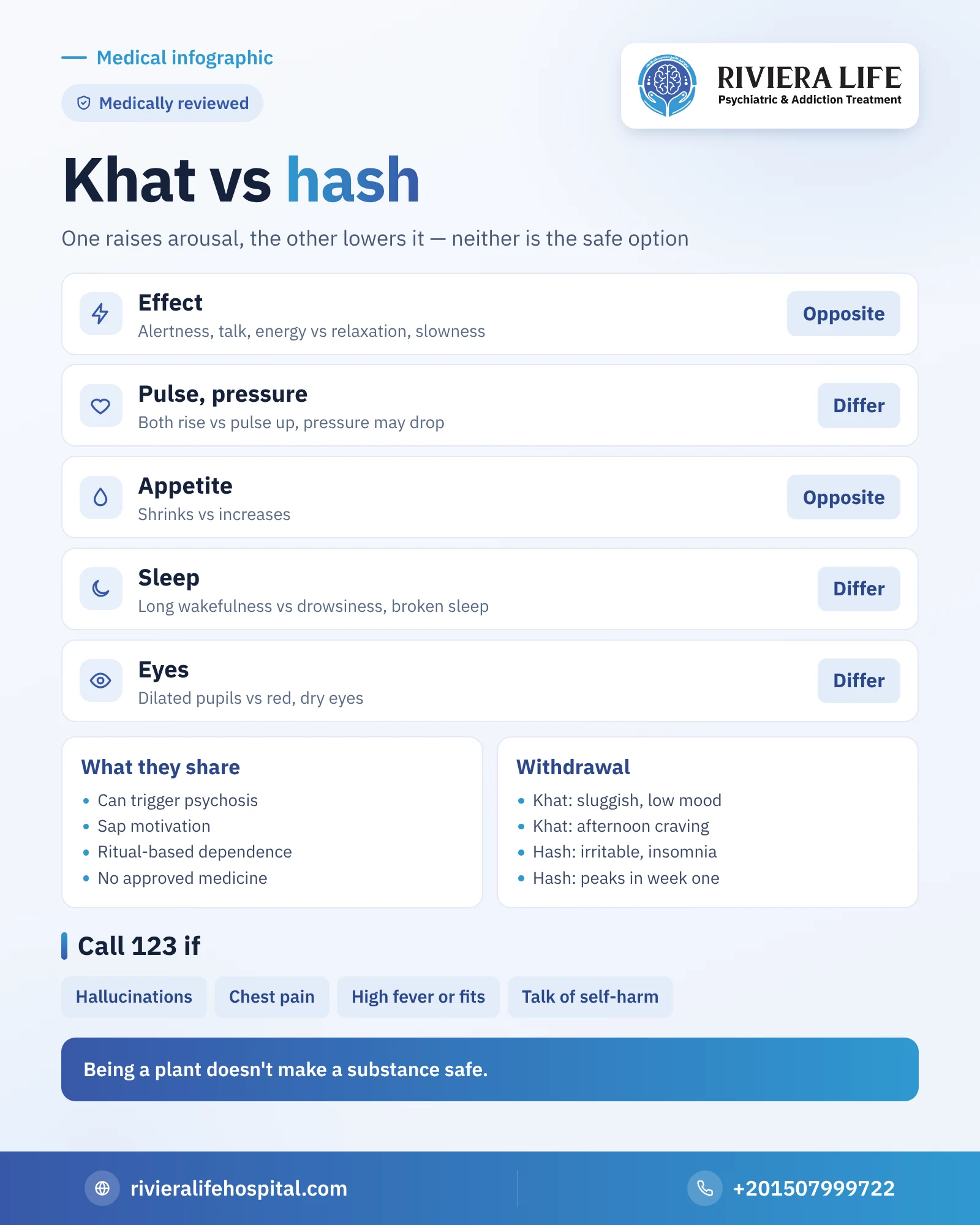
| Nature of the effect | Stimulant: alertness, much talking and energy | Sedative that distorts perception: relaxation, slowness and laughter |
| Pulse and blood pressure | Usually both rise | Pulse rises temporarily, and blood pressure sometimes drops on standing |
| Appetite | Shrinks | Increases |
| Sleep | Staying up long | Drowsiness, then broken sleep with long-term use |
| Eyes | Dilated pupils | Redness and dryness of the eyes |
| Method of use | Chewing for hours in a session | Smoking or shisha |
The health risks of each
Khat
It strains the heart and blood vessels by raising pulse and blood pressure, harms the gums and mouth, causes constipation, loss of appetite and malnutrition, and may be linked to liver problems with long chewing. It damages sleep and family relationships because of the hours of the session. You will find the details in the harms of khat.
Hash
It affects short-term memory, concentration and motivation, irritates the lungs with smoke, raises the risk of anxiety and panic, and may hasten the onset of psychosis in those predisposed. The articles on the harms of hash explain the full picture.
What the two share
Despite the difference, they agree in matters that mustn’t be ignored. Both may trigger psychosis with psychological predisposition or large amounts. Both weaken motivation and achievement over time. And both may lead to psychological dependence that revolves around the ritual, not the substance alone: the afternoon session for khat, and the evening joint for hash. There is nothing today that justifies saying either one “isn’t addiction”, as substance use disorders that doctors treat have been documented for both.
Dependence: how does it differ?
Khat dependence is more behavioral and social than physical. The session becomes a fixed appointment around which the day, friends and money revolve, so someone who stops can’t imagine the afternoon without it. Hash dependence combines the psychological side with a mild physical one: the regular user needs a larger amount for the same effect, and feels irritability, anxiety and insomnia when stopping. Someone who uses both together finds stopping harder, because each substance makes up for the absence of the other.
Withdrawal: what happens when you stop?
Khat withdrawal is dominated by sluggishness, long sleep, low mood, nightmares and a craving timed for the afternoon, and settles in days to a few weeks; the article on khat withdrawal symptoms details it. Hash withdrawal comes with irritability, insomnia, vivid dreams, poor appetite, anxiety and mild sweating, and peaks in the first week, as hash withdrawal symptoms explains. Both rarely threaten life physically, but low mood and thoughts of despair deserve to be taken seriously.
The social picture: why do people take both lightly?
Each passes behind a social mask that lowers caution. In the areas where it is chewed, khat is considered a group habit like drinking tea, so a teenager joins the session among adults before realizing it is drug use. And hash is presented in some circles as “natural” because it is a plant, so its danger is underestimated. The truth is that a substance being a plant doesn’t make it safe: cathinone and THC are substances with a strong effect on the brain, and their concentration and how they are used determine the risk, not their plant origin.
If khat and hash are combined in one session
Some people combine the stimulant and the sedative, thinking one balances the other. This combination confuses the body more than it balances it: the stimulant raises the heart and blood pressure, and the sedative hides the signs of strain from the person, so they don’t notice that their pulse has gone beyond the limit. The likelihood of a panic attack and suspicion also increases, and it becomes hard to judge which substance caused the symptom when going to the emergency department. If symptoms appear after combining, tell the doctor everything you took without embarrassment, as accuracy here saves precious time. The article on mixing drugs covers the dangers of mixing in general.
Psychosis and mental health
The relationship with psychosis deserves a pause. Khat is known to sometimes trigger a paranoid state with hallucinations after excess, which usually goes after stopping and sleeping. With hash, heavy and early use has been linked to an increased risk of psychosis and schizophrenia in those predisposed, and the symptoms may not go after stopping. If voices, strange suspicions or disorganized behavior appear, the question isn’t which substance it is, but when we get to a psychiatrist.
Call an ambulance on 123 immediately if you see
With khat, hash or a combination of them, especially if tramadol, alcohol or stimulants were added to them.
- Hallucinations or suspicion that drives violence or running away
- Chest pain or severe palpitations
- A very high temperature or seizures
- Severe confusion or loss of consciousness
- Talk of self-harm
Which is more dangerous?
A common question, and the honest answer is that there is no comparison that fits everyone. Khat is more dangerous for the heart, the digestive system and sleep, and hash is more dangerous for the lungs, memory and the development of the teenage brain. And both kill motivation. It is a mistake to justify one substance as lighter than the other, as the comparison concerns symptoms, not a verdict on safety. If either one is affecting your work, your relationships or your sleep, that is enough reason to ask.
Treatment: does it differ?
The two substances agree in the basics: a psychological and physical assessment, then cognitive behavioral and motivational therapy that deals with the ritual and the habit, treatment of accompanying depression or anxiety, then a relapse-prevention plan. There is no approved medicine that treats dependence on either one itself, and medicines are used to treat accompanying symptoms. The details differ: a khat chewer needs to restructure a whole day and a social environment, and a hash smoker needs to deal with insomnia, anxiety and smoking. For the steps, see khat addiction treatment and hash addiction treatment.
At Riviera Life your family can talk to a consultant in psychiatry and addiction in complete confidentiality, with a free first consultation on +201507999722.
More from the khat guide
Questions many people ask
Khat is a leaf that is chewed, a stimulant through cathinone. Hash is a cannabis resin that is smoked, a sedative that distorts perception through THC.
No comparison fits everyone: khat has a stronger effect on the heart, sleep and digestion, and hash on the lungs, memory and the teenage brain, and both may cause psychosis.
Yes, each has documented psychological and behavioral dependence, which doctors treat with cognitive behavioral and motivational therapy, with no approved medicine for the dependence itself.
They are alike in mostly not being life-threatening, but khat withdrawal is dominated by sluggishness and depression, and hash withdrawal by irritability, insomnia and poor appetite.
No. It confuses the body, hides signs of strain on the heart and increases the risk of panic and suspicion.