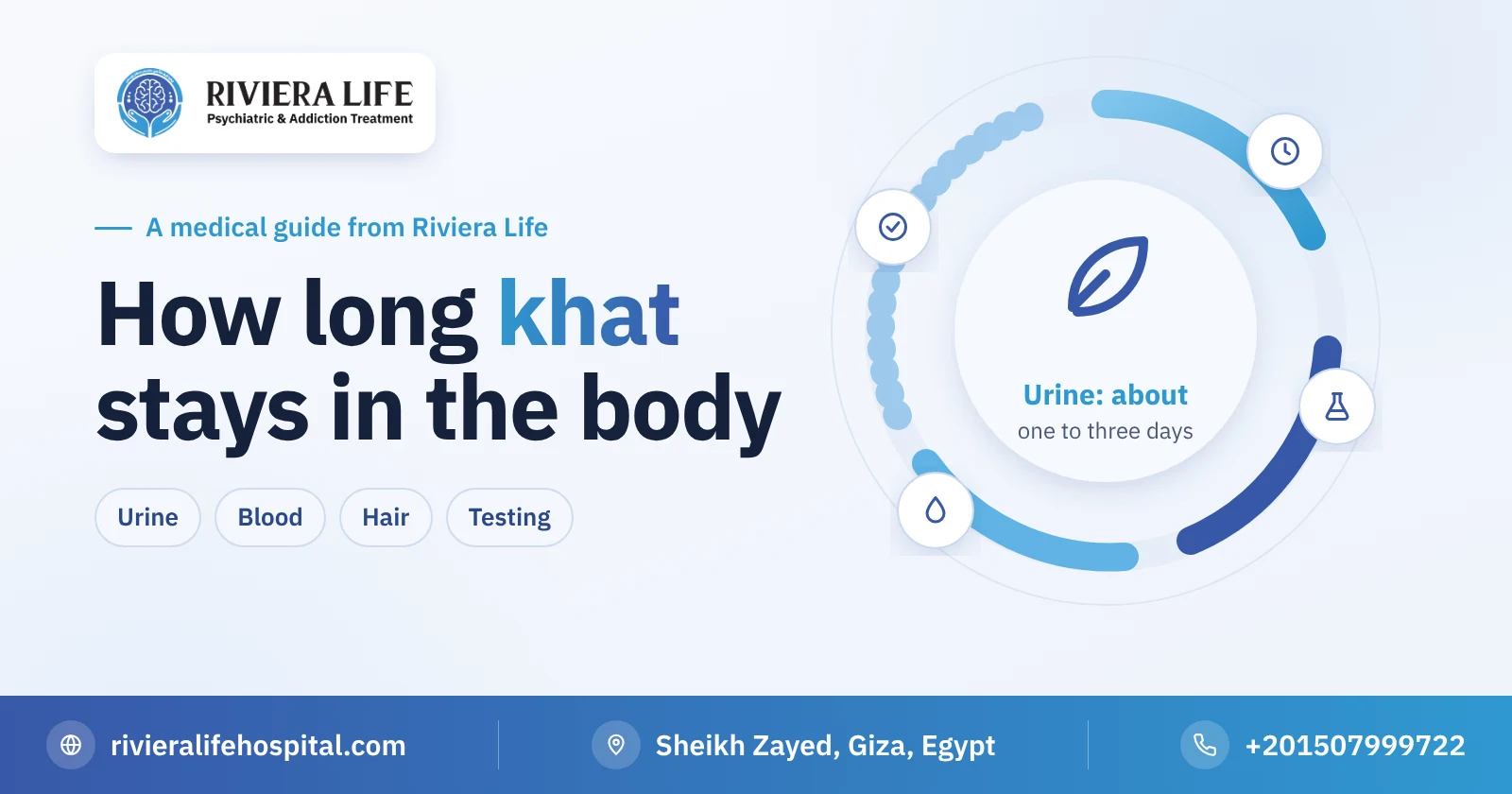
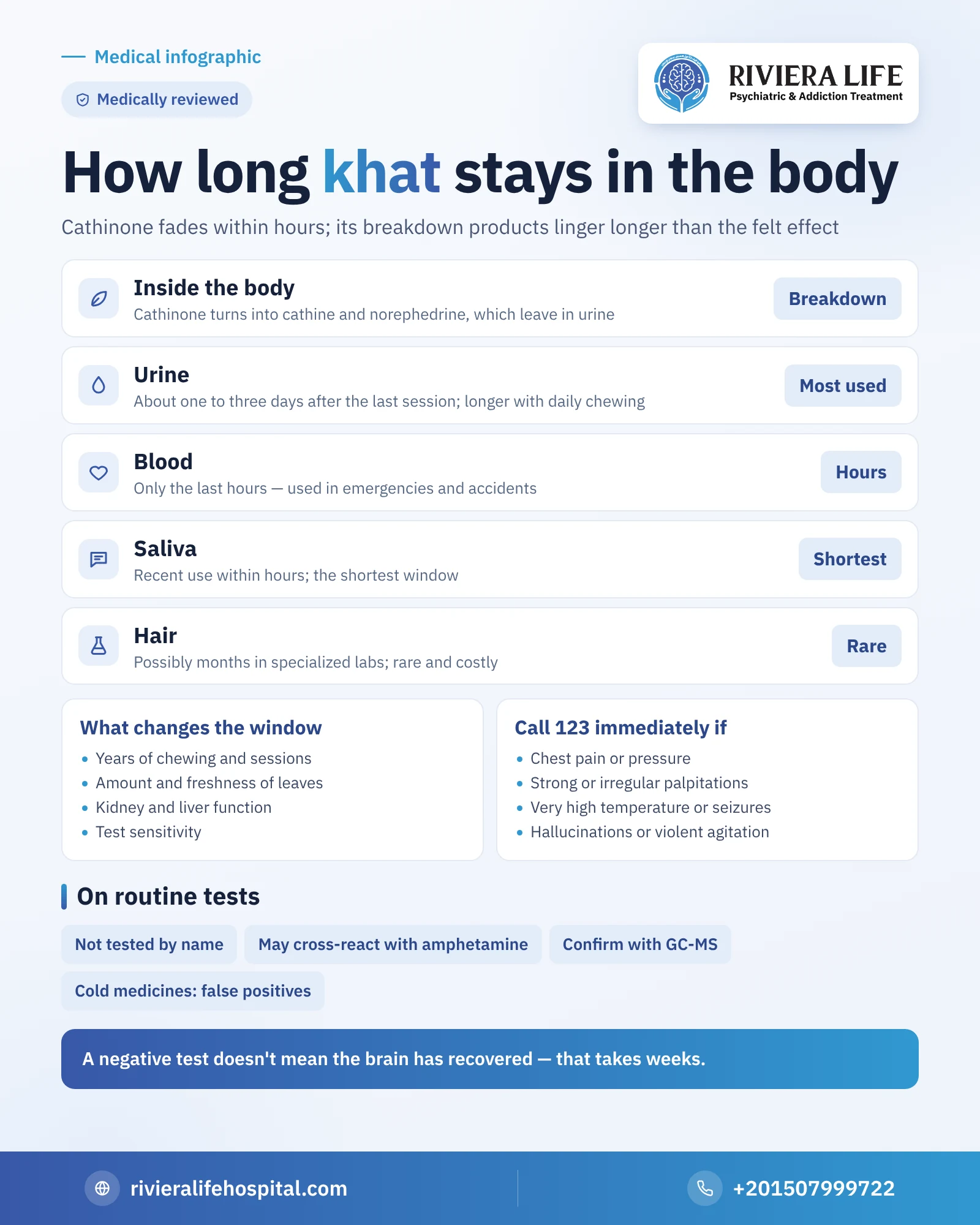
The time khat stays in the body is relatively short compared with many drugs: its active substance, cathinone, breaks down quickly, halving within a few hours, while another related substance, cathine, stays a little longer. Traces of chewing can usually be detected in urine for about one to three days after the last session, and longer in someone who chews daily.
But the picture isn’t that simple, as routine panels don’t test for khat by name, and some tests may pick up substances with a similar structure. This article explains what happens to khat inside the body, the detection windows for each sample, and why the result changes from one person to another.
What happens to khat leaves inside the body?
When chewing, part of the active substance dissolves in saliva and is absorbed through the mouth and stomach. Cathinone is the strongest stimulant component, but it is chemically unstable. Within hours it turns in the body into weaker compounds, most notably cathine (norpseudoephedrine) and norephedrine, which leave with the urine. That is why testing mostly relies on looking for cathine and the breakdown products rather than cathinone itself, because it fades too quickly to be caught.
The state of the leaves themselves affects the picture. Fresh leaves are richer in cathinone, and lose a large part of it with drying and storage as it turns into the weaker cathine, which is why chewers insist on “fresh” leaves. This difference explains why the amount of leaves alone isn’t enough to predict what will show on a test.
Half-life: why are its figures only an indicator?
Studies suggest that the half-life of cathinone is very short, around one to two hours, while the half-life of cathine extends to several hours. That is why the stimulant effect calms down a few hours after the session ends, but the breakdown products stay in the urine much longer than the felt effect. So the subjective feeling isn’t a reliable guide: the person may feel that “the khat has left” while it is still detectable. The exact figures vary by study, amount and method of measurement, so don’t treat them as guaranteed limits.
The detection window by sample type
The following figures are approximate for someone who uses khat repeatedly, not once, and vary by lab and the sensitivity of the equipment:
Urine
This is the most widely used sample, and khat’s breakdown products can appear in it for about one to three days after the last session. In someone who has chewed every day for years, the period may extend slightly. Concentrations are affected by the acidity of the urine, the amount of fluids and the time the sample is taken.
Blood
It reflects only the last few hours, and is used in emergencies or accidents to explain confusion, psychosis or a severely fast heart. Its window is measured in a few hours to about a day.
Saliva
It can detect recent use within hours, the shortest window, and isn’t used much outside rapid tests.
Hair
In highly specialized labs, khat’s breakdown products may be detected in hair for months, but it is a rare and expensive test and doesn’t determine the time of use precisely.
Does khat show up on a regular drug test?
The short answer: not reliably. Routine panels, including rapid strips, are designed for amphetamines and their derivatives, and cathinone and cathine are close to them in molecular shape, so some may give a weak positive result and some may not, depending on the type of test and the manufacturer. That is why, when needed, a confirmatory test using chromatography and mass spectrometry is requested to distinguish between substances precisely. Conversely, some cold medicines containing pseudoephedrine may give a false positive for amphetamine, which is why no legal or employment decision is based on a single preliminary result.
Factors that change the period from person to person
- Years of chewing and number of sessions: daily chewing lengthens the window compared with an occasional session.
- The amount and freshness of the leaves: a larger amount and fresher leaves mean more substance.
- Kidney and liver function: weakness in them slows elimination.
- Body fluids and urine acidity: change the concentration, not the presence.
- Test sensitivity: each lab has a minimum detection threshold that differs from the next.
- Other substances: mixing khat with stimulants or sedatives complicates interpreting the result.
When is a khat test requested?
The test isn’t usually requested out of curiosity, but in specific situations: in emergencies when someone arrives with a panic attack, psychosis or a very fast heartbeat and the cause isn’t known; in addiction treatment programs for follow-up and to confirm commitment; and in some medical checks for work or travel in countries whose law bans khat. If the person takes certain medicines, they should tell the doctor and the lab before the test so the result is read with awareness.
A single session or daily chewing?
The difference between the two is big, both in the test and in the body. Someone who chewed once on a single occasion has few breakdown products in their urine, and they disappear quickly, usually within a day or two. But someone used to a daily session lasting three or four hours takes in accumulating amounts, so breakdown products build up in their body and their detection may extend for longer. And the short window with occasional chewing doesn’t mean it has no effect: disturbed sleep the following night, raised blood pressure and suppressed appetite may last longer than the substance’s presence in the urine.
What can the family gain from this information?
A family that suspects a relative is chewing khat tends to rely on the test alone. But a negative test doesn’t rule out intermittent chewing, and a positive one doesn’t measure the severity of dependence. It is more useful for the family to notice the pattern: absence in the afternoon hours, frequent outings to certain gatherings, staying up until dawn, and lethargy in the morning. These observations are what the doctor builds the assessment on, and the test result completes the picture when needed.
Khat and the law in Egypt
Khat and the substance cathinone are listed as controlled substances in many countries, including Egypt, and possessing or trading it carries legal liability. This is general information and no substitute for consulting a lawyer, but the important point here is that knowing how long khat stays in the body isn’t a basis for planning behavior that breaks the law. You will find wider background on its legal status in our guide to khat.
There is no reliable way to speed up elimination
Recipes promising to “cleanse the body” within a day are widespread online: drinks, herbs and huge amounts of water. There is no scientific evidence that any of them work, and drinking too much water may upset the balance of salts in the blood, a dangerous condition. The body gets rid of khat with time, the kidneys and the liver, and no mixture replaces that. Someone who wants to stop would do better to ask for medical help than for a trick, because the real problem isn’t the hours of the test but the habit of a day that revolves around the session.
Khat leaving the urine doesn’t mean the brain has recovered
The test may become negative after days, but a brain used to daily stimulation needs weeks to regain its balance, and someone who stops goes through lethargy, long sleep, low mood and a craving that returns at the time of the session. These stages are detailed in our article on khat withdrawal symptoms. And if chewing has become a burden, read khat addiction symptoms to know its signs, then khat addiction treatment for the steps to recovery.
Signs that need an ambulance
Call an ambulance on 123 immediately if you see
Khat raises the pulse and blood pressure and agitates the nervous system, and may be mixed with other stimulants.
- Pain or pressure in the chest
- Strong palpitations or an irregular heartbeat
- A very high temperature or seizures
- Hallucinations, paranoia or violent agitation
- Fainting or confusion that doesn’t clear
More from our khat guide
Questions many people ask
Usually about one to three days after the last session, and the period may be slightly longer in someone who has chewed daily for years.
Not reliably. Some tests may pick up substances close to amphetamine, and a confirmatory test is needed to identify the substance.
Cathinone is the stronger stimulant and breaks down quickly; cathine is weaker and leaves the body more slowly. The first turns into the second as the leaves dry and in the body.
There is no proven method, and drinking too much water may be harmful. The body gets rid of it with time through the kidneys and liver.
Medicines containing pseudoephedrine may give a false positive on an amphetamine screen, which is why decisions aren't based on a single preliminary result.