Autism, or autism spectrum disorder, is a neurodevelopmental difference in the way the brain develops and works, showing in the style of communication and interaction with others, in repetitive or restricted interests and behaviors, and in the way sounds, lights and touch are received. It begins in early childhood and continues throughout life, but it differs greatly from person to person; some need intensive daily support, and some study, work and form a family and their autism is only discovered in adulthood.
Autism isn’t the result of wrong upbringing and isn’t caused by vaccines, and it isn’t an illness that one is cured of, but a different way of perceiving whose owner needs appropriate understanding and support. Only a specialized team can make the diagnosis after a comprehensive assessment.
What is autism spectrum disorder?
The word “spectrum” is the key to understanding. Autism isn’t a single picture, but a wide group of features brought together by two core traits: a difference in social communication, and repetitive or restricted patterns of behavior and interests. A three-year-old child who doesn’t respond to his name, doesn’t point to what he wants and lines up his toys in straight rows for hours, and a twenty-year-old woman who excels in mathematics, finds small talk in the office exhausting and needs headphones to block out the cafeteria noise; both are on the same spectrum.
The fifth edition of the American Diagnostic and Statistical Manual brought together under this name diagnoses that used to be separate, including Asperger syndrome, and describes severity in three levels according to the amount of support the person needs: support, substantial support, and very substantial support.
How common is autism?
The World Health Organization estimates that about one in every one hundred and twenty-seven people around the world was on the autism spectrum in 2021, with clear variation between studies, and higher rates recorded in countries that expand screening. It is diagnosed more in males than females, and it is likely that girls are diagnosed less because they often learn to hide difficulties and imitate others. The rise in figures in recent decades is attributed in large part to the broadening of the definition of autism and increased awareness and screening.
Early signs of autism by age
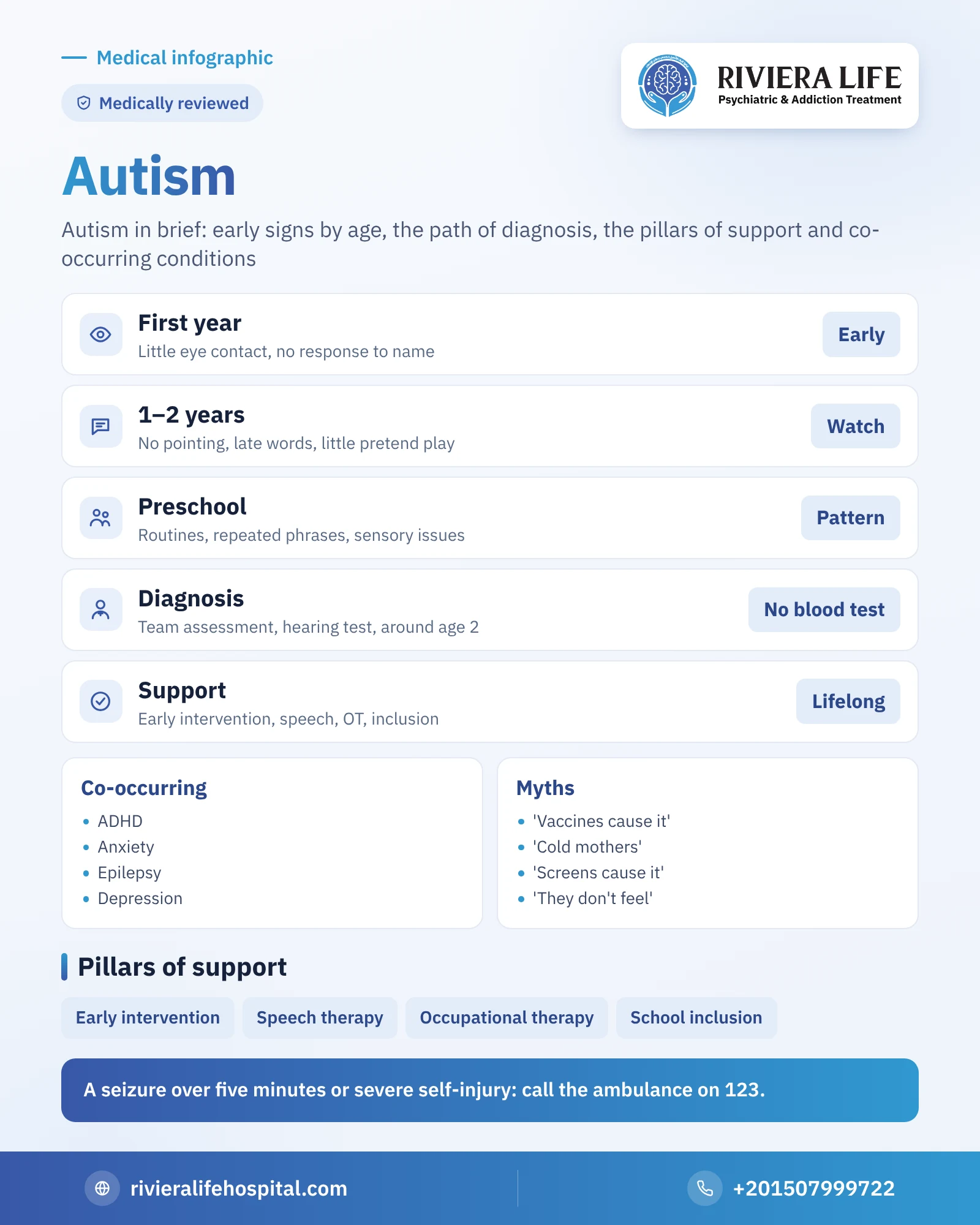
The appearance of a single sign doesn’t mean the child is on the spectrum; what matters is the repeated and persistent pattern. And any loss of skills the child had previously acquired deserves an immediate assessment.
In the first year
Little eye contact, a rare social smile, not responding to their name as the first year nears its end, and little babbling and exchange of sounds with the mother.
From one to two years
Not pointing with a finger to ask for something or to show something interesting, delayed first words, little imaginative play, and preoccupation with parts of a toy, such as spinning the wheel instead of playing with the whole toy.
At preschool age
Difficulty playing with other children, repeating words or phrases they have heard, a strong attachment to routine and emotional outbursts when it changes, repetitive movements such as hand-flapping or rocking, and excessive or reduced sensitivity to sounds, clothes and foods.
At school age and adolescence
Difficulty understanding jokes, hints and the unwritten rules of friendship, deep and focused interests in specific subjects, and talking at length about them, social exhaustion after the school day, and sometimes isolation or being bullied.
Causes of autism
Research confirms that genetics plays the largest role; autism recurs in families, and has been linked to a large number of genes, each contributing a small amount. Added to this are factors that raise the likelihood during pregnancy and birth, including very premature birth, older parents, and some medicines and infections during pregnancy. No single cause explains every case, and what is certain is that autism begins in the development of the brain before birth or shortly after it, not because of what the family does later.
Common myths about autism
The myth: vaccines cause autism. The truth: extensive research on millions of children has studied this claim, and the World Health Organization confirms that the measles, mumps and rubella vaccine doesn’t cause autism, and the study that started the rumor has been retracted. Skipping vaccination exposes the child to real serious diseases.
The myth: the cause is an emotionally cold mother or wrong upbringing. The truth: this is an old theory that has been completely dropped, and it caused mothers unjust guilt for decades.
The myth: screens cause autism. The truth: this hasn’t been proven, though reducing screens and increasing direct interaction is useful for language development in all children.
The myth: every autistic person is a genius, or every autistic person has an intellectual disability. The truth: intellectual abilities are spread across a wide range, as in non-autistic people.
The myth: people on the autism spectrum don’t feel or love. The truth: they feel deeply, but the way they express and read emotions may differ.
How is autism diagnosed?
There is no blood test or scan that confirms autism. The path usually begins with the observation of the parents or the pediatrician, and short screening questionnaires may be used at follow-up visits. Then a specialized team, which may include a child psychiatrist or pediatric neurologist, a psychologist and a speech therapist, carries out an assessment that includes a detailed developmental history, observing the child in play and communication, and standardized tests. The team always requests a hearing test to rule out hearing loss, and may request genetic tests or an EEG when needed. The diagnosis can be reliable at around the age of two in many children, and the earlier support begins, the greater the benefit.
Supporting the child on the autism spectrum
The aim isn’t to “erase” autism, but to enable the child to communicate, learn and be independent as far as they can, and to reduce what causes them distress.
Early intervention
Programs that begin in the first years, and involve the parents in training, achieve the best results in language and interaction. Their foundation is regular sessions and daily activities built into the home routine.
Speech and communication therapy
The speech therapist helps the child develop spoken language, or its alternatives when speech is delayed, such as pictures and augmentative communication devices. These alternatives don’t hinder speech as some parents fear; rather, they often support it.
Occupational therapy
It works on daily skills such as dressing, eating and writing, and on regulating the sensory response, helping the child who breaks down in noisy places or refuses particular clothes.
Behavioral and developmental approaches
These include programs based on applied behavior analysis and naturalistic developmental programs that follow the child’s interests in play. The best of them are those that respect the child, focus on skills meaningful to their life, and review their goals with the family continuously, not those that seek to hide every different behavior.
School inclusion
Many children on the spectrum learn in ordinary schools with adjustments: a classroom assistant, a visual timetable, a quiet corner, advance preparation for any change, and teachers who understand that a sensory meltdown isn’t bad manners. Some need specialized schools or classes, and the most suitable choice is determined by the child’s needs, not the name of the diagnosis.
Conditions that co-occur with autism
Autism often comes together with other conditions that need their own diagnosis and treatment:
- Attention-deficit hyperactivity disorder: very common with autism, adding difficulties with concentration and impulsivity. Its details are in the ADHD guide.
- Anxiety: among what most exhausts people on the spectrum, including specific fears and social anxiety. See the anxiety guide and the phobia guide.
- Epilepsy: more common in people on the spectrum than in the general population, and may begin in childhood or adolescence.
- Sleep disorders, digestive problems and food selectivity.
- Depression: especially in adolescence and adulthood, with the feeling of being different and isolated.
Is there a medicine for autism?
There is no medicine that treats the core traits of autism. But the doctor may prescribe medicines for specific symptoms that affect quality of life: some atypical antipsychotics for severe outbursts of anger, aggression and self-injury, ADHD medicines when it is present, treatments for anxiety and sleep, and epilepsy medicines when needed. The doctor chooses the medicine and follows its side effects, and no medicine is started, changed or stopped except with them. And beware of “treatments” promoted as curing autism, such as harsh diets, injections or unproven supplements; they cost a lot and may do harm.
Autism in adults
Many adults, especially women, weren’t diagnosed in childhood, and lived for years feeling like “strangers” without knowing why. The diagnosis may come after severe exhaustion, depression or a crisis at work, and many describe it as a moment of understanding and relief. Adults on the spectrum face challenges in job interviews, noisy work environments and relationships, but they usually have clear strengths such as precision, deep focus and honesty.
Some adults resort to alcohol or sedatives to ease social anxiety or sensory exhaustion, a road that may end in dependence. When autism comes together with substance use, the person needs a plan that takes into account their way of communicating and their sensitivity, as in the dual diagnosis program.
Family support
Many families go through a mixture of shock, sadness and confusion after the diagnosis, then begin a long journey of sessions, schools and decisions. Some of what helps:
- Learn your child’s own language: what calms them, what exhausts them, and how they express distress.
- A clear routine and advance preparation for any change, with pictures or a visual timetable.
- Celebrating strengths and interests instead of focusing only on difficulties.
- Not neglecting siblings, as they need time, attention and explanation suited to their ages.
- Parents caring for themselves, and connecting with other families living the same experience.
Depression and anxiety in the parents of children on the spectrum aren’t rare, and seeking psychological support for the parents is part of caring for the child themselves.
Related articles
- Attention-deficit hyperactivity disorder: the three presentations and treatment, and how it comes together with autism.
- Anxiety: its symptoms and treatment, and it is among what most often accompanies autism.
- Types of phobia: the specific fears common in children on the spectrum and their treatment by exposure.
- Obsessive-compulsive disorder: how compulsions differ from repetitive behaviors in autism.
- Cognitive behavioral therapy: an adapted therapy that benefits adults and adolescents on the spectrum with anxiety and depression.
- The difference between Asperger’s and autism
When does it become an emergency?
Autism itself isn’t an emergency, but some situations need immediate intervention.
Seek urgent help immediately if any of these appear
Call the ambulance on 123 or go to the nearest emergency department, and you can contact the mental health hotline on 16328, if you notice:
- A seizure lasting more than five minutes or repeating without regaining consciousness
- Severe self-injury causing wounds or head injuries
- A sudden loss of skills such as speaking or walking, with lethargy or fever
- Talk of ending their life or self-harm in an adolescent or adult
When should you ask for help?
Ask for an assessment if you notice a delay in speech, pointing or responding to their name, or a loss of skills your child had acquired, or if you are an adult who has long felt that social communication and noise exhaust you in a way those around you don’t understand. Waiting “until they grow up” wastes precious years. At Riviera Life in Sheikh Zayed, the consultant psychiatrists assess what accompanies autism, such as anxiety, hyperactivity, depression or substance use, and offer guidance to the family in complete confidentiality, and the first consultation is free, around the clock, via +201507999722.
Medical sources and referencesThe information in this article is based on reliable scientific sources