Attention-deficit/hyperactivity disorder (ADHD) is a neurodevelopmental disorder that begins in childhood and shows as persistent difficulty with attention, with controlling movement and impulsivity, or with both, to a degree beyond what is expected for the person’s age and that disrupts their study, work or relationships.
It is not the result of bad parenting, laziness or too much sugar, and many children with it grow up with some of their symptoms staying with them into adulthood in a calmer but still significant form. This page explains its three presentations, its signs at each stage of life, its causes, how it is diagnosed and treated, its link with addiction, and its effect on adults at work and at home. The diagnosis is made only by a psychiatrist, a child psychiatrist or a qualified specialist after a comprehensive assessment.
What is attention-deficit/hyperactivity disorder?
The disorder is classified among the neurodevelopmental disorders, meaning it is linked to the way the brain develops and works, especially the networks responsible for executive functions: planning, organizing time, inhibiting a quick response, and holding information in mind while working on it. So “inattention” does not mean the person never pays attention; they may be absorbed for hours in a game or hobby they love, but are unable to direct their attention when the task is boring, long or has no reward soon.
A third-grade child gets up from his seat ten times in a lesson, answers before the question is finished, and forgets his exercise book at home three times a week despite reminders. A thirty-five-year-old employee starts five projects and finishes none of them, is late for every appointment, and loses his keys every day. Both may carry the same diagnosis with two different faces.
How common is ADHD?
It is considered one of the most common mental disorders in childhood, and references estimate its prevalence at roughly five percent of children around the world, with figures differing between countries according to diagnostic methods. It is diagnosed in boys more than girls, and it is likely that girls are diagnosed less because the presentation that dominates in them is quiet inattention that does not catch teachers’ attention. The disorder continues into adulthood in a considerable proportion of those affected, and its prevalence among adults is estimated to be lower, but not marginal.
The three presentations of ADHD
The fifth edition of the American Diagnostic and Statistical Manual describes three presentations according to the symptoms that dominated over the last six months:
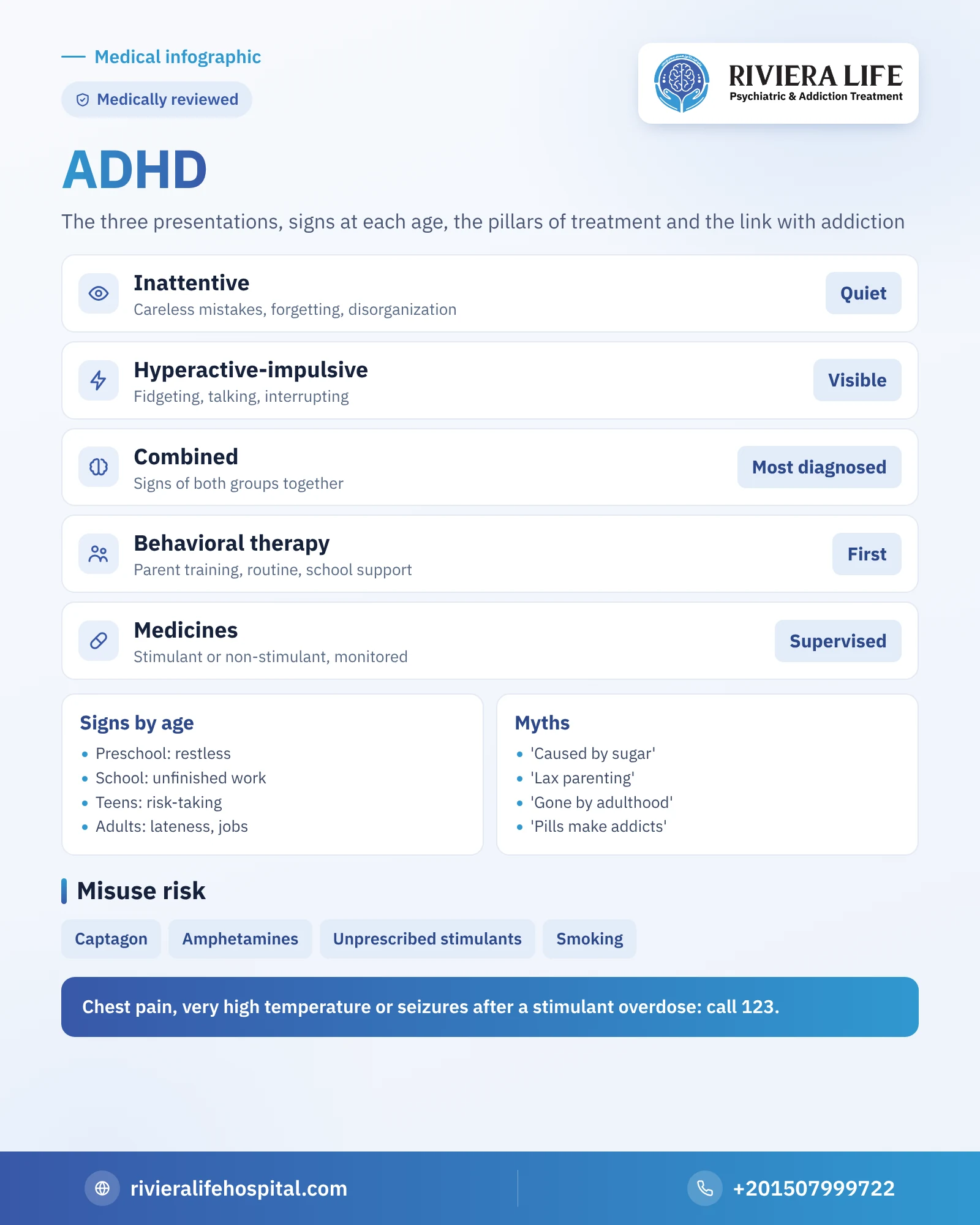
- Predominantly inattentive presentation: repeated careless mistakes, difficulty following instructions and finishing tasks, disorganization, forgetting and losing things, and getting distracted quickly. It used to be called “attention deficit disorder”.
- Predominantly hyperactive-impulsive presentation: fidgeting and constant movement, difficulty staying seated, talking a lot, interrupting others, and difficulty waiting one’s turn.
- Combined presentation: signs of both groups come together in it, and it is the most diagnosed in children.
The presentation may change with age; visible movement often calms down in adolescence while inattention and inner impulsivity remain.
Signs of ADHD by age
Before school
Restless movement that clearly exceeds that of their peers, climbing and running in inappropriate places, and impulsivity that exposes them to repeated injuries. Doctors take care with diagnosis at this age because extra activity is partly normal.
School age
The picture becomes clearer with the demands of the classroom: difficulty sitting and listening, incomplete homework, careless mistakes, forgetting supplies, repeated complaints from teachers, and sometimes problems with classmates because of impulsivity.
Adolescence
Hyperactivity turns into an inner feeling of restlessness, and poor time management, procrastination and falling grades stand out as subjects increase. The tendency to take risks rises, such as reckless driving and early experimenting with smoking and drugs.
Adults
Chronic lateness, forgetting appointments and bills, difficulty finishing projects, moving between jobs, quick boredom, hasty financial decisions, emotional swings and impatience. Many adults were not diagnosed in childhood, and lived thinking they were careless or less intelligent.
Causes of ADHD
Heredity is the strongest factor; the disorder is among the mental disorders with the highest heritability, and it often recurs within the same family, so a father may discover his own symptoms during his son’s assessment. Research shows differences in the development of some brain regions and in the activity of the dopamine and noradrenaline systems that regulate attention and reward. Factors that raise the risk include premature birth, low birth weight, smoking or alcohol during pregnancy, and exposure to lead in childhood.
What is not a proven cause: sugar and sweets, parenting style in itself, and phones and screens. Chaos at home or excessive screen time may make the symptoms harder to control, but they do not create the disorder out of nothing. This is an important point for many mothers who blame themselves without any basis.
How is ADHD diagnosed?
No blood test or scan confirms the diagnosis. The doctor relies on a detailed interview and developmental history, and rating scales filled in by parents and teachers, or by the person themselves and their partner in the case of adults. The diagnosis requires that the symptoms began before the age of twelve, lasted at least six months, appear in more than one setting such as home and school, and actually disrupt functioning.
The doctor rules out causes that may resemble the disorder: poor hearing or vision, sleep disorders, thyroid problems, specific learning difficulties, anxiety and depression, and the effects of substance use in adolescents and adults. The disorder often occurs together with one of these, so each needs treatment.
Treatment of ADHD
Behavioral therapy and parent training
For young children, treatment usually begins with training parents in practical methods: short, clear instructions, a fixed routine, immediate reward for desired behavior, and calm, predictable consequences instead of shouting. Adolescents and adults benefit from cognitive behavioral therapy and from training in organizing time and tasks.
At home
An organized home takes a great burden off the child: a visual schedule hung on the wall for the morning, study and sleep, a fixed place for the bag and shoes, and dividing homework into short parts with minutes of movement between them. Enough sleep and daily physical activity help improve concentration and mood. Most importantly, the child should hear about their strengths as much as they hear about their mistakes, because many people with ADHD grow up with the image of “the troublemaker child” more entrenched in their minds than the disorder itself. And don’t forget yourself; caring for a very active child is exhausting, and supporting the parents is part of the treatment.
School support
A seat near the teacher and away from sources of distraction, dividing long tasks, extra time in tests if possible, and regular communication between home and school with a simple follow-up notebook.
Medicines
Medicines are divided into stimulants and non-stimulants. Stimulants, including methylphenidate and amphetamine derivatives, are the most used and improve attention and impulse control in many patients within a short time. Non-stimulants, such as atomoxetine and guanfacine, are alternatives the doctor turns to when there is no response, the stimulants are not tolerated, or there is a risk of misuse. The doctor chooses the medicine and its dose and monitors appetite, sleep, pulse, blood pressure and height in children, and no medicine should be started, changed or stopped except with the treating doctor.
ADHD and addiction
Adolescents and adults with untreated ADHD are more prone than others to early smoking, drug use and addiction, because of impulsivity, sensation-seeking and the frustration accumulated from academic failure. Research indicates that medical treatment under supervision does not increase the risk of addiction, and may even be linked to a lower risk.
On the other hand, prescribed stimulants are misused by some students who take them without a prescription to stay up before exams, a use that may cause palpitations, insomnia and anxiety and may lead to dependence. In Egypt and the region, some young people turn to street stimulants such as captagon and amphetamines seeking concentration, replacing controlled treatment with a dangerous substance of unknown content. Keep your child’s medicine in a locked place, and don’t share it with anyone. Someone who has both the disorder and an addiction needs a plan that treats them together, as in the dual diagnosis program.
ADHD in adults: at work and in relationships
At work, the disorder shows in missed deadlines, tasks begun with enthusiasm and then abandoned, difficulty with long meetings, and mistakes in details. But many shine in fast-changing work and in crises, and have remarkable energy and creativity. Simple tools help: an electronic calendar with alerts, dividing a task into small steps, short work periods with breaks between them, and a quiet place.
In relationships, the partner may read forgetfulness, interrupting and postponing promises as a lack of interest, so the matter turns into a “father and son” role between the spouses: one side reminds and follows up, and the other feels inadequate and criticized. Understanding the disorder together, dividing responsibilities clearly, and treatment ease this tension a great deal.
Common myths about ADHD
Myth: sugar causes hyperactivity. Fact: controlled studies have not proven this, although a balanced diet is useful for every child.
Myth: the cause is lax parenting. Fact: the disorder is neurodevelopmental with a strong genetic basis, and parenting affects the severity of the symptoms and how they are handled, not whether the disorder exists.
Myth: it disappears with adulthood. Fact: it improves in some, and continues in a considerable proportion in a different form.
Myth: its medicines turn the child into an addict. Fact: prescribed treatment under follow-up does not raise the risk of addiction, while misuse without supervision is a real danger.
Myth: a child who concentrates on games cannot have it. Fact: excessive focus on what interests them is a known part of the picture.
Related articles
Related pages that may help you:
- Amphetamines: what they are, how they affect the brain, and why using them without supervision turns into addiction.
- Captagon: the most widely circulated stimulant in the region and its dangers to the heart and mind.
- Addiction treatment program for students and adolescents: how an adolescent is assessed and treated with the family involved.
- Dopamine and addiction: the reward system linked to attention, impulsivity and substance use together.
- Dual diagnosis program: treating a mental disorder and addiction in one plan.
For adults in particular, the adult attention deficit test offers a quick indication of the possibility of the disorder, and it does not replace the doctor’s assessment.
When does it become an emergency?
The disorder itself is not an emergency, but taking a large amount of a stimulant medicine or mixing it with street stimulants may cause serious poisoning that needs immediate intervention.
Call the ambulance on 123 immediately if you see
After taking a large amount of a prescribed stimulant, captagon or amphetamine, go to the nearest emergency department if you notice:
- Chest pain or severe, irregular palpitations
- A very high temperature with sweating or dehydration
- Seizures or loss of consciousness
- Severe agitation, hallucinations or frightening suspicion of others
- Talk of ending life or self-harm
When should you seek help?
Seek an assessment if difficulties with attention, movement or impulsivity have been affecting your child’s study or relationships for months, or if you are an adult living with chronic disorganization, procrastination and setbacks at work and in relationships that circumstances do not explain. It becomes more urgent if substance use or misuse of stimulant medicines appears. At Riviera Life in Sheikh Zayed, consultant psychiatrists carry out the assessment in complete confidentiality, the first consultation is free, and you can reach us around the clock on +201507999722.
Medical sources and referencesThe information in this article is based on reliable scientific sources