
Asperger syndrome was an independent diagnosis used for people who share difficulties in social communication and focused interests, with normally appearing language and average or higher intelligence. Today it is no longer diagnosed by its name in the American diagnostic manual (fifth edition) or the International Classification of Diseases (eleventh edition), but is merged under the name autism spectrum disorder. Yet the name is still used among people, and parents ask: what is the difference between Asperger’s and autism? The answer is that the difference was in degree and in language development, not in their being two completely different conditions. Only a specialist team can make the diagnosis after a comprehensive assessment.
What did “Asperger’s” mean?
The name derives from the Austrian doctor Hans Asperger, who in the 1940s described intelligent children with good language but stumbling social relationships and uncoordinated movement. Dr Lorna Wing introduced the term into the English literature in the 1980s, and it then became an official diagnosis in the 1990s. Doctors used it for people who don’t have a noticeable delay in speech in childhood or an intellectual disability, but who find it difficult to understand social cues and two-way conversation, and hold on to narrow, deep interests and strict routine.
Why did the name disappear from diagnostic manuals?
Researchers noticed that the boundaries between Asperger’s and “high-functioning” autism were blurred, and that the diagnosis itself differed from one clinic to another for the same person. So instead of an inconsistent division, the fifth manual gathered these diagnoses under one umbrella, and added a description of the severity of the need for support at three levels.
Someone who was previously diagnosed with Asperger’s is today usually described as being on the autism spectrum at level one, meaning needing support. This doesn’t cancel their old diagnosis or withdraw services from them; only the medical name changed. Later discussions added another reason to avoid the name, related to the history of the doctor it was named after, which pushed some specialists to prefer “autism spectrum”.
Asperger’s vs autism: where was the old difference?
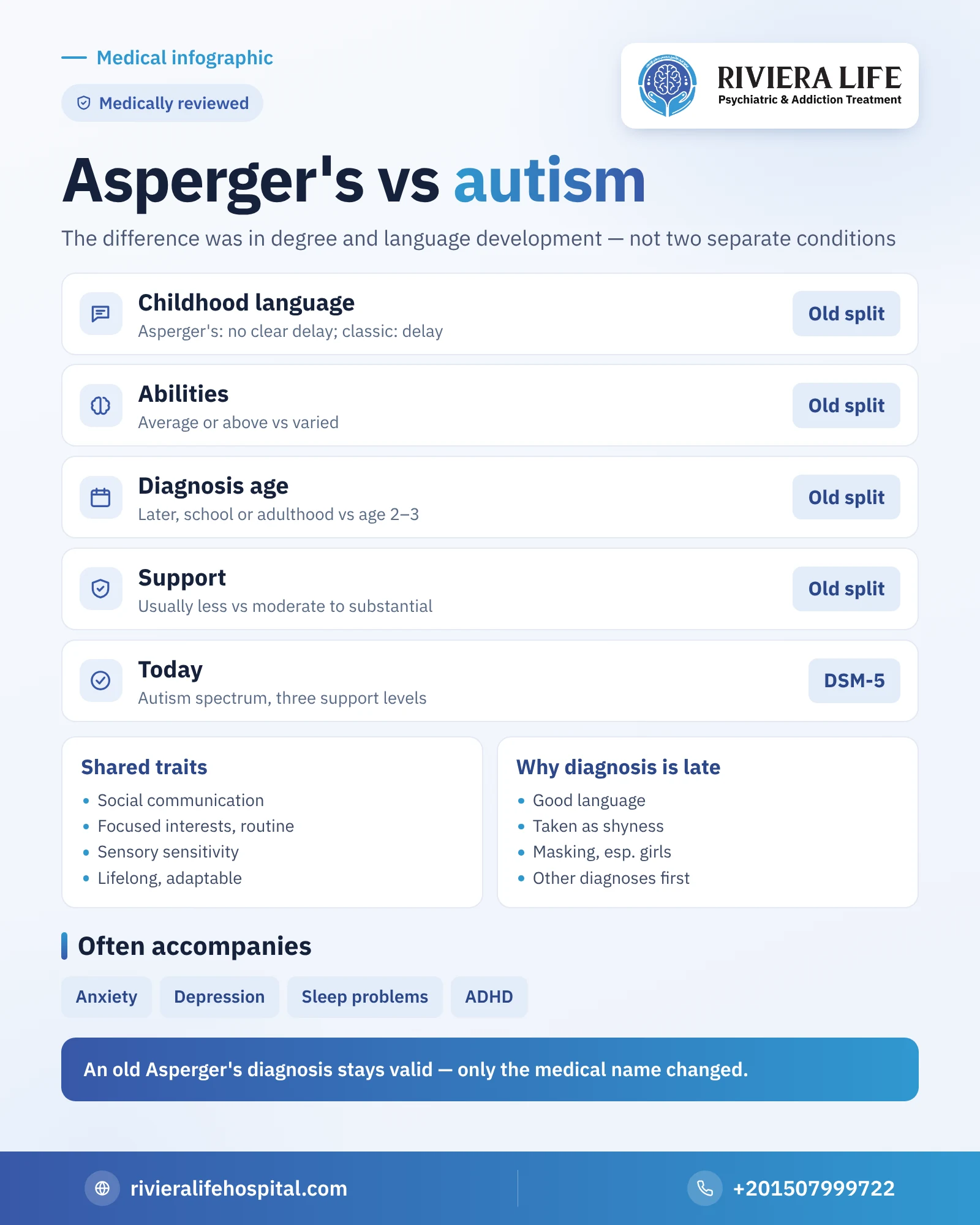
The following table shows how doctors distinguished in the old classification’s diagnoses:
| Aspect | Asperger’s (old classification) | Classic autism |
|---|---|---|
| Language in childhood | No noticeable delay in speech | Delay or sometimes absence |
| Mental abilities | Usually average or above | Varied, and may be accompanied by intellectual disability |
| Diagnosis | Late, usually after starting school or in adulthood | Early, from the second or third year |
| Support needed | Usually less | Varies from moderate to substantial |
These are general differences, not a rule for every person: some whose speech was delayed live independently, and some who speak fluently need substantial support in daily life. That is why medicine chose the concept of a spectrum.
What do the two have in common?
- Difficulty in reciprocal social communication and understanding tone and unspoken cues.
- Repetitive patterns or focused interests, attachment to routine and distress at sudden change.
- Particular sensitivity to sounds, lights, textures and smells.
- Symptoms beginning in early childhood, even if they are only noticed later.
- The difference continuing throughout life, with a great capacity to learn adaptive skills.
An explanation of these traits and the causes and early signs around them is in the complete guide to autism.
What does Asperger’s look like in daily reality?
A university student who knows everything about trains or programming and talks about it for an hour without noticing the boredom of the listener. An excellent employee who gets confused at lunch meetings and doesn’t understand implied jokes. A young man who takes speech literally and believes that “the hall is boiling”. A man of forty who reaches his diagnosis after going through a marriage and two faltering jobs and hears for the first time that what he lives with has a name. This doesn’t mean that every shy or meticulous person has autism; the sign is the total of the difficulties, their persistence since childhood, and their effect on life.
Why is diagnosis delayed in some people?
Because their language is good and their academic level acceptable, so their distance from people is interpreted as shyness and their behavior as stubbornness. Some, especially girls and women, learn to imitate others and hide their difficulties, which is called “masking”, so they seem normal outside the home and then collapse with exhaustion at home. These people are sometimes given other diagnoses such as anxiety, depression or hyperactivity before the autism behind them is discovered. Symptoms of attention-deficit/hyperactivity disorder sometimes appear with it; to compare them see ADHD.
Conditions that accompany it and are confused with it
It is common for autism to be accompanied by generalized anxiety or social phobia, depression, sleep disorder and sensory sensitivity. It may be confused with the picture of social phobia because both avoid gatherings, but the motive for avoidance differs: in phobia it is fear of judgment, and in autism difficulty understanding the situation or sensory exhaustion. It also sometimes resembles avoidant personality. What distinguishes these conditions is an assessment that includes the developmental history since childhood, which tests published online can’t replace.
Can I say “Asperger’s” from now on?
There is no harm in the word itself in daily conversation, and some who were diagnosed with it like to keep using it as an identity, while others prefer the word “autism” or “spectrum”. What matters is that parents and teachers know that the approved medical meaning today is the spectrum, and that services and official reports are written under this name. And if you are asked in a report, school or workplace, use the modern name to avoid confusion.
What changes after diagnosis?
The diagnosis doesn’t change the person, but it changes their understanding of themselves and what surrounds them. They learn ways of organizing life: a clear routine, preparation for what will happen, quiet places when it is crowded, social skills training, and treatment for anxiety or depression if present. In study and work, simple adjustments may be requested such as written instructions and a less noisy environment. There is no medicine that treats autism itself, but the doctor may prescribe a medicine for an accompanying condition such as anxiety or insomnia, with full supervision. And beware of promises of quick cures and unproven diets and supplements.
How do you talk to your child, or yourself, about the diagnosis?
Choose honest, calm words, and focus on the brain working in a different way, not a worse one. Mention strengths clearly: precision, focus, honesty and deep knowledge, and mention the difficulties without belittling. And remember that a teenager or adult who receives the diagnosis late may feel sad, relieved, or both, and this is normal. Support groups and meeting people like them help, and some may need psychological follow-up to get past years of misunderstanding.
Seek urgent help immediately if you see
Call an ambulance on 123 or go to the nearest emergency department, and you can contact the mental health hotline 16328 for:
- Thoughts of self-harm or ending life
- Severe self-harm during a meltdown
- Prolonged refusal to eat and drink or complete withdrawal from everything
- A sudden, sharp change in behavior with confusion or hallucination
When should you seek an assessment?
Seek an assessment from a child or adult psychiatrist, or a developmental specialist, if you notice ongoing social difficulties since childhood, severe avoidance of change, repeated meltdowns in crowds and noise, chronic exhaustion after social situations, or anxiety and depression that don’t respond to usual treatment. At Riviera Life in Sheikh Zayed, Giza, you can start with a free first consultation on +201507999722 in complete confidentiality, with consultant psychiatrists and fourteen years of experience.
More from the autism guide
- Autism: the complete guide
- Mental illness in children: signs by age
- Social phobia symptoms: psychological and physical signs
- Tourette syndrome and tic disorders
Questions many people ask
It is no longer used in the fifth American diagnostic manual or the eleventh international classification, and is merged under autism spectrum disorder. It continues to be used in general conversation.
It was described as usually needing less support with language that isn't delayed, but this doesn't mean its difficulties are simple. Need varies from person to person.
No, your diagnosis remains valid and is redescribed in today's language as autism spectrum. This doesn't lose you services or support.
Yes, many are diagnosed in adolescence or adulthood. The assessment relies on developmental history and current difficulties and is carried out by a specialist.
There is no medicine that treats autism itself. The doctor may prescribe a medicine for an accompanying condition such as anxiety or insomnia, and support relies on training and organizing the environment.