A phobia is an intense, persistent fear of a specific thing or situation, far greater than the real danger, that drives the person to avoid it in ways that narrow their life. The types of phobia fall into three large groups: specific phobia, such as fear of dogs, heights, injections or lifts; agoraphobia, which revolves around places that are hard to escape from; and social phobia, which centers on how people see and judge you.
The person with a phobia usually knows that their fear is exaggerated, but this knowledge is not enough to stop the racing heart and shortness of breath when the trigger comes close. The good news is that phobia is one of the mental disorders that responds best to treatment, especially exposure therapy. The diagnosis is made only by a psychiatrist or a qualified psychologist.
What is a phobia? And where does normal fear end?
Fear itself is a healthy function; it is what makes you step back when a barking dog comes close, or hold the handrail on a high staircase. A phobia, however, begins when fear becomes detached from danger: an employee who turns down a promotion because her new office is on the fifteenth floor and she cannot bear the lift; a young man who has postponed a blood test he needs for two years because just seeing the needle makes him pale and close to fainting; and a mother who checks every room before entering it for fear of a cockroach. In all three cases, the fault is not the presence of fear, but its size, its persistence and its cost.
Doctors usually require that the fear be consistent, repeating with the same trigger almost every time, that it last several months, and that it cause clear distress or disrupt study, work or relationships. A passing fear from a horror film, or tension before a first flight, is not considered a phobia.
How common are phobias?
Specific phobia is one of the most common anxiety disorders of all, and references estimate that a considerable proportion of people, possibly close to roughly one in every ten, experience it at some stage of their lives. Most of it begins in childhood, and it is diagnosed more in women than in men. Even so, many people live for long years without treatment, either because they find a way to avoid what frightens them, or because they are ashamed of a fear they see as childish. The types of anxiety page explains where phobia sits among the seven major anxiety disorders; here we go deeper into the types of phobia themselves.
Types of phobia: the full picture
The fifth edition of the American Diagnostic and Statistical Manual and the International Classification of Diseases divide phobias into three main types:
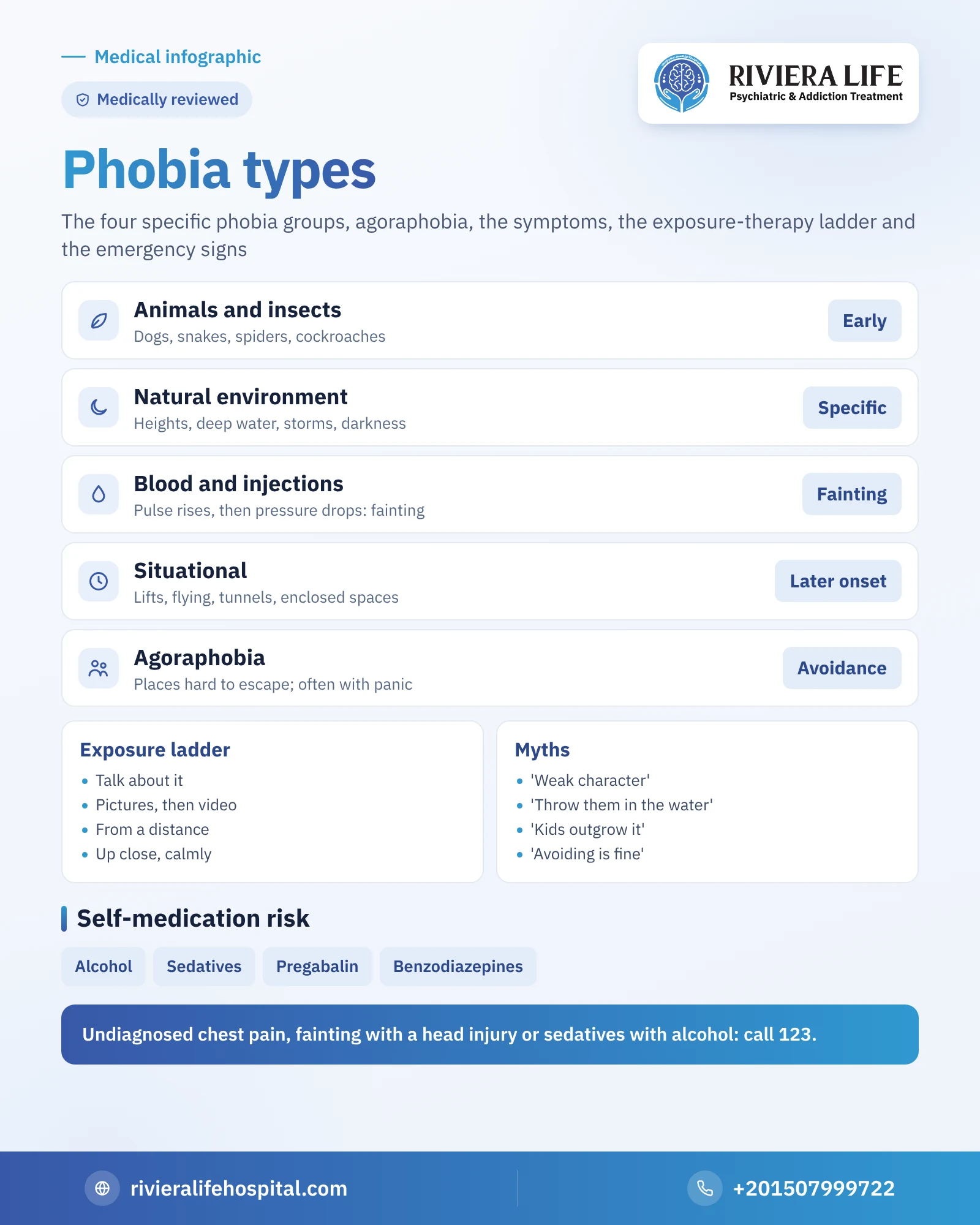
- Specific phobia: fear linked to a particular thing or situation; it is the most common, and includes hundreds of names grouped into four groups.
- Agoraphobia: fear of places and situations from which it is hard to get out or to call for help if what is feared happens.
- Social phobia (social anxiety disorder): fear of embarrassment and negative evaluation in front of others.
The many Greek names circulating online, from spider phobia to number phobia, do not mean types that differ in treatment; the mechanism is nearly the same, and the path to improvement is similar.
Specific phobia and its four groups
Animal and insect phobias
Fear of dogs, cats, snakes, spiders, cockroaches, mice and birds. It usually begins at an early age, sometimes after being bitten or chased, and sometimes with no clear memory at all. It may extend to avoiding parks, family visits and nature films.
Natural environment phobias
Fear of heights, deep water, storms and thunder, or the dark. Someone with a fear of heights may avoid balconies, bridges and upper floors, and may feel dizzy and want to cling to the ground even on an escalator.
Blood, injection and injury phobias
This group has a different physical signature: the heart rate rises at first, then blood pressure drops suddenly, so the person feels dizzy or loses consciousness for seconds at the sight of blood or a needle. That is why it can be more dangerous than the others in practice, because it makes people avoid vaccinations, blood tests, pregnancy follow-up and dental treatment. It often recurs within the same family.
Situational phobias
Fear of specific situations: lifts, flying, tunnels, bridges, driving a car and enclosed spaces. One of the best known is claustrophobia, which appears in lifts, MRI scanners and planes. Situational phobia usually begins at an older age than animal phobia, in adolescence or early adulthood.
Other types
These include fear of choking, vomiting, loud noises or costumed characters in children. Responses that are not an official diagnosis but are real for those who experience them also spread online, such as trypophobia, in which disgust dominates more than fear.
Agoraphobia
Despite the name, agoraphobia is not only about open spaces. Its core is fear of being in a place where it may be hard to escape or get help if frightening or embarrassing symptoms appear. It usually includes two or more of these situations: public transport, markets and wide squares, enclosed places such as cinemas and malls, queues and crowds, and leaving home alone.
Agoraphobia is often linked to panic attacks: the person has an attack on the metro, for example, so they start avoiding the metro, then the bus, then any place far from home. In severe cases, they may not leave the house except with someone they trust. You can find an explanation of the attack itself and how to tell it apart from a heart attack in the article Panic attacks.
Social phobia in brief
Social phobia is the third type of phobia, and it centers on the fear that others will notice your awkwardness or judge you negatively, when speaking in front of a group, eating in front of strangers or even making a phone call. It has its own guide on the site, with its symptoms, causes and treatment, on the social phobia page.
Symptoms of phobia
The symptoms of phobia are similar across its types, and appear when the person faces the trigger, expects to face it, or even sees it in a picture:
- Physical symptoms: palpitations, sweating, trembling, shortness of breath or a choking feeling, nausea, dizziness and a dry mouth.
- Psychological symptoms: sudden terror, a sense of losing control, an urgent wish to escape, and sometimes fear of dying or fainting.
- Avoidance: changing routes, plans, work and holidays to avoid the trigger; this is the symptom that maintains and feeds the phobia.
- Anticipatory anxiety: tension that begins days before the situation, like someone who doesn’t sleep for a week before a flight.
In children, fear may appear as crying, tantrums, freezing or clinging to a parent.
Causes of phobia
There is no single cause, but a mixture of factors that accumulate:
- A direct frightening experience: a dog bite, being trapped in a broken lift, or severe air turbulence.
- Learning by observation: a child who sees their mother scream whenever she sees a cockroach learns that a cockroach is an imminent danger.
- Frightening information: repeated stories about plane crashes or drowning may plant a fear that no experience preceded.
- Genetic and temperamental predisposition: some people are more sensitive to danger by nature, and phobias recur in certain families.
- Evolutionary predisposition: it is likely that humans are primed to learn fear of things that threatened their ancestors, such as snakes and heights, faster than fear of modern dangerous things such as electricity.
Then avoidance comes along and turns temporary fear into a permanent phobia; each time you escape, your mind feels relief, so it records that escaping is what saved you, and it never gets the chance to learn that the situation was safe.
How is a phobia diagnosed?
Diagnosis relies on an interview in which the doctor asks about the trigger, the form of the response, its duration, the extent of avoidance and its effect on life. They may use short scales to estimate severity. The doctor pays attention to two things: ruling out physical causes of the symptoms, such as thyroid disorders or heart problems, and detecting what may accompany the phobia, such as depression, panic disorder or substance use.
Treatment of phobia: exposure first
Gradual exposure therapy
It is the cornerstone of phobia treatment, and is supported by strong evidence. The patient builds a ladder of situations with the therapist, from easiest to hardest, then faces each step until the anxiety calms down on its own. Someone who fears dogs, for example, may begin by talking about them, then pictures, then video, then watching a leashed dog from a distance, until they stand next to a calm dog. What matters is that this is done gradually and under supervision, not by suddenly being thrown into the heart of the fear. A few sessions may be enough in many cases of specific phobia, and a single extended session is sometimes used.
Cognitive behavioral therapy
Cognitive behavioral therapy adds to exposure work on frightening thoughts: “The lift will fall”, “I’ll pass out and embarrass myself”. The patient learns to examine these thoughts and test them in practice, and to gradually give up the safety behaviors that keep the fear alive. Some therapists use virtual reality for situations that are hard to arrange, such as flying.
Applied tension for blood phobia
Because blood and injection phobia causes a drop in blood pressure, people with it are trained to tense the muscles of the arms and legs to raise blood pressure and prevent fainting, then they combine this with exposure.
The role of medicines
Medicines are not the main treatment for specific phobia. The doctor may turn to antidepressants in agoraphobia or social phobia, or when depression or panic accompanies the phobia, or prescribe a short-term medicine for a rare, unavoidable situation. As for sedatives from the benzodiazepines class, they may bring momentary relief but they block the learning of safety and carry a risk of dependence, so they are taken only with a prescription and under follow-up, and no medicine is started, adjusted or stopped except with the treating doctor.
You can find the steps in detail, and what happens at each stage, in the article Phobia treatment.
Phobia and addiction
Some people with phobias try to “numb” their fear on their own: a drink before flying, a sedative pill before every outing, or pregabalin without a prescription. The solution seems to work at first, but it prevents the mind from learning that the situation is safe, and the person needs larger amounts over time, so they find themselves facing two problems instead of one. This picture is more common with agoraphobia and social phobia. Someone who has both a phobia and substance use needs a plan that treats them together, as in the dual diagnosis program.
Common myths about phobia
Myth: a phobia is a weak character or being spoiled. Fact: it is an anxiety disorder with a clear neural mechanism, and it affects people who are very brave in other areas of their lives.
Myth: the best treatment is to throw you into the water so you learn to swim. Fact: sudden, forced confrontation may deepen the fear; effective exposure is gradual and agreed upon.
Myth: the child will grow up and it will go away on its own. Fact: some childhood fears do disappear, but an entrenched phobia usually persists if it isn’t treated.
Myth: as long as I avoid what frightens me, there is no problem. Fact: avoidance grows over time and eats away new areas of life.
The phobia guide: each aspect in its own article
Choose the page closest to what concerns you:
- Trypophobia: why the sight of clustered holes triggers disgust and shivers, what the theories say, and how it is treated when it disturbs life.
- Claustrophobia: fear in lifts, planes and MRI scanners, its link to panic, and exposure therapy.
- Social phobia: the comprehensive guide to the fear of how others see and judge you.
- Panic attacks: how to tell an attack from a heart attack, and what to do during it.
- Types of anxiety: where phobia sits among the other anxiety disorders.
When does a phobia become an emergency?
A phobia in itself is not a danger to life, but some accompanying situations need immediate intervention, especially when it cannot be confirmed that the symptoms are psychological.
Seek urgent help immediately if you see
Call the ambulance on 123 or go to the nearest emergency department, and you can contact the mental health hotline on 16328, if you notice:
- Chest pain or shortness of breath that doesn’t settle and whose cause has not been diagnosed before
- Fainting with a head injury, or not regaining consciousness quickly
- Mixing sedatives with alcohol, or taking a large amount of them to calm the fear
- Talk of ending life or self-harm because of isolation and despair
When should you seek help?
Seek an assessment if your fear makes you turn down work, travel or medical treatment you need, or narrows the range of places you go to, or if you find yourself relying on a sedative or a substance to face your day. And if your child has been living with a fear that disrupts school or sleep for months, early intervention is easier and faster. At Riviera Life in Sheikh Zayed, consultant psychiatrists assess the case in complete confidentiality and put together a plan of exposure therapy and cognitive behavioral therapy that suits the type of phobia, and the first consultation is free, around the clock, on +201507999722.
Medical sources and referencesThe information in this article is based on reliable scientific sources