How to deal with an addicted husband starts from one idea: you can’t stop his use by your own strength, but you can change how you deal with him in a way that moves him toward treatment and protects you and the children. Covering for him, paying his debts and threats that are never carried out prolong the addiction, while clear boundaries, conversation at the right time and rewarding sober days open the door. This is a wife’s guide: how to be sure, what to avoid, how to talk with him, how to protect the home, the money and yourself, and when safety matters more than any conversation.
Is my husband addicted? Signs a wife sees before others
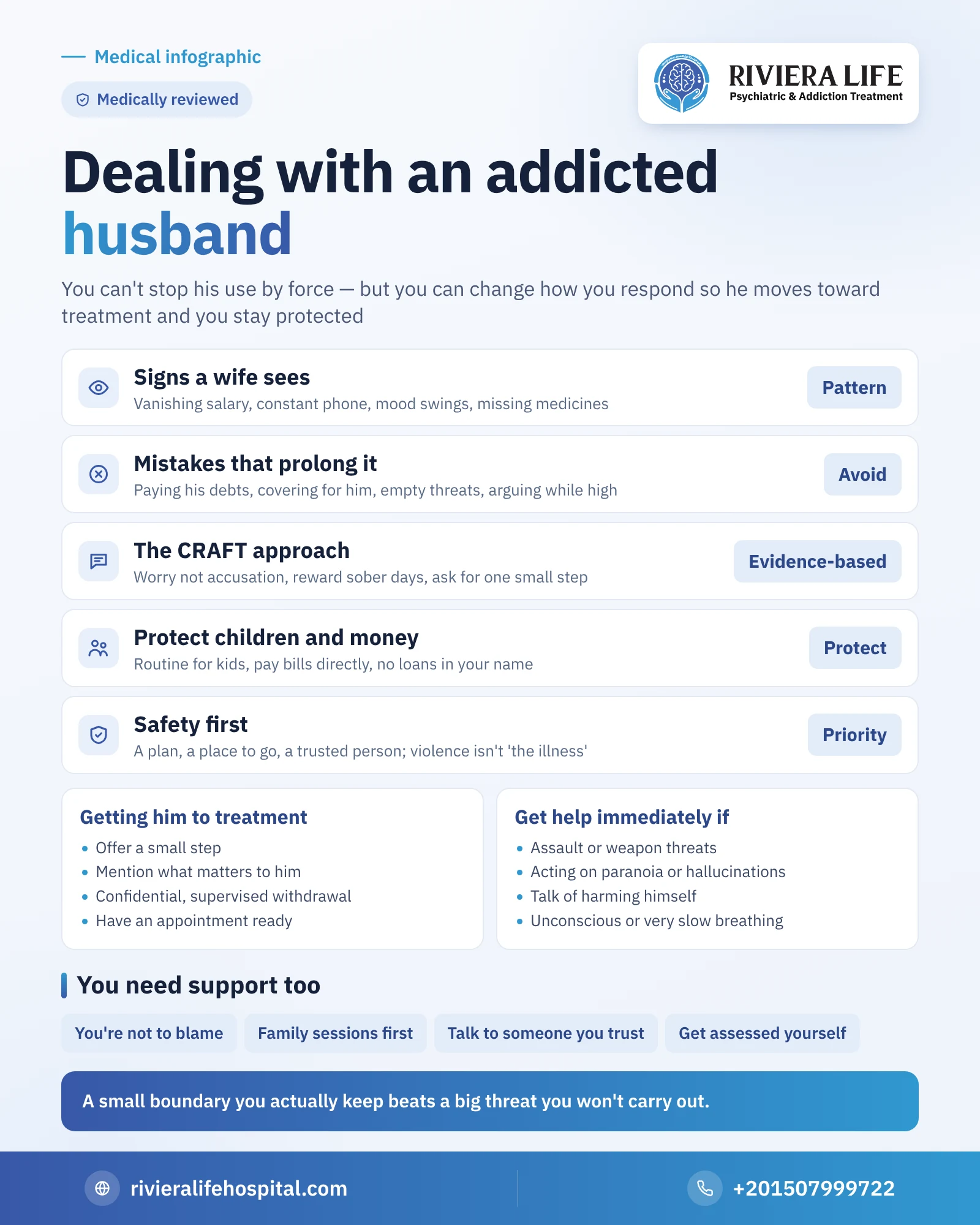
The wife is closest to the small details that don’t show to the family or colleagues:
- A salary that disappears before mid-month, and requests for money with excuses that change every time.
- A phone that never leaves him, short calls he goes outside to answer, and repeated nights out.
- Sharp swings: exaggerated calm or strange energy, then irritability and explosions over the smallest thing.
- Changes in sleep, appetite and intimacy, either sudden interest or complete coldness.
- Medicines disappearing from the home medicine cabinet, or strips and papers whose presence he can’t explain.
- Absence from work, or repeated excuses for not attending family occasions.
A single sign isn’t enough to judge, and the general signs any family sees are explained in our article on how to know if there is a drug addict in your home.
Mistakes that prolong addiction without meaning to
Enabling: protecting him from the results of his actions
Paying his debts, giving him money “so he doesn’t borrow”, and repairing what he damages every time. The intention is good, but the message he receives is that using costs him nothing.
Covering up: lying for him
Calling his manager to say he is ill, or hiding the truth from his family and yours. Covering up takes the burden off him and places the weight of the secret on you alone.
Threats that aren’t carried out
“If you do it again, I’ll leave the house”, then nothing happens. After two or three times, he learns your words mean nothing. A small boundary you actually keep is better than a big threat you won’t carry out.
Confronting him while he is under the influence
Talking while your husband is under the influence of a substance or in a withdrawal crisis usually turns into a fight, and may turn into violence. Always postpone the conversation.
Dealing with an addicted husband: when do you talk to him?
The best times are his sober hours, and right after a crisis when regret is present: a day he was late for work because of staying up, a morning after a bad night, or after a financial loss. At these moments he is more ready to hear that there is a solution. Choose a quiet place without the children, and decide in advance exactly what you will ask for.
The CRAFT approach: change what you do
Therapists have developed an approach for training the families of addicts known by the abbreviation CRAFT, meaning Community Reinforcement and Family Training. Its idea is that the family doesn’t wait until the addict “hits rock bottom”, but learns skills that increase the chances he accepts treatment and improve the family’s own life at the same time. Its most important principles:
| Instead of | Try |
|---|---|
| “You’re an addict and you’ve destroyed the home” | “I’m worried about you, and I noticed you haven’t slept for three nights” |
| Ignoring the good days | Showing gratitude and closeness when he spends a sober day with the family |
| Cleaning up the aftermath of a night of use | Letting the natural consequences fall on him, without humiliation |
| A big demand: “You have to go to rehab” | A small, specific request: “Come with me to one consultation” |
| Arguing when he denies | Withdrawing calmly and postponing the talk to a better moment |
Most importantly, this approach puts your safety before everything; no step that increases the risk of violence is applied.
How do you protect the children?
Children sense what is happening even if they don’t understand it, and often think they are the cause. Tell them, in language suited to their ages, that their father is ill and that the illness isn’t their fault, without details they don’t need. Keep their daily routine of school, sleep and food, and don’t make them messengers between you or witnesses to arguments. Don’t leave them in his care while he is under the influence, and don’t let them ride in the car with him in that state.
How do you protect the money and the home?
- Separate what you can of the household budget and the children’s savings from his reach.
- Pay rent, bills and school fees directly instead of giving him cash.
- Don’t sign loans or guarantees for him, and don’t pay debts whose source you don’t know.
- Keep important documents and valuables in a safe place.
- Lock the home medicine cabinet, and dispose of unused medicines.
The details of protecting the family from debts and compulsive spending are explained in our article my husband gambles: what should I do?, and much of it applies here.
If it turns into violence: safety first
Some substances, especially stimulants, alcohol and synthetic cannabis, increase impulsivity, suspicion and aggression, and violence may also come in withdrawal crises. Any physical harm or threat isn’t “part of the illness” that you must endure, but a danger that calls for action. Prepare a small plan in advance: a place to go with the children, a trusted person who knows, a charged phone, and copies of important documents. Help is always available; don’t hesitate to ask for it from your family or the relevant authorities.
Seek help immediately if
Call the police on 122 for threats or violence, and an ambulance on 123 for a health danger, and leave with the children if you can.
- Physical assault, or a threat with a weapon or to kill
- Suspicion and hallucinations he acts on, as if someone is chasing him
- Talk of harming himself or ending his life
- Loss of consciousness or very slow breathing after using
How do you get him to treatment?
Offer treatment as a small step, not a life-changing decision, and mention what matters to him: his work, his children, his health, and how his family sees him. Reassure him that treatment is confidential, and that withdrawal is done under medical supervision that eases the pain. Have the hospital number and a possible appointment ready in advance, so that if he says “OK”, days don’t pass and he backs out. If he refuses completely despite clear danger, our article on involuntary addiction treatment explains when admission without his consent is justified and how it is done legally. Persuading an addicted son in particular has its own article: how to help someone addicted to drugs.
My husband is addicted and refuses treatment: should I report him?
This is one of the questions that troubles wives most, especially when the promise to stop is repeated and then everything goes back to how it was. There is a big difference between reporting drug use and requesting treatment: most Arab laws punish use if someone is caught, but give explicit protection to those who apply for treatment before being caught, and in a number of countries allow the wife or relatives to apply on his behalf, usually on condition that he hands over any substances he has. In other words, requesting treatment protects him and you, while a report alone may open a criminal case that treats nothing.
The details vary from country to country, so read what applies in yours before any step:
- In Egypt: the law and addicts in Egypt.
- In Saudi Arabia: drug penalties in Saudi Arabia and treatment without prosecution.
- In Kuwait: Kuwait’s drug law and voluntary treatment.
- In the UAE: drug penalties in the UAE and voluntary treatment.
- In Bahrain: Bahrain’s drug law and family requests.
If there is a threat, violence or urgent danger to you or the children, safety comes before any calculation, and calling emergency services is the first step. Matters of divorce, maintenance or custody are personal status issues that need a specialist lawyer in your country.
After treatment: how do you handle the first days of recovery?
His leaving hospital is the beginning of a new stage, not its end. Don’t turn into a guard who searches his pockets and phone every hour, and don’t act as if nothing happened. Agree with the treatment team on clear rules: money, going out, old friends, and the schedule of follow-up sessions. Learn the early signs of relapse, such as going back to late nights, small lies and skipping sessions, and act quickly if they appear; relapse doesn’t mean treatment has failed, but that the plan needs adjusting.
You need support too
The wives of addicts live with chronic anxiety, insomnia, guilt and loneliness, and many fall ill in silence. You aren’t responsible for his addiction, and you aren’t asked to be his therapist. Talk to someone you trust, and ask for family sessions even before he agrees to treatment, as the skills you learn protect you whatever his decision. If signs of depression or severe anxiety appear in you, ask for an assessment for yourself.
My husband uses hashish, Lyrica or captagon: is dealing with it different?
The basic steps are the same: safety first, then protecting the money and children, then a calm conversation leading to a medical assessment. But the type of substance changes two important things: the danger signs, and the way of stopping.
- Hashish: many think it is “light”, but daily use is linked to lethargy and irritability on stopping, and it may trigger anxiety attacks or psychosis in some people. The details are in how to deal with a hashish addict.
- Lyrica (pregabalin): stopping suddenly after high doses may cause insomnia and severe anxiety, and rarely seizures, so withdrawal is gradual under supervision. Read pregabalin addiction treatment.
- Captagon and stimulants: the biggest danger is continuous sleeplessness, suspicion and aggression, then a sharp mood crash after stopping. Read captagon.
- Alcohol and sedatives: must not be stopped suddenly at home after long use, because their withdrawal may be medically dangerous.
And if what preoccupies him isn’t a substance but his phone, games or betting, our guides my husband is addicted to his phone and my husband gambles are closer to your situation. For religious questions about divorcing an addict and the wife’s rights, we present what Dar al-Ifta and the law have published in families’ religious questions about addiction.
Should I stay in the marriage?
This is your decision alone, and no one has the right to judge it. Some wives stay and support a real treatment journey and see a different husband after recovery, and some decide on a temporary or permanent separation to protect themselves and the children. What helps you think: is there violence or danger? Does he admit the problem and actually accept treatment, or only repeat promises? Can you continue without losing yourself? Don’t make the decision in a moment of anger, and don’t stay only out of fear of what people will say.
And because children are affected by what happens even if nothing is said to them, the signs of their distress by age, and when a child needs a therapist, are in our article on the effect of a father’s addiction on children.
How can Riviera Life help you?
You can start with yourself before your husband: the first consultation is free and confidential, and in it the team helps you understand the situation and decide the next step. When he agrees, consultants in psychiatry and addiction treatment assess him, withdrawal is done under round-the-clock medical supervision, and the household takes part in the family program and then aftercare. Contact us on +201507999722 at any time; we are located in Sheikh Zayed, Giza.
Read also
- How does a drug addict think, and why do they deny?
- The family rehabilitation program for addiction treatment
- Involuntary addiction treatment: when is it justified?
- Women’s addiction: why it is different and how it is treated
- How do I know if my husband is addicted? Signs a wife notices and how to confirm
- The effect of addiction on married life: what breaks and how it is repaired
Questions many people ask
The decision is yours alone, and depends on whether there is violence or danger, whether he actually accepts treatment rather than only promising, and whether you can continue without losing yourself.
Cash usually makes using easier. It is better to pay basic needs directly, and to show full willingness to pay for treatment.
Choose a time when he is sober or right after a crisis, talk about your worry and specific facts rather than accusations, and ask for a small step such as a single consultation.
Yes. A wife can start with a consultation and family sessions in which she learns coping skills, and these skills increase the chances he will accept treatment later.
Your safety and the children's safety come first: leave if you can, call the police on 122 or an ambulance on 123 if there is injury, and ask your family for support.