
The short answer
If your husband won’t put his phone down at meals or in bed, flares up when you ask him to set it aside, and is late for work or neglects the children because of it, the matter has gone beyond habit. Start with calm observation, not searching, then a conversation at a clear moment in which you talk about the effect of what is happening on you and the home, not about his faults. Suggest shared rules that both of you keep, and pay attention to what goes on behind the screen: games, betting, pornographic content, or escape from depression. And if he refuses any change, or debts or aggression appear, a psychiatric assessment is the next step.
- The criterionLoss of control and continued use despite harm
- First stepA calm talk and rules both of you keep
- When to see a doctor?Refusing change, debts, aggression or depression
You sit beside him on the sofa, the TV is on, the children are talking, and he is in another world. You ask him a question and he answers a minute later with one word, eyes on the screen. And late at night you wake to find the blue light still on his face. Many wives type “my husband is addicted to his phone” into Google and then hesitate: am I exaggerating? Isn’t everyone like this? This guide helps you distinguish between annoying preoccupation and real addiction, and suggests practical steps that protect the relationship and the home without your life turning into constant surveillance.
When is my husband’s preoccupation with his phone addiction, not habit?
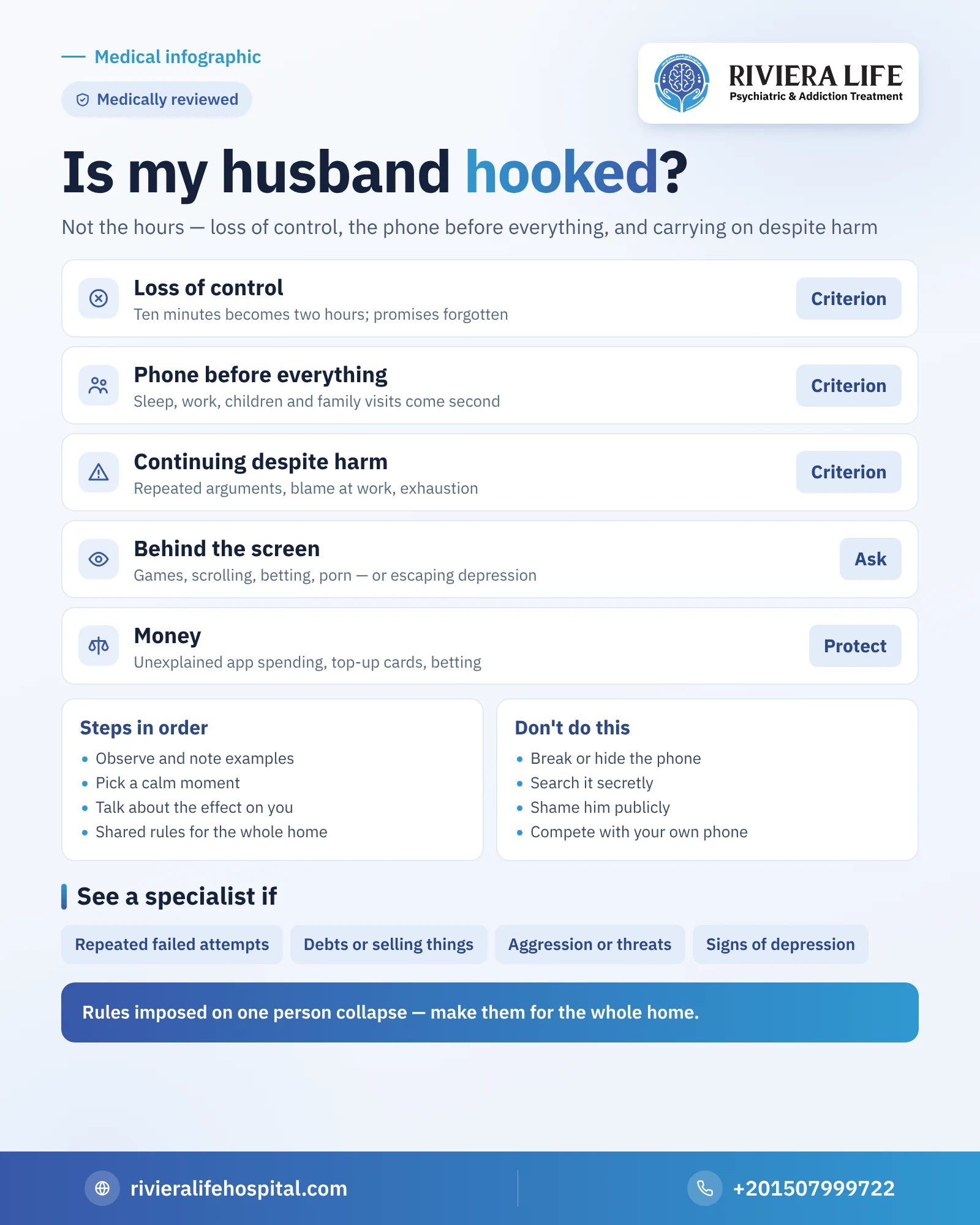
The number of hours alone doesn’t settle the matter; some people work on their phones all day. What doctors look at is a pattern of three elements. The first is loss of control: he decides to close it after ten minutes and spends two hours, and promises not to touch it at the table and then forgets. The second is putting the phone before everything: sleep, work, sitting with the children, visiting family, until it has become the main thing and everything else wasted time. The third is continuing despite harm: he sees the arguments repeat, is blamed at work, feels exhausted, and still comes back every time.
The World Health Organization officially recognizes gaming disorder when this pattern continues for about twelve months and leads to clear harm in family or work life. Phone addiction in general and social media are still described by doctors as compulsive behavior assessed by the same criterion, and the medical details are in our guide to smartphone addiction.
Signs a wife notices at home
- The phone is present in every shared moment: meals, outings, even during serious conversation.
- Clear tension or irritability when the battery dies, the internet cuts out, or you ask him to leave it.
- Repeated late nights until dawn, then waking tired and arriving late for work.
- Declining interest in the children, their studies and how they are.
- Hiding the phone or keeping it face down, changing the password, and being annoyed if you come near it.
- Lying about the number of hours or what he is doing: “I was answering work messages”.
- Unexplained spending on apps, top-up cards or subscriptions.
- Coldness in intimacy, or sleeping separately on the excuse of staying up.
One sign doesn’t mean much. Several signs together over several months, with arguments recurring around them, is what deserves a pause.
What goes on behind the screen?
The word “phone” sums up different worlds, and how you deal with it changes according to what is actually drawing him in:
Online games
Endless multiplayer games, with ranks, daily rewards and a team waiting for him. It is hard for him to withdraw in the middle of a round because he will “let the team down”. You will find more in video game addiction symptoms.
Social media and short videos
Scrolling that never stops, each video opening the next. He doesn’t feel the time pass, and comes out more tired than he went in.
Betting and online gambling
Here the level of risk changes; the losses are the household’s money. If you notice transfers, loans or things being sold, read our guide my husband gambles — what should I do? before any other step.
Pornographic content
Long late nights, hiding the phone and coldness in the relationship may be signs of compulsive viewing. This is a sensitive subject that needs a different kind of conversation, and may need specialist treatment; you will find the details in porn addiction symptoms.
Escaping something else
Sometimes the phone is a painkiller, not the original problem: suffocating work pressure, debts, undiagnosed depression, or anxiety that makes silence with himself heavy. In this case he returns to the phone whenever he feels low, and treating the cause eases the attachment by itself.
Why is it hard for him to leave it?
Apps are designed to make stopping hard. Notifications, likes and surprise rewards work on a principle we know from slot machines: the reward doesn’t come every time, but at unpredictable times, and this is exactly what makes the brain come back to check again and again. With repetition, his enjoyment of quiet things decreases, so sitting with you or the children seems unexciting compared with the screen. The detailed explanation of this cycle is in our article on dopamine and addiction. Understanding this doesn’t excuse him from responsibility, but it helps you not to take it as a personal rejection of you.
What do I do? Practical steps in order
1. Observe before you speak
For a week or two, note for yourself the specific situations: up until three for three nights, forgot the school appointment, distracted during a visit to his mother. These concrete examples are much stronger in a conversation than the phrase “you’re on your phone all the time”. And there is no need to search his phone; what you need is visible at home.
2. Choose the right time
Not after an argument, not while he is holding the phone, and not in front of the children. A calm time, the two of you alone, and sometimes preferably outside the home.
3. Talk about its effect on you, not about his faults
“I feel lonely even with you next to me” gets through faster than “you’re an addict”. Start with what you miss: talking before sleep, going out together, his interest in the children. Mention two examples from your notes, then ask him how he sees the matter. Many men know they are overdoing it and feel guilty, and attacking makes them defend the phone instead of admitting it.
4. Agree on rules both of you keep
Rules imposed on one side collapse quickly. They work best when they are for the whole home:
- No phones at the table.
- The phone charges outside the bedroom, with an ordinary alarm clock instead.
- One screen-free hour a day for the family, and one day a week for an outing without phones.
- Turning off unnecessary notifications, and moving the most time-consuming apps off the home screen.
- Using the screen time tool built into the phone itself, set by him, not you.
5. Fill the gap
Taking away the phone without an alternative leaves a gap that brings him back to it within days. Think together of activities he used to enjoy: sport, time with friends, an old hobby, or a weekly outing with the children.
6. Protect the money if there is betting or spending
If part of the problem is in-app spending or bets, agree on separating accounts, unlinking cards from online stores, and each of you knowing about large expenses. This isn’t a punishment but protection for the home until he regains control.
Phrases that open the conversation and phrases that close it
| Instead of | Try |
|---|---|
| You’re addicted to your phone and don’t care about anyone | I miss our talks before sleep — shall we bring them back? |
| Give me the phone so I can see what’s on it | I feel something is on your mind — would you like to tell me? |
| The children might as well have no father | Your son asked me when his dad will play with him |
| It’s me or the phone | Let’s try a week without phones at meals and then see |
What not to do
- Don’t break or hide the phone; he will buy another and hide it more.
- Don’t search his phone secretly; what you discover may hurt you without changing anything, and the conversation will lose trust.
- Don’t shame him in front of family or on social media.
- Don’t compete by busying yourself with your own phone in response.
- Don’t carry all the household burdens alone in silence for years; long silence turns into an explosion.
Children see more than we think
A child who sees their father always busy with his phone learns two things: that the screen is more important than people, and that they themselves aren’t interesting enough. And you won’t convince your son to cut down on games while his father plays until dawn. So the children’s interest is an acceptable way into the conversation with your husband, not as blame, but because you are role models together. And if one of the children shows signs of a similar attachment, our guide to video game addiction treatment explains the family’s role.
When does my husband need a psychiatrist?
A specialist assessment is necessary if one or more of the following appears:
- Sincere attempts to cut down fail again and again.
- Debts, loans or selling possessions because of betting or purchases.
- Aggression, breaking things or threats when he is asked to leave the phone.
- A clear decline at work, warnings or losing a job.
- Signs of depression: flatness, talk of pointlessness, and withdrawal from people.
- Chronic insomnia and complete disruption of sleeping times.
- Compulsive pornography viewing affecting the marriage.
Treatment is usually psychological, not medication. The most commonly used approach is cognitive behavioral therapy, which helps him understand what drives him to the phone and learn alternatives. If depression or anxiety lies behind the attachment, treating them is an essential part of the plan. And couples therapy that rebuilds communication between you may be suggested.
And if he refuses to admit the problem?
You can’t force him to change, but you can change what is in your hands. Keep the rules that concern you and the children, spend time with people who support you, and don’t put your life on hold until he decides. Consulting a specialist on your own isn’t an admission that you are the problem, but a way to think clearly and protect yourself from being drained. And if the disagreement recurs until it threatens the marriage, our article on the effect of addiction on married life helps you read the situation, and most of it applies to behavioral addiction too.
How can Riviera Life help you?
Riviera Life’s psychiatry team assesses all types of behavioral addiction, looks at what lies behind them such as anxiety or depression, and sets an individual psychotherapy plan with couples sessions when needed. And you can start alone with a consultation in which you understand how to approach him. The first consultation is free and confidential on +201507999722.
Read also
- Internet addiction: types, symptoms and treatment
- The harms of video game addiction on health and relationships
- How do I know if my husband is addicted?
- Digital addiction: the complete guide
Questions many people ask
There is no cut-off figure; some jobs are done entirely on the phone. The criterion is loss of control, putting the phone before sleep, work and family, and continuing despite arguments and harm.
Gaming disorder is officially listed in the World Health Organization's classification. Compulsive use of the phone and social media is assessed medically by the same criteria, and treated psychologically with good results.
Secret searching destroys trust and makes conversation harder, and usually doesn't change the behavior. The visible signs at home are enough to start a frank talk, and if you suspect betting or spending, ask directly for transparency about money.
Deleting may help at first, but it isn't enough alone, because the emptiness and pressure the phone was soothing remain. It works best with an alternative for the time, shared rules, and treatment of the cause if there is anxiety or depression.
The core treatment is psychological, most commonly cognitive behavioral therapy. Medicines are only used if there is an accompanying disorder such as depression, anxiety or ADHD, decided by the doctor after assessment.