The first thing to know about OCD and psychosis is that the first isn’t a form of the second. Most people with OCD recognize that their thoughts are exaggerated or illogical and fight them, while in psychosis a person loses contact with reality, believing fixed delusions or hearing and seeing what others don’t. But the relationship between them is more complex than this simple separation: some people with OCD have insight so weak that they approach complete conviction, and some people with schizophrenia have clear obsessive symptoms. This article explains the differences between the two disorders, the situations where they meet, and why an accurate diagnosis changes the treatment plan.
Is OCD a type of psychosis?
No. This is one of the most widespread misconceptions, and it makes patients afraid to talk about their thoughts for fear of being called mad. OCD is classified in the DSM-5 and ICD-11 within a separate group, “obsessive-compulsive and related disorders”, far from the group of schizophrenia and psychotic disorders. A person with OCD usually says, “I know this isn’t logical, but I can’t stop”, and this sentence alone reveals that their contact with reality is intact.
What is psychosis?
Psychosis is a state in which a person’s perception of reality is disturbed, appearing in one or more of the following forms:
- Delusions: fixed false beliefs that don’t change with evidence, such as the conviction that someone is watching them or controlling their thoughts.
- Hallucinations: hearing voices or seeing things that aren’t there, as explained in our article on hallucination symptoms.
- Disordered thinking and speech: incomprehensible jumps between ideas or speech that is hard to follow.
- Disorganized or strange behavior that doesn’t fit the situation.
Psychosis appears in schizophrenia, in severe episodes of depression or mania, with the use of or withdrawal from some drugs, and in some physical illnesses.
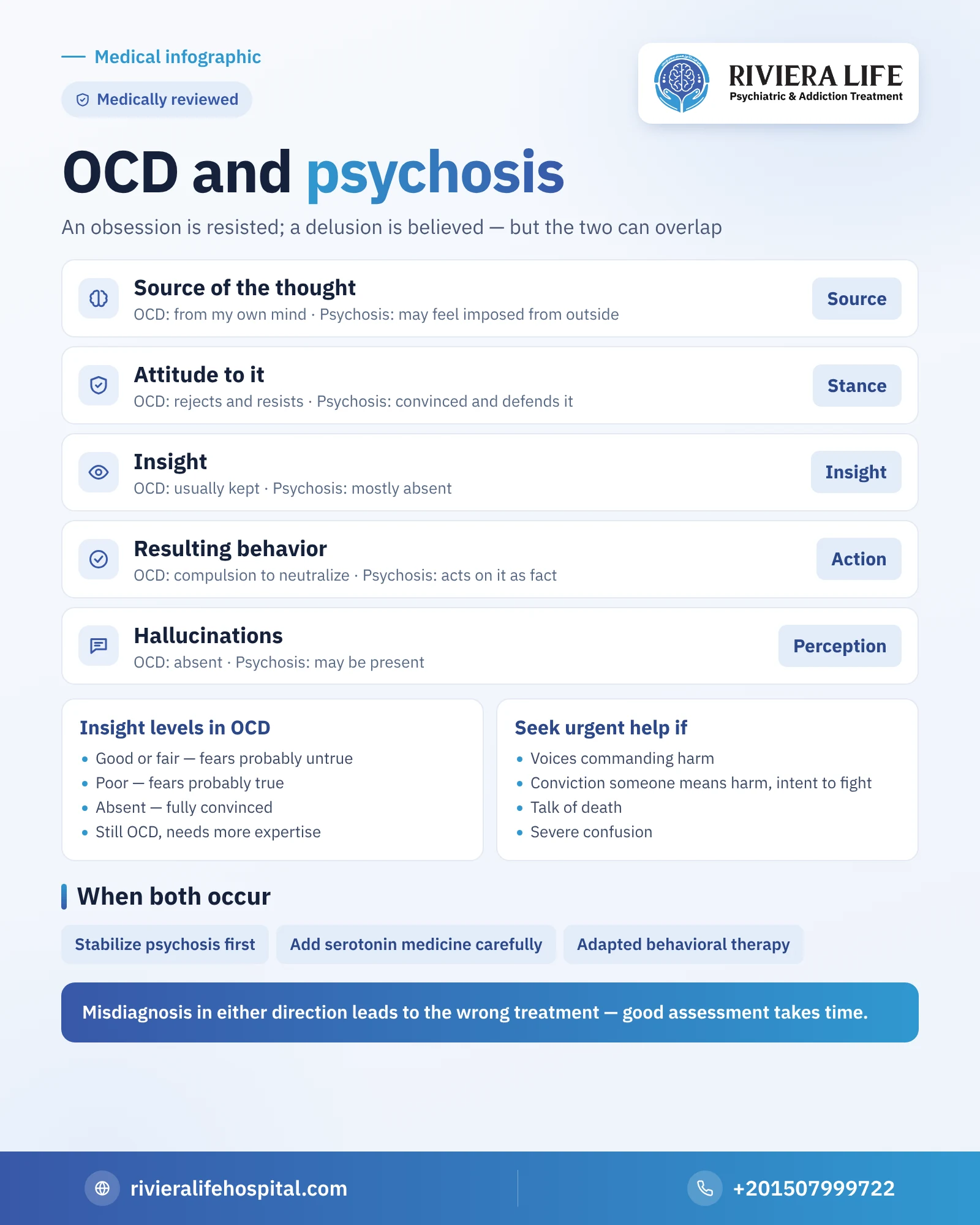
The difference between an obsessive thought and a delusion
| Point of comparison | Obsessive thought | Psychotic delusion |
|---|---|---|
| Source of the thought | Knows it comes from their own mind | May believe it is imposed from outside |
| Attitude to it | Rejects and resists it | Is convinced of it and defends it |
| Insight | Usually preserved | Mostly absent |
| Accompanying feeling | Anxiety, guilt and disgust | Fear, suspicion of others, or grandiosity |
| Resulting behavior | A compulsion to neutralize the thought | Acting on the thought as fact |
| Hallucinations | Absent | May be present |
When insight weakens in OCD
Not all people with OCD have the same degree of awareness of their thoughts. That is why, at diagnosis, doctors specify the degree of insight: good or fair when the person knows their fears are probably untrue, poor when they think they are probably true, and absent when they become completely convinced that what they fear will happen.
A patient convinced that not washing their hands forty times will kill their family through infection, and who accepts no discussion, may seem psychotic, but they remain a person with OCD with absent insight, because their conviction revolves around the obsession’s subject itself, without hallucinations or thought disorder. These cases need more expertise in treatment, and sometimes the addition of an antipsychotic medicine.
When do OCD and schizophrenia occur together?
Studies indicate that obsessive and compulsive symptoms are more common in people with schizophrenia than in the general population, and some meet the full criteria for OCD alongside schizophrenia. In these cases the obsessions are separate from the delusions: a person with schizophrenia believes their neighbors are watching them, and at the same time suffers from an ordering obsession that has nothing to do with that delusion. It has also been observed that some antipsychotics, most notably clozapine, may bring out or increase obsessive symptoms in some patients, which the doctor monitors without the patient stopping the medicine on their own. To learn more about schizophrenia, see our page on schizophrenia.
Harm thoughts: obsession or real danger?
This is a question that terrifies many families. A mother is visited by an image of harming her child and stays away from the kitchen; a young man is intruded on by the idea of pushing someone in front of a train and avoids stations. In OCD these thoughts are unwanted and frightening to the person, who does everything they can to stay away from acting on them, and the evidence doesn’t suggest that they are more dangerous than anyone else. The picture is different when a person hears voices commanding them to harm and feels they must obey, or when they are convinced, as part of a delusion, that someone deserves harm. Here the state is psychotic and needs urgent assessment. A psychiatrist is the one who distinguishes the two situations, so don’t try to judge on your own.
Drugs between OCD and psychosis
Some substances complicate the picture further. Stimulants such as methamphetamine can cause psychosis with persecutory ideas and hallucinations, sometimes accompanied by repetitive, purposeless behavior that looks like compulsions on the surface but differs in nature. Hashish may trigger psychotic symptoms in those predisposed, and increases anxiety and intrusive thoughts in some people with OCD. That is why the doctor always asks about substance use, and may request a test, before judging the nature of the symptoms. When substance use is part of the picture, the plan begins with stopping the substance safely, then the symptoms are reassessed after a period of abstinence.
Why does an accurate diagnosis matter?
Confusing the two disorders leads to wrong treatment in both directions. A person with OCD misdiagnosed with psychosis may receive antipsychotics alone, so their OCD doesn’t improve, and they carry a stigma that isn’t theirs. A person with psychosis thought to have “just OCD” may have their treatment delayed and their condition worsen. Exposure and response prevention therapy also needs adapting for a psychotic patient, so it isn’t applied in the same way. That is why a good assessment takes time, and may need follow-up for weeks before a decision is made.
Treatment when OCD and psychosis occur together
The priority is usually stabilizing the psychotic symptoms with a suitable antipsychotic, because the patient can’t benefit from behavioral therapy while in active psychosis. After stabilization, the doctor carefully adds, with monitoring, a medicine acting on serotonin to treat OCD if needed, watching for any change in the psychotic symptoms. Then adapted behavioral therapy that suits the patient’s capacity begins. These cases often need a hospital stay to adjust the medicines safely. You’ll find the general picture of OCD treatment in our article on OCD treatment.
When is the situation an emergency?
Seek urgent help immediately if you see
Call an ambulance on 123 or go to the nearest psychiatric emergency department, and don't leave the person alone.
- Hearing voices commanding them to harm themselves or others
- Conviction that someone wants to harm them, with intent to defend themselves violently
- Talk of death or ending their life
- Dangerous strange behavior or a complete stop to eating and sleeping
- Severe confusion or not knowing the place and time
How should the family respond?
Don’t argue with the delusion or mock it, and don’t confirm it either; it is enough to say you understand they are afraid and that you want to help. With a person with OCD, don’t call them mad; this increases their shame and delays their treatment. Keep notes on the symptoms and their timing, as they help the doctor distinguish. At Riviera Life, consultant psychiatrists carefully assess these overlapping cases, with round-the-clock medical supervision when an inpatient stay is needed. To understand the difference between obsessive doubt and delusional doubt in detail, see our article on OCD and doubt.
More from our OCD guide
Questions many people ask
No. OCD doesn't turn into schizophrenia; they are two different disorders. But they can occur together in a proportion of patients, which the doctor determines through assessment and follow-up.
A person with OCD usually knows their thought is exaggerated and resists it, while a person with a delusion is fully convinced of it and evidence doesn't change it, sometimes with hallucinations. A psychiatrist makes the precise distinction.
In OCD these thoughts are unwanted and frightening to the person, who stays away from acting on them. Hearing voices commanding harm, or being convinced it is necessary, is a different situation needing urgent assessment.
Some antipsychotics, such as clozapine, have been observed to bring out or increase obsessive symptoms in some patients. Don't stop the medicine yourself; tell your doctor so they can adjust the plan.
It means the patient tends to believe their obsessive fears are true, and may reach complete conviction. The diagnosis remains OCD, but treatment needs more expertise and sometimes an additional medicine.