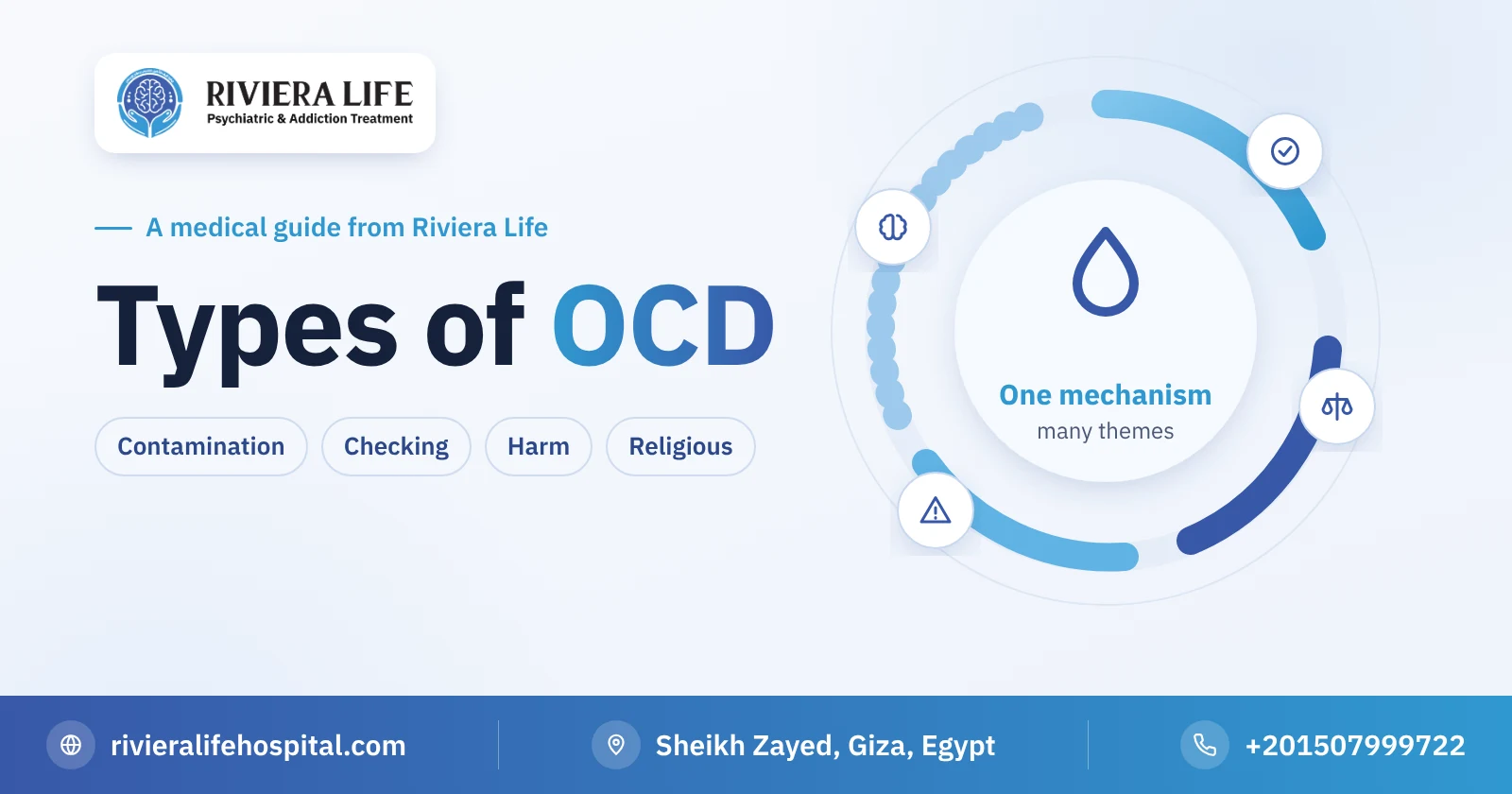
The types of OCD aren’t separate diagnoses in medical books, but themes around which intrusive thoughts and compulsions revolve: contamination, checking, symmetry, fear of harm, sexual thoughts, religious thoughts, doubt about relationships and others. The mechanism is the same in all types: a disturbing thought raises anxiety, then a visible or mental act to relieve it, so the anxiety returns stronger. Knowing the type of OCD helps the patient see that what they are going through is known and shared with millions of others, and helps the therapist design the treatment exercises. In this article we present each type briefly, and refer you to the specialized articles for those who want to go deeper.
Does OCD have official types?
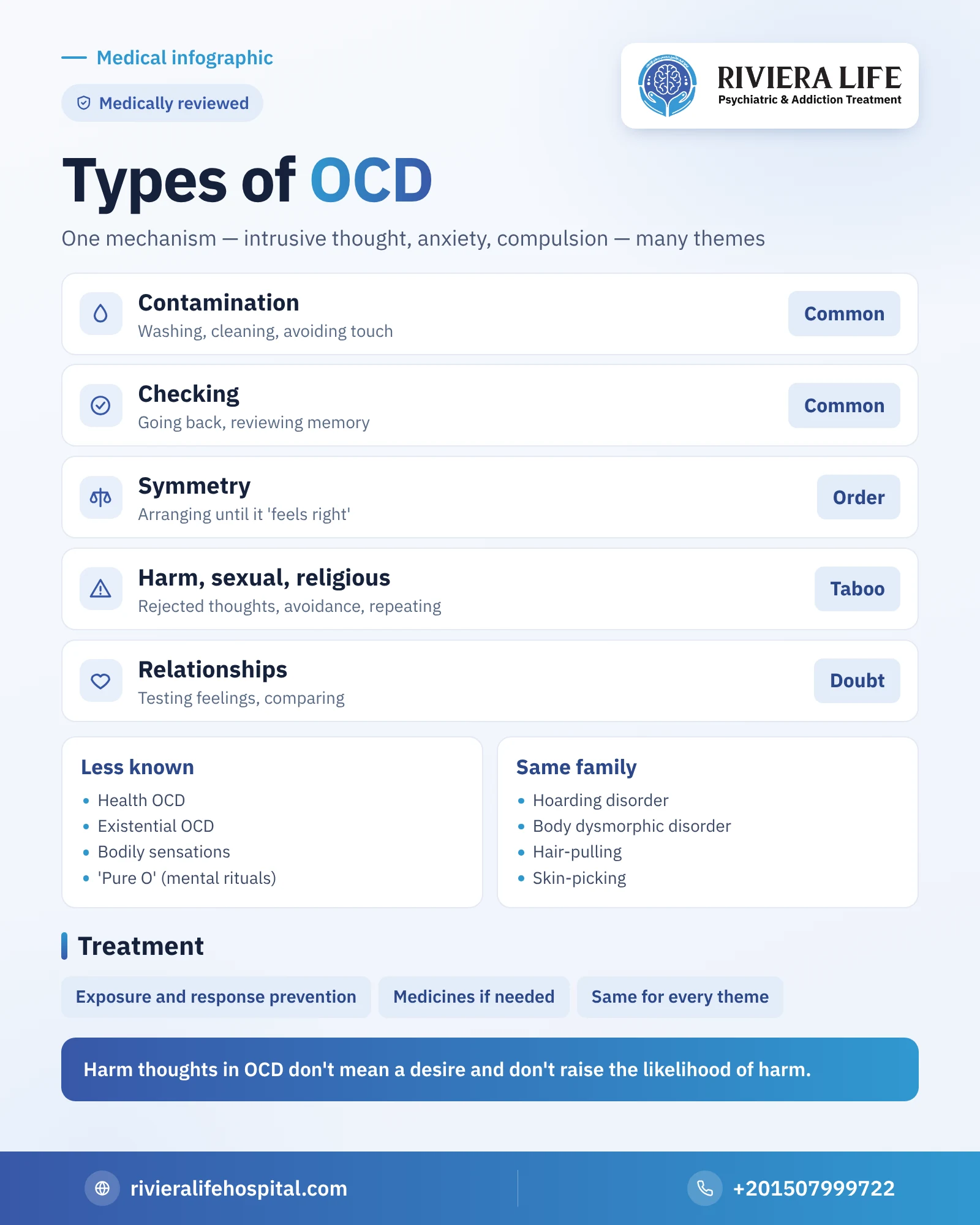
In the American Diagnostic Manual and the International Classification of Diseases, OCD is a single diagnosis. What the doctor officially specifies is the degree of insight: good if the patient realizes their fears are exaggerated, poor, or absent when they are completely convinced they are true. They also specify whether the patient has a history of motor or vocal tics. Dividing OCD into “types” by theme, however, is a practical division used by therapists and patients, and this article relies on it. Many patients have more than one type at the same time.
Contamination and cleanliness OCD
One of the most common types. The patient fears germs, infection, impurity, chemicals or body fluids, or feels a vague sense of dirtiness not linked to a specific danger. It is met by repeated washing of the hands and body, excessive cleaning of the house, and avoiding touching door handles, money and public toilets. We cover this type, its harms to the skin and the role of the family in detail in the article on cleanliness OCD.
Checking and doubt OCD
Did I turn off the gas? Did I lock the door? Did I hit someone with the car without noticing? The patient goes back to check again and again, and may photograph the stove with their phone before leaving then doubt the photo itself. The driver here is fear of responsibility for a disaster, and checking doesn’t convince because memory loses confidence in itself with every repetition. The relationship of doubt to OCD and the limits of normal doubt are explained in the article on OCD and doubt.
Symmetry and ordering OCD
Here the patient doesn’t always fear a disaster; sometimes the motive is a feeling that things are “not quite right”. The pens must be parallel, the steps equal on both feet, and writing is redone until it looks perfect. Some patients link ordering to a magical idea: “If I don’t arrange them something bad will happen to my mother”. This type takes an enormous amount of time and delays study and work, and it is more linked than others to a history of tics.
Harm OCD
Sudden thoughts or images of harming a loved one: a mother imagining she harms her baby, or a young man afraid of pushing someone in front of a train. These thoughts are terrifying to their owner precisely because they completely contradict their values, which is why they put knives away, avoid being alone with someone they love and review their memory to make sure they didn’t do anything. Doctors stress that these thoughts in OCD don’t mean a desire and don’t increase the likelihood of harm, and this is among the most important things the patient and family need to hear.
Sexual OCD
Intrusive and rejected sexual thoughts about people or situations that contradict the person’s values, or repeated doubt about orientation. They are met by examining feelings, avoidance and repeated confession. We explained this type and how OCD is distinguished from real desire in the article on sexual OCD.
Religious OCD
Care for worship turns into torment: repeating ablution and prayer, doubting intention, and fear of blasphemous thoughts that intrude on the mind against the person’s will. It is common in our societies among Muslims and Christians alike. We dedicate to it the article on religious OCD, which explains how the psychotherapist cooperates with a trusted religious figure in treatment.
Relationship OCD
Repeated doubt revolving around the romantic relationship: do I really love him? Is he the right person? Or around the partner’s flaws, like their nose or the way they laugh, in a way that consumes thinking. This is met by comparing the relationship with others’ relationships, examining feelings at every meeting, and repeatedly asking friends. The difference from normal doubt is that the thoughts are intrusive and painful, and that any answer only brings relief for moments. This type is widespread before engagement and marriage.
Less well-known types
- Health OCD: fear of getting an illness, met by checking and seeking reassurance, and in its picture it resembles illness anxiety, which the doctor distinguishes from OCD.
- Existential OCD: endless questions about the meaning of existence and reality, not out of curiosity but with pressing anxiety.
- Bodily sensations OCD: compulsive attention to breathing, swallowing or blinking that the patient can’t ignore.
- OCD that seems “without actions”: some think it is thoughts-only OCD, but the compulsions are present in the mind: reviewing, counting, and replacing one thought with another.
Hoarding and other disorders from the same family
Hoarding used to be considered a type of OCD, but it has become a separate disorder within the category of “obsessive-compulsive and related disorders”. Its owner finds severe difficulty getting rid of things until the house becomes crowded and life in it is disrupted, and usually doesn’t feel intrusive thoughts as in OCD. The category also includes body dysmorphic disorder, compulsive hair-pulling and compulsive skin-picking. Each has a treatment close to OCD treatment with special adjustments.
A quick comparison between the types
| Type | The intrusive thought | The most common compulsion |
|---|---|---|
| Contamination | I’ve been contaminated and will get sick or pass on infection | Washing, cleaning and avoiding touch |
| Checking | I forgot something that will cause a disaster | Going back to check and reviewing memory |
| Symmetry | Things aren’t as they should be | Arranging and redoing until the feeling is complete |
| Harm | I might harm someone I love | Avoidance, putting tools away and seeking reassurance |
| Sexual | A sexual thought that goes against my values | Examining feelings and avoidance |
| Religious | I made a mistake in my worship or sinned with a thought | Repeating worship and asking repeatedly |
| Relationships | Maybe I don’t really love my partner | Comparing and testing feelings |
How does the doctor determine the type of OCD?
It isn’t enough for the patient to say “I have OCD”. The doctor or therapist conducts a structured interview going through a long list of common thoughts and actions, because many patients are embarrassed to mention sexual, religious or harm thoughts unless asked about them directly.
A well-known scale is usually used that measures the time OCD consumes, the degree of distress, the amount of disruption, and the patient’s ability to resist. The doctor also asks about hidden compulsions such as mental reviewing, about accompanying depression and anxiety, and about a history of tics. This complete picture is what the ladder of exercises in treatment is built on, as the article on OCD symptoms explains, detailing the visible and hidden signs.
Does the type of OCD change?
Yes, and often. Checking OCD may begin in adolescence, then calm down so that relationship OCD appears before marriage, then harm OCD about the baby after birth. This happens because OCD usually attaches to what matters most to the person at their stage. The reassuring news is that a change of theme doesn’t change the treatment: OCD treatment with exposure and response prevention and medicines when needed targets the same mechanism, and the skills the patient learns with one type help them with others. And if you notice these pictures in yourself or a relative, the diagnosis is made by a psychiatrist after assessment, and at Riviera Life the first consultation is free via +201507999722.
More from the OCD guide
- OCD: the complete guide
- OCD symptoms: mental and behavioral signs
- Religious OCD: symptoms and treatment
- Cleanliness OCD: symptoms, the family’s role and treatment
- Compulsive hoarding: why can’t someone throw things away, and how is it treated?
- OCD test: instant result
Questions many people ask
Contamination and cleaning OCD and checking OCD are among the most widespread types. But many patients have more than one type at the same time.
It may seem so, but compulsions are often present inside the mind, such as reviewing, counting, replacing thoughts and seeking reassurance. They are treated the same way.
Hoarding has become a separate disorder within the category of OCD and related disorders. It differs from OCD in that its thoughts are usually not intrusive, and it has its own treatment.
The principle is the same: exposure and response prevention and medicines when needed. What differs is the exposure exercises, which are designed according to the theme of the obsession.
In OCD the thoughts are rejected by their owner and cause them terror, and they don't mean a desire or increase the likelihood of harm. The doctor distinguishes them from other conditions through assessment.