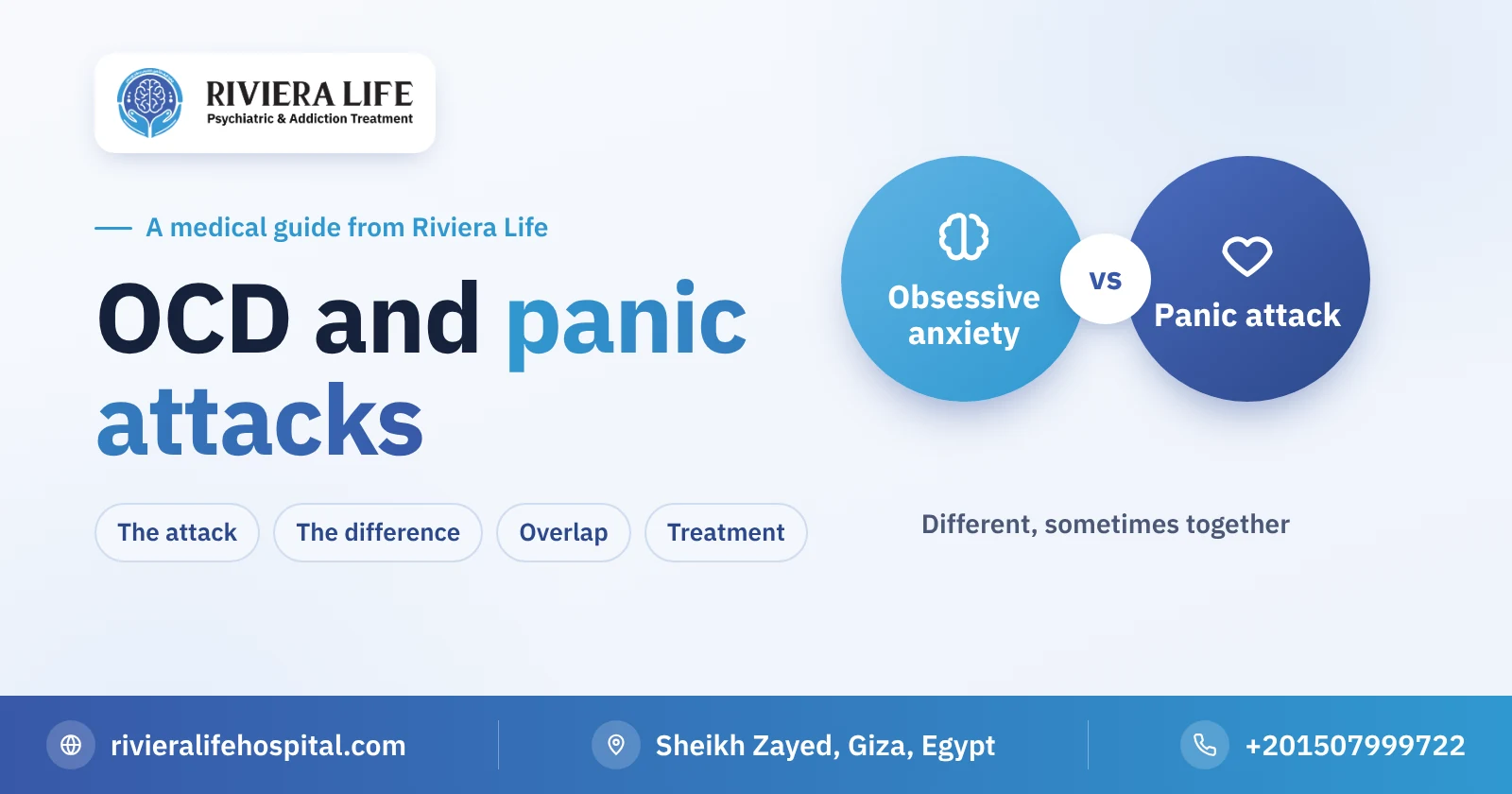
OCD and panic attacks are two different conditions that may meet. A panic attack is a sudden wave of fear that reaches its peak within minutes with palpitations, shortness of breath and a feeling of dying or losing control, while anxiety in OCD is tied to a specific thought and calms temporarily by performing the compulsive act. A person with OCD may go through a panic attack when prevented from their rituals or when facing what they fear most, and OCD may coexist with panic disorder in the same person. This article explains how to tell them apart, why they meet, how the treatment of each differs, and what to do during an attack.
What is a panic attack?
A panic attack is a sudden surge of intense fear or acute discomfort, reaching its peak within a few minutes, then calming gradually. It comes with strong physical signs that make the person think they are having a heart attack or are about to faint:
- Palpitations or a severely racing heartbeat.
- Shortness of breath or a feeling of choking.
- Pain or pressure in the chest.
- Dizziness or a feeling that the ground is swaying.
- Tremor, sweating and numbness in the limbs or face.
- A feeling that things are unreal or that the person is detached from themselves.
- Fear of dying, or of losing one’s mind or control.
A single attack does not mean a disorder, as many people go through one once in their life. Panic disorder, however, means repeated unexpected attacks, followed by constant worry about a new attack happening and a change in behavior to avoid it.
Obsessive anxiety and a panic attack: where is the difference?
Anxiety in OCD has an “address”: a thought about contamination, error or harm. It rises when the thought intrudes, and drops temporarily when the person performs the compulsive act. A panic attack, by contrast, may come “out of nowhere”, in the car, during sleep or in a quiet gathering with friends, and there is no specific act that puts it out; it ends on its own within minutes. The focus of fear in panic is the body itself: “my heart will stop” or “I’ll lose consciousness”, while the focus of fear in OCD is what may happen because of a thought or an act.
Does OCD cause panic attacks?
This may happen in certain situations. When a person with OCD finds themselves forced to leave their rituals before they “feel right”, or suddenly faces what they fear most, their anxiety may escalate to a degree that looks exactly like a panic attack. A patient with contamination OCD may have an acute attack if her child touches something she considers contaminated and she cannot clean it. This attack is “expected” because it is tied to the OCD situation. On the other hand, panic disorder coexists with OCD in a proportion of patients, so the person suffers from both types: sudden attacks with no clear cause, and obsessions and compulsions independent of them.
The difference between OCD and panic disorder
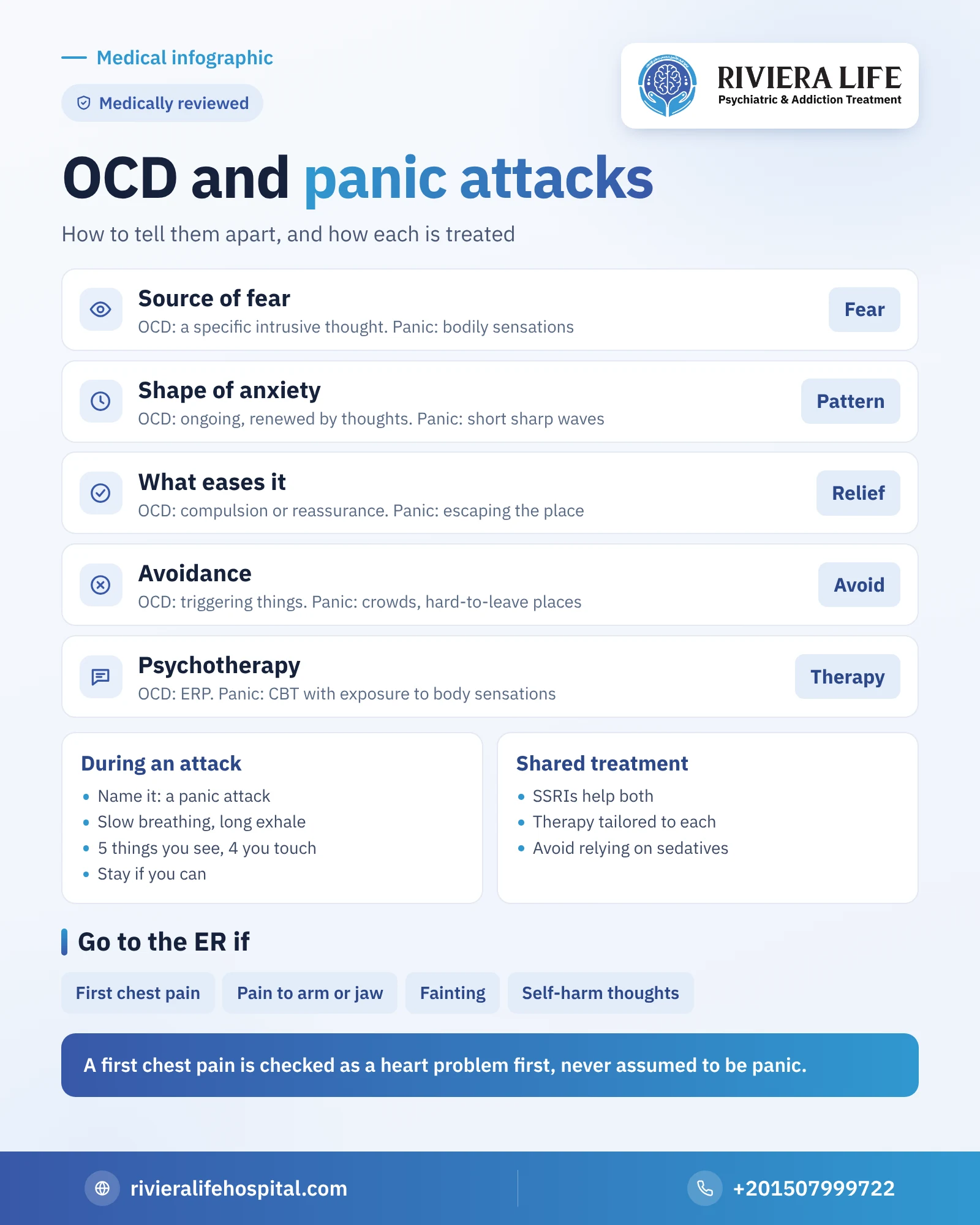
| Point of comparison | OCD | Panic disorder |
|---|---|---|
| Source of fear | A specific intrusive thought | Bodily sensations and sudden attacks |
| Shape of anxiety | Ongoing, renewed with the thoughts | Short, sharp waves |
| What eases it temporarily | The compulsive act or reassurance | Escaping the place or asking for help |
| Avoidance | Things and places that trigger the obsession | Places that are hard to leave, or crowds |
| Psychotherapy | Exposure and response prevention | Cognitive therapy with exposure to bodily sensations |
When fear of the attack becomes an obsession
After a frightening first panic attack, some people start monitoring their bodies constantly: they take their pulse several times a day, check their blood pressure, search the internet for symptoms of heart attacks, and ask the doctor for one ECG after another. Here the picture overlaps; repeated checking and reassurance work in the same way compulsive acts do: temporary relief, then fresh doubt. The psychiatrist needs to determine whether this is part of panic disorder, health anxiety, or OCD whose subject is the body. And each has different details in treatment. Get to know the wider picture in the article Types of anxiety.
Does a “khal’a” cause OCD?
“Khal’a” is a colloquial Egyptian word for a sudden fright or shock. A fright alone does not cause OCD, as its causes are a mix of genetic predisposition, brain chemistry and ways of thinking. But a frightening situation or severe pressure may be the spark after which symptoms appear in someone with a predisposition, or it may leave behind anxiety and panic attacks that become mixed up with the obsession.
So if the repetitive thoughts or rituals continue for weeks after the situation, the more correct step is a psychological assessment instead of waiting for them to go away on their own.
How does the doctor diagnose the condition?
The first step with attacks that resemble a heart attack is to make sure they are not one. That is why the doctor may ask for basic tests of the heart, thyroid and blood sugar, and ask about caffeine, stimulants and any medicines or substances the person takes, because some of them, or stopping some suddenly, such as sedatives, may cause similar attacks. After ruling out physical causes, the psychiatrist asks about the timing of the attacks and what precedes them, whether they are linked to obsessive thoughts or to particular situations, and about compulsive acts and avoidance. These details are what determine the precise diagnosis.
What do you do during a panic attack?
The attack is very distressing, but in itself it does not harm a healthy heart, and it ends on its own. What helps in those minutes:
- Remind yourself that it is a panic attack, and that it will reach its peak then calm within minutes.
- Breathe slowly: a calm inhale through the nose, then a longer exhale through the mouth, without trying to take fast deep breaths.
- Anchor your attention in what is around you: name five things you see and four you touch.
- Don’t flee the place immediately if you can, as staying teaches the brain that the situation is safe.
These steps are no substitute for treatment, but they reduce the terror that comes with the attack.
Treatment of OCD and panic attacks
The two disorders share some treatment tools and differ in others. Selective serotonin reuptake inhibitors help both, and the doctor chooses the type and dose to suit the case. Psychotherapy, however, is designed for each of them: exposure and response prevention for OCD, and cognitive therapy with gradual exposure to frightening bodily sensations for panic, such as a racing pulse after climbing stairs, until the brain stops interpreting them as danger. And when they occur together, the therapist orders the steps so that the patient is not exposed to pressure beyond what they can bear. The details of OCD treatment are in the article OCD treatment, and anxiety treatment in general in the article Anxiety treatment.
It is important to warn against relying on fast-acting sedatives to stop the attacks. They may bring relief in the short term, but their repeated use without supervision may lead to dependence, as happens with benzodiazepines, and then stopping them itself becomes a cause of anxiety and more severe attacks.
When do you go to the emergency department?
No one, not even the patient themselves, can be certain the first time that chest pain is a panic attack and not a heart attack.
Ask for urgent help immediately if there appears
Call the ambulance on 123 or go to the nearest emergency department to make sure the heart is healthy first.
- Chest pain that spreads to the arm or jaw or reaches the back
- Chest pain for the first time, or different from the usual attacks
- Fainting, or shortness of breath that does not improve after minutes
- An attack after taking stimulants or while stopping sedatives
- Thoughts of self-harm during or after the attack
How do you help a relative going through a panic attack?
Stay calm and close to them, and speak in short, clear sentences: “I’m with you, it will pass within minutes”. Breathe slowly in front of them so they follow your rhythm, and don’t tell them “calm down” in a sharp tone or “you’re imagining it”. And after the attack calms, encourage them to get a specialist assessment instead of settling for repeated emergency visits. At Riviera Life, psychiatry consultants distinguish between panic, OCD and health anxiety, and set a plan that treats what the patient actually has, in complete confidentiality. And to read more about anxiety in its types see the page Anxiety.
More from the OCD guide
- OCD: the comprehensive guide
- OCD symptoms
- OCD and depression
- OCD and doubt
- Panic attacks: how to tell them from a heart attack and what to do during an attack
Questions many people ask
It is not one of its core symptoms, but it may happen when the patient is prevented from their rituals or faces what they fear intensely. And OCD may coexist with panic disorder in the same person.
It usually reaches its peak within a few minutes then calms gradually, and fatigue or anxiety may remain for some time afterwards. Very long attacks, or ones different from usual, deserve a medical assessment.
The symptoms are similar, so you should go to the emergency department at the first chest pain or if the attack differs from usual. After making sure the heart is healthy, it can be dealt with as a panic attack.
Some medicines help both, but the psychotherapy differs: exposure and response prevention for OCD, and exposure to bodily sensations for panic. The therapist arranges the plan according to what the patient is suffering from.
The doctor may prescribe them for a short, defined period in some cases, but their repeated use without supervision may cause dependence and increase anxiety when stopping. The main treatment is long-term psychological and medical.