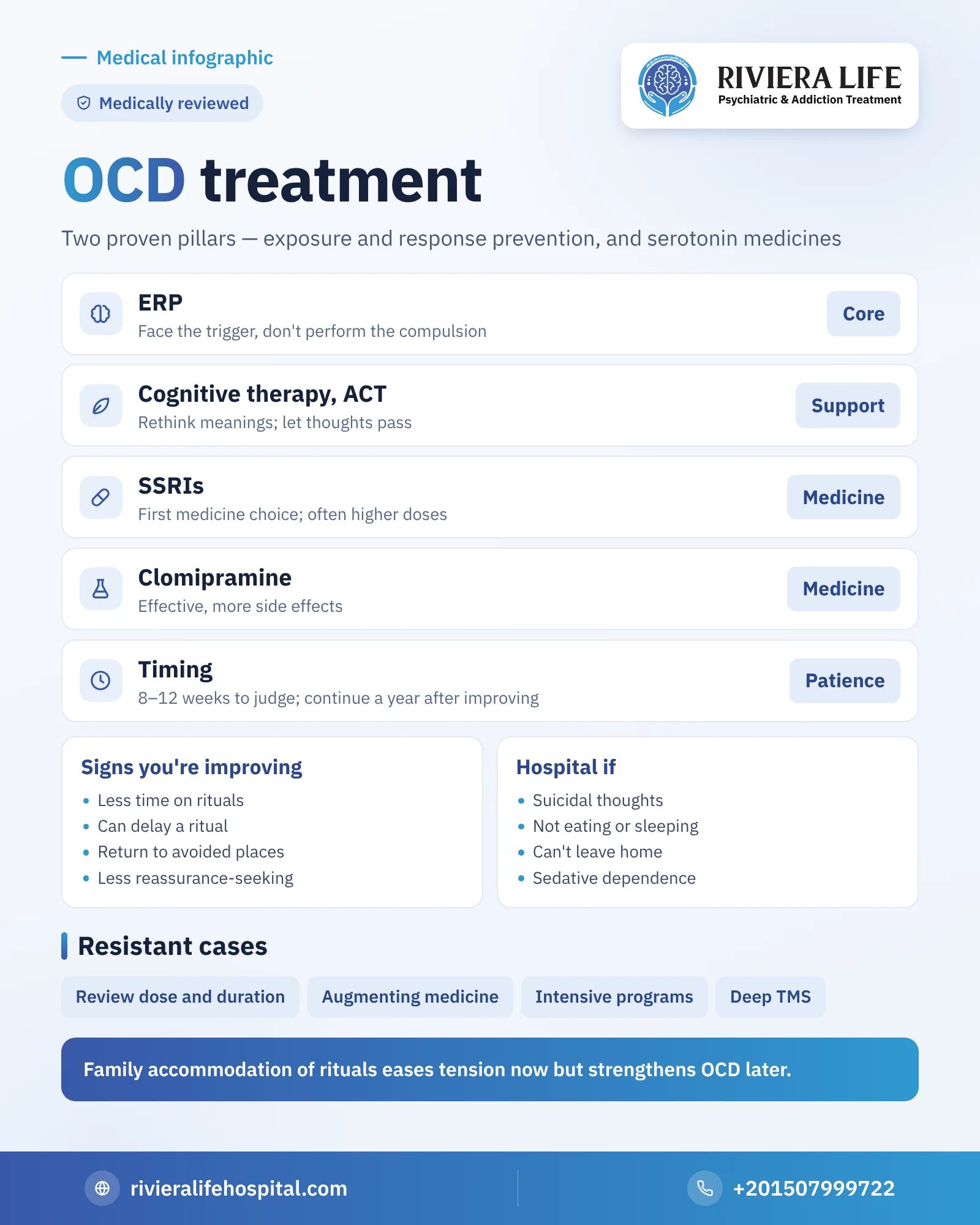
OCD treatment rests on two pillars whose effectiveness has been proven: cognitive behavioral therapy using exposure and response prevention, and medicines affecting serotonin chosen by the psychiatrist. They are sometimes combined, and sometimes one is enough, depending on the severity of the case. With regular treatment most patients improve clearly, although improvement takes weeks to months, not days. In this article you will learn about each option and how it works, when the case needs an intensive program or a hospital stay, and how to choose the right place for treatment.
Can OCD be treated?
Yes. OCD is one of the psychiatric disorders with well-studied treatments, and international guidelines indicate that most patients benefit from them to a tangible degree. The realistic goal of treatment isn’t for every disturbing thought to disappear forever, as passing thoughts are part of every human mind, but for obsessions to lose their power, for the person to stop carrying out compulsions, and to regain their time and life. Many patients reach a stage where the obsessive thought becomes “background noise” they pass by without it controlling them.
The first step: assessment and setting the plan
The psychiatrist starts with a detailed interview to learn the themes of the obsessions, the visible and hidden compulsions, the time they consume, and the degree of insight, and usually uses a validated scale to measure severity that is repeated later to follow improvement. They look for accompanying disorders that change the plan, most importantly depression, anxiety disorders, tics and use of sedative substances. Then a clear plan is written: what type of treatment, how many sessions, and when to reassess. And if you aren’t yet sure that what you are going through is OCD, start with our article on OCD symptoms.
Exposure and response prevention
This is the first psychotherapy for OCD. Its idea is simple and applying it takes courage: the patient gradually faces the situation that provokes their obsession, then refrains from performing the compulsion, and stays with the anxiety until it calms down on its own. With repetition the brain learns what it never learned before: that anxiety passes without washing or checking, and that the expected disaster doesn’t happen.
What does the plan look like in practice?
The patient writes with the therapist a list of feared situations ordered from easiest to hardest. A patient who fears contamination, for example, may start by touching a door handle inside the home without washing her hands for ten minutes, then move after weeks to touching handles in public places, then to eating without repeated washing. The patient isn’t forced into anything, and doesn’t move to a new step before the previous one becomes bearable. Homework is added between sessions, because daily practice is what makes the difference.
Cognitive therapy and supporting methods
Cognitive therapy helps the patient review the meanings they give their thoughts, such as an exaggerated sense of responsibility or the belief that a bad thought equals a bad act. Some therapists may use acceptance and commitment therapy, which trains the person to let the thought pass without struggling with it, and to move towards what matters to them in life even with anxiety present. These methods complement exposure and response prevention and don’t replace it in most cases.
Medicines used in OCD treatment
The psychiatrist chooses the medicine, its type and dose according to the case, other illnesses and the medicines the patient takes. The main classes are:
- Selective serotonin reuptake inhibitors: usually the first medicine choice, including fluoxetine, fluvoxamine, sertraline, escitalopram and paroxetine. In OCD the doctor may need higher doses than usually used in depression, and for longer.
- Clomipramine: an older antidepressant of the tricyclic class, effective in OCD, but with more side effects, so the doctor usually turns to it when the first class isn’t enough.
- Augmenting medicines: in cases that improve only partially, the doctor may add small doses of some newer antipsychotics to the main medicine, under close follow-up.
There are three facts the patient should know: the effect appears gradually and may need about 8 to 12 weeks to be judged, these medicines don’t cause addiction, and stopping them suddenly or right after improvement raises the risk of symptoms returning. Guidelines usually recommend continuing for at least a year after improvement, then reducing gradually under the doctor’s supervision. And avoid sedatives taken without a prescription to calm anxiety, because they don’t treat OCD and may lead to dependence, as with benzodiazepines.
How long does OCD treatment take?
An exposure and response prevention program usually runs between about 12 and 20 sessions, and may be longer in severe cases. The medicine is assessed after weeks, then continues for months. More important than the number of sessions is for the patient to gain the skill to become “their own therapist”, dealing with any new obsession before it grows. It is natural for symptoms to intensify a little in periods of stress after improvement, and this doesn’t mean treatment failed, but is a signal to use what they learned or for booster sessions.
Treatment-resistant cases
A considerable proportion of patients, possibly a third or more, don’t improve enough with the first treatment attempt. Before judging resistance, the doctor reviews: was the medicine taken at a sufficient dose and for a sufficient period? Was exposure actually applied, or were sessions limited to talking? Is there untreated depression or substance use? After that, other options are available, including changing the medicine or adding an augmenter, intensive daily programs, and deep transcranial magnetic stimulation, which has received international approvals for this use. Surgical deep brain stimulation is reserved for very rare, severely resistant cases in specialist centers.
When does an OCD patient need hospital?
Most patients are treated in the outpatient clinic, but a hospital stay is the most suitable option in cases including:
- Suicidal thoughts or accompanying severe depression.
- Symptoms that prevent the patient from eating, sleeping or looking after themselves.
- Complete inability to leave home or do any work.
- The need for an intensive daily exposure program that couldn’t be applied at home.
- Dependence on sedatives or drugs needing safe withdrawal before treating the OCD.
The details of the danger when OCD combines with thoughts of death are in our article on OCD and suicide.
Treating religious OCD
Religious OCD makes up a large proportion of cases in our communities: repeating ablution and prayer, doubting intention, fearing disbelief because of a thought, and doubting whether a divorce has taken place. It is treated in the same way, with exposure and response prevention and medicine when needed, but the therapist takes care to respect the patient’s beliefs. It may help to seek the opinion of a trusted religious scholar who clarifies the religious ruling on obsessive doubts, which usually calls for giving up repetition, so religion itself becomes a support for the plan rather than an obstacle to it.
The family’s role in the treatment journey
The family is affected by OCD and affects it. Answering reassurance questions, washing things the way the patient asks, and changing the home’s schedule to suit their rituals all ease tension in the moment and strengthen OCD in the long term. That is why a good plan includes family sessions in which they learn how to reduce this participation gradually and in agreement with the patient, and how to encourage them towards exposure without pressuring or mocking them. Our article on the harms of OCD sets out what the disorder leaves on the family if it lasts without treatment.
Signs of recovery from OCD: how do you know you’re improving?
Recovery doesn’t mean every disturbing thought disappears from your head forever, as that isn’t a realistic goal for anyone. The truest measure is the power OCD has over your day: how much of your time it takes, and how much it stops you doing.
Among the signs patients and doctors notice with improvement:
- The time rituals and checking consume daily falls clearly.
- You can postpone or skip a ritual despite some anxiety remaining, and then the anxiety calms down on its own.
- The intrusive thought comes and doesn’t drag you into a whirl of reviewing and arguing with it.
- You return to places and activities you used to avoid, such as eating out or touching public surfaces.
- Your need to seek reassurance from your family decreases.
- Your score falls on the scale the doctor repeats at follow-up.
Improvement doesn’t move in a straight line; symptoms may return temporarily in periods of stress or lack of sleep, and this doesn’t mean treatment failed, but is a signal to use what you learned or to visit the doctor. And don’t stop the medicine on your own when you feel better, as stopping follows a gradual plan.
You will find a description of the symptoms assessment starts from in OCD symptoms, and of the impact that recedes with treatment in the harms of OCD on life.
The right hospital for OCD treatment: how to choose
The right hospital for OCD treatment is one that offers what this patient specifically needs: real behavioral therapy with exposure and response prevention, not just talking sessions, a doctor who adjusts medicine patiently, and the ability to deal with accompanying depression or substance use. Before you decide, ask:
- Does the team apply exposure and response prevention with a written plan and homework between sessions?
- Does it have consultant psychiatrists experienced in resistant OCD and adjusting medicines?
- Does it measure OCD severity with a validated scale at the start and during treatment?
- Does it assess depression, suicide risk and accompanying substance use, and treat them within the same plan?
- Is an intensive program or an inpatient stay with continuous supervision available for severe cases?
- Does the program include the family and teach it how to stop taking part in rituals?
And it is wise to stay away from any provider that guarantees you a fixed recovery rate, or says OCD will disappear in a few days.
How Riviera Life meets these standards
Riviera Life meets the criteria above:
- Official accreditation: a psychiatry and addiction treatment facility operating under a license from the Ministry of Health.
- Specialist consultants: consultant psychiatrists set the plan and follow the medicine and improvement step by step.
- A structured behavioral treatment plan: gradual exposure and response prevention with an individual plan suited to the theme and severity of the obsessions.
- Round-the-clock medical supervision: for severe cases or those accompanied by depression and dangerous thoughts.
- Dual diagnosis treatment: safe withdrawal from any accompanying sedatives or substances, then completing OCD treatment.
- Years of experience: over fourteen years we have helped thousands of patients recover from psychiatric disorders and addiction.
- Complete confidentiality: the patient’s thoughts and data are protected at every stage.
- Follow-up that protects improvement: a program that includes the family, and aftercare that reduces the chance of obsessions and compulsions returning.
The first consultation costs you nothing, and you can call us at any hour on +201507999722; we are based in Sheikh Zayed, Giza.
More from our OCD guide
- OCD: the complete guide
- The causes of OCD and its risk factors
- OCD and depression: the relationship and treatment
- OCD symptoms
- Anafranil (clomipramine): uses, side effects and warnings
- Body dysmorphic disorder: when a small flaw becomes a daily obsession, and how it is treated
- Trichotillomania: why the hand won’t stop, and how habit reversal treats it
- Religious OCD: when care for worship turns into torment
- Fluvoxamine (Faverin): OCD and drug interactions
- OCD and drugs: when the substance turns from a solution into part of the problem
- Transcranial magnetic stimulation: how it works, who it’s for and its side effects
- OCD test: an instant result
Questions many people ask
Cognitive behavioral therapy using exposure and response prevention is the first psychotherapy, and a serotonin reuptake inhibitor is added in moderate and severe cases. Combining the two suits many patients.
Improvement starts gradually over weeks, and the doctor usually needs about 8 to 12 weeks to judge the medicine's benefit. Don't stop it early because you haven't felt a difference.
Yes in many mild and moderate cases, if the patient commits to an exposure and response prevention program with a trained therapist. Severe cases, or those with depression, usually benefit from adding medicine.
Some symptoms may return in times of stress or when medicine is stopped early. Someone who has learned exposure skills can usually contain them quickly, and booster sessions help with that.
Choose a licensed hospital that applies real exposure and response prevention with a written plan, has consultant psychiatrists experienced in adjusting medicines, measures severity with a validated scale, and offers intensive care for severe cases and a family program. Riviera Life in Sheikh Zayed meets these criteria.