Research shows a link between OCD and suicide that deserves attention: obsessive-compulsive disorder is associated with a higher risk of suicidal thoughts than in the general population, especially when it comes with depression or goes on for a long time without treatment and the person reaches hopelessness. But this risk can be greatly reduced: treatment works, asking directly protects, and seeking help at the right time saves lives. And not every disturbing thought of self-harm is a wish to die; some are obsessional thoughts the person dreads. This article explains the warning signs, how families can tell the two apart, how to respond, and where to get help immediately in Egypt.
If you are thinking of ending your life right now
If you are reading these lines feeling that you can’t bear it any more, stop here for a moment. What you feel right now is very painful, but it isn’t permanent, and pain that seems endless can ease with the right help. Don’t stay alone: talk now to someone you trust, call an ambulance on 123, or go to the nearest emergency department. You can also contact the hotline of the General Secretariat of Mental Health and Addiction Treatment on 16328 or 0220816831. Asking for help isn’t weakness — it is the bravest step you can take today.
OCD and suicide: is OCD linked to suicidal thoughts?
Yes. Studies suggest that people with OCD are more prone to suicidal thoughts than the general population, and that the risk is higher in certain groups among them. But it is important to keep this in proportion: most patients don’t harm themselves, and a link doesn’t mean inevitability. What it means is that the doctor asks about these thoughts in every assessment, and that families should know the signs and take them seriously without panic.
Why is the risk higher in some patients?
The risk doesn’t come from OCD alone, but from factors that gather around it:
- Accompanying depression: the strongest of these factors, explained in detail in our article on OCD and depression.
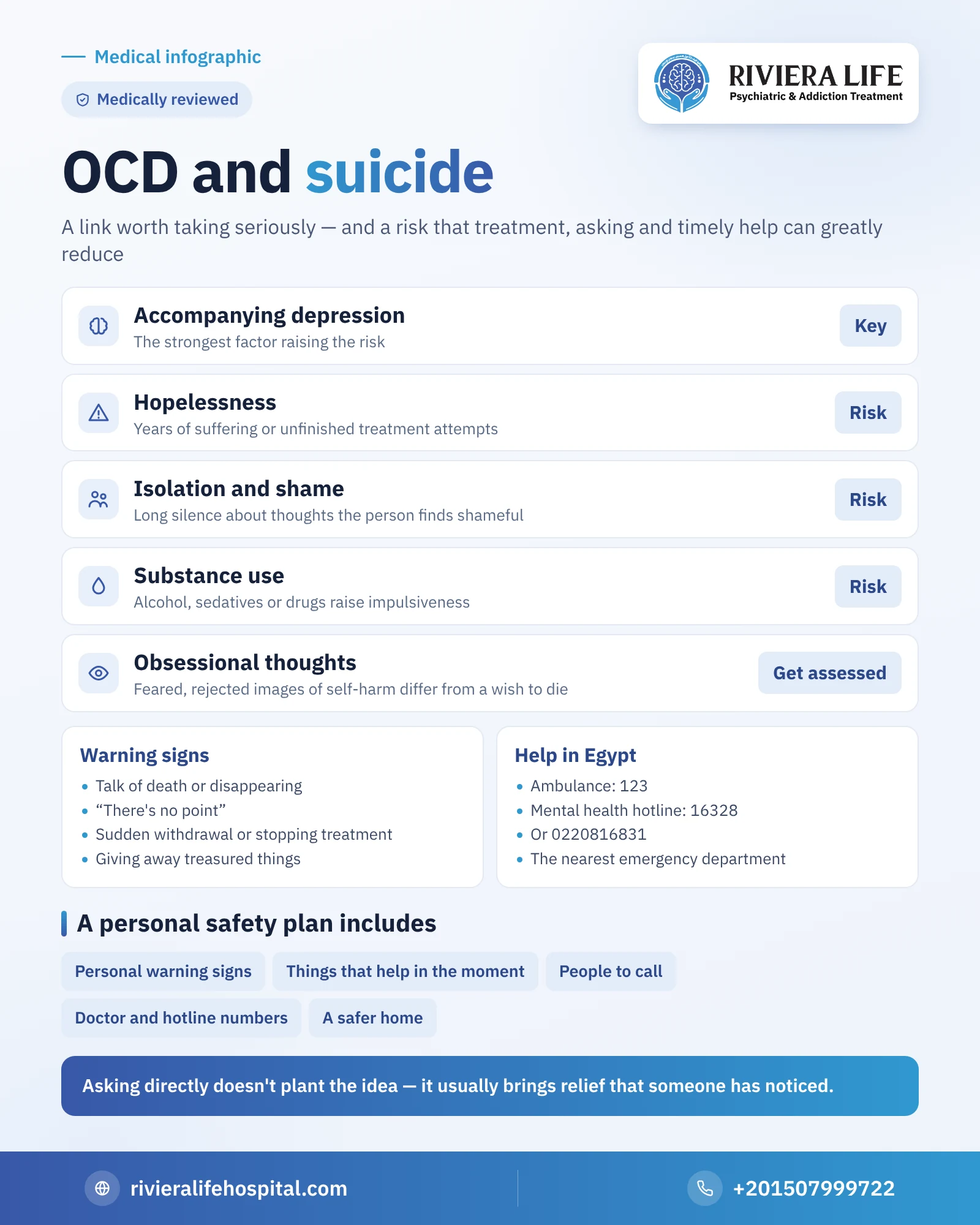
- Hopelessness: the patient feeling they have tried everything and nothing will change, especially after years of suffering or treatment attempts that weren’t completed.
- Severe symptoms that disrupt life: losing work, study or relationships.
- Isolation and shame: long silence about thoughts the person considers shameful.
- Using alcohol, sedatives or drugs, because they increase impulsiveness and deepen depression.
- A previous attempt at self-harm, or a family history of it.
Obsessional thoughts of self-harm, or suicidal thoughts?
Some people with OCD are invaded by sudden images or impulses of harming themselves; they feel intense terror at them, and avoid high places or sharp objects for fear of “losing control”. These are obsessional thoughts the person rejects, and they differ from suicidal thoughts, in which the person feels a wish to die or that life is no longer worth living. But this distinction shouldn’t be made by the patient or the family alone, because the two can occur together, and a mistaken judgment carries a heavy price. The safe rule: any thought of self-harm, obsessional or not, deserves to be told to a psychiatrist.
Warning signs families should watch for
- Talking about death, about wanting to disappear, or that others would be better off without them.
- Expressions of hopelessness: “There’s no point”, “I’ll never get better”, “I’m tired of everything.”
- Sudden withdrawal from family and friends, or stopping treatment.
- A clear change in sleep and eating, or neglecting personal hygiene — even in those who used to overdo it.
- Giving away treasured belongings or saying goodbye to people in an unusual way.
- Increased use of sedatives, alcohol or any substance.
- A sudden, unexplained calm after a long period of severe distress.
How to ask someone you are worried about
Many people fear that asking will plant the idea in the person’s mind, but research doesn’t support this; on the contrary, a calm, direct question usually brings relief, because someone has noticed their pain. Choose a calm time and a private place, and say clearly: “I’ve noticed you’ve been very worn down lately — are you thinking of harming yourself, or of dying?” Then listen without interrupting, lecturing or blaming, and don’t promise to keep secret something that threatens their life.
What to do if they tell you about their thoughts
Thank them for trusting you, and tell them you will help them get specialist support. If the thoughts are persistent or come with an intention or a plan, don’t leave them alone, remove spare medicines and objects that may be dangerous from their reach, and ask for help immediately.
Get urgent help immediately if you see
Call an ambulance on 123 or go to the nearest emergency department, and stay with the person until help arrives.
- Open talk of an intention to end their life, or a plan
- A recent previous attempt or self-harm
- Saying goodbye to people or writing farewell letters
- Severe hopelessness with stopping eating, sleeping or treatment
- Hearing voices telling them to harm themselves
Where to get help in Egypt
- The ambulance: 123, or the nearest emergency department in a general or psychiatric hospital.
- You can call the hotline of the General Secretariat of Mental Health and Addiction Treatment: 16328 or 0220816831.
- The treating psychiatrist, if the person is already being followed by a doctor.
- Riviera Life for psychiatry and addiction treatment: +201507999722 around the clock, with continuous medical supervision for cases that need a safe inpatient stay.
The role of treatment in protecting the patient
Treating OCD and the depression that accompanies it is the most important thing for lowering the risk in the long term. When symptoms ease and the patient gets their time and relationships back, the hopelessness that feeds suicidal thoughts recedes. At critical times the doctor may recommend a hospital stay to ensure safety and adjust treatment quickly under continuous supervision. It is important for the patient and family to know that the first days after starting some antidepressants, especially in young people, need close follow-up, and that any increase in suicidal thoughts must be reported to the doctor immediately, without stopping the medicine on your own. The details of the treatment options are in our article on OCD treatment.
A personal safety plan
The therapist draws up a short written plan with the patient to return to in difficult moments, which usually includes:
- The personal signs that warn a crisis is starting.
- Simple things that help them get through the moment, such as walking or talking to a friend.
- Names and numbers of people they can call at any time.
- The numbers of the doctor, the emergency services and the hotline.
- Steps to make the home safer during critical periods.
After the crisis has passed: what should the family do?
The weeks after any crisis, or after leaving hospital, need special attention, because this is a period when the patient is more fragile. Keep up calm daily contact without suffocating surveillance, help them stick to follow-up appointments and medication, and agree with them on a signal or word to use if the thoughts come back. Avoid blaming phrases such as “How can you think like that when you have a family?” — they increase guilt and don’t protect. And look after yourselves too: a family carrying this worry alone is quickly drained, and it has the right to ask the treating team for support and guidance. To understand the depression that usually lies behind these crises, see our page on depression.
A message of hope
Many people who have been through the darkest moments of OCD and depression are living calm, stable lives today. It didn’t happen through willpower alone, but through the right treatment and the support of people who didn’t leave them. At Riviera Life, consultant psychiatrists deal with these cases in complete confidence and without judgment, and the first consultation is free. To learn about the disorder from the beginning, see our page on obsessive-compulsive disorder.
More from our OCD guide
- OCD: the complete guide
- OCD and depression
- OCD and psychosis
- OCD treatment
- Suicidal thoughts: help is available now, and how to protect yourself and those you love
Questions many people ask
No. Some thoughts are obsessions that the person fears and avoids. But a psychiatrist is the one who tells the two apart, and any thought of this kind deserves to be mentioned to them.
No, research doesn't support this. A calm, direct question usually makes them feel someone cares, and it opens the door to asking for help.
Accompanying depression is the strongest factor, along with hopelessness, long suffering without treatment and substance use. Treating depression and OCD together lowers the risk.
Don't leave them alone, remove medicines and dangerous objects from their reach, and call an ambulance on 123 or go with them to the nearest emergency department.
Yes: the hotline of the General Secretariat of Mental Health and Addiction Treatment on 16328 or 0220816831, and in an emergency call an ambulance on 123.