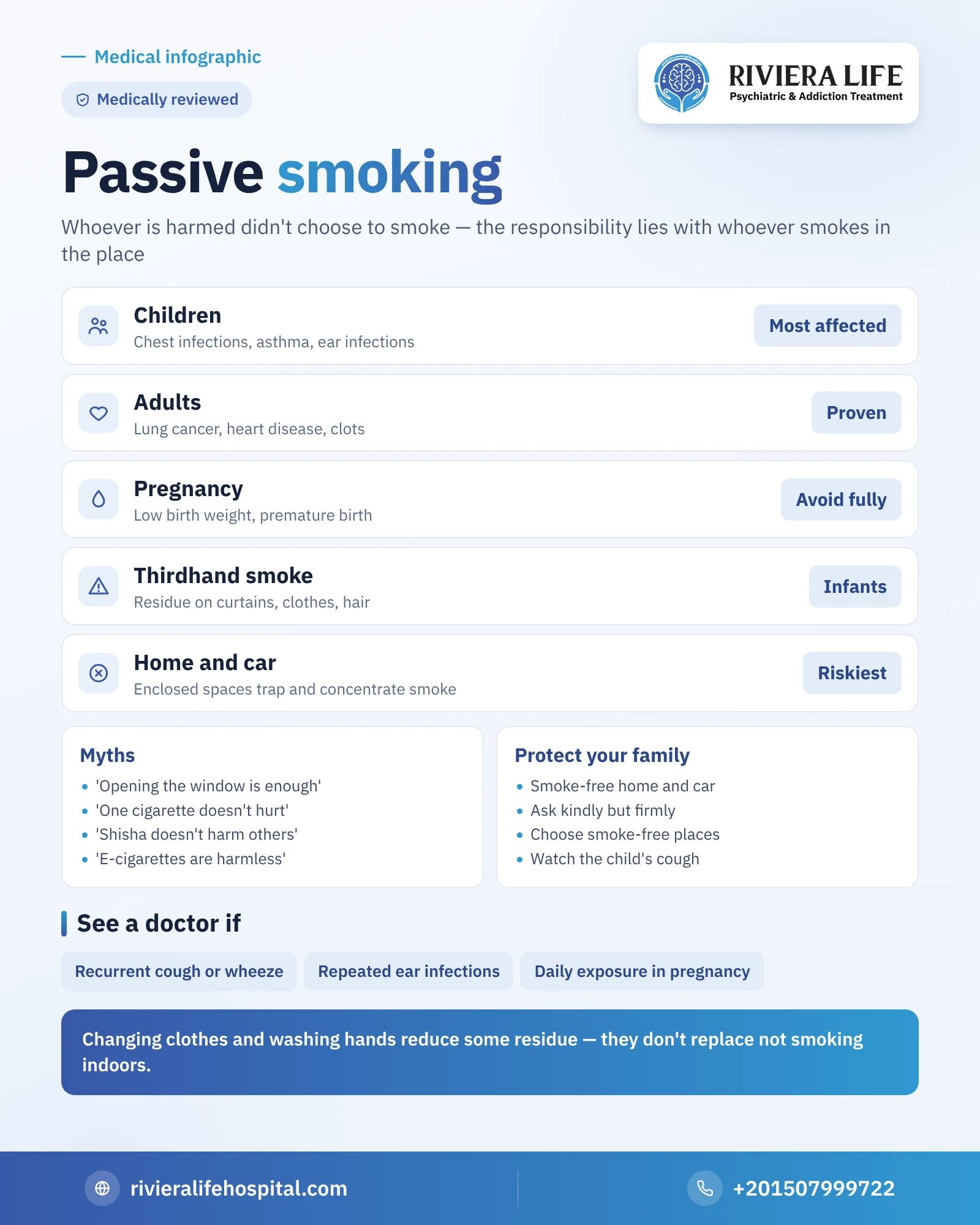
The harms of passive smoking affect everyone who breathes in the smoke of a cigarette or shisha smoked by someone else, which is the smoke given off by the burning end of the cigarette plus what the smoker breathes out. This smoke contains hundreds of harmful substances, a large number of which are known to cause cancer. Health bodies don’t set a safe limit for exposure to it, and it affects children, pregnant women and heart and asthma patients more than others.
And because the person harmed didn’t decide to smoke, the responsibility here lies with whoever smokes in the place. In this article we explain what smoke does to those around the smoker, how to protect children and pregnancy, and what actually reduces the harm and what people think is a solution.
What is meant by passive smoking?
A person sitting in a room where someone else smokes breathes two mixtures of smoke: the first rises from the end of the cigarette between puffs, and the second is breathed out by the smoker. The first is more concentrated in some toxic substances because it burns at a lower temperature. This explains why a little distance or opening a side window doesn’t protect from the smoke enough.
Research adds a third concept called “thirdhand smoke”, which is the smoke residue that sticks to curtains, furniture, clothes, carpets and hair, and remains long after the cigarette is put out. It is a source of particular concern for infants who touch surfaces and put their hands in their mouths, though the size of its health effect is still being studied.
What does smoke do to adults?
The proven harms in non-smokers constantly exposed to smoke include:
- An increased risk of lung cancer, even though the person has never smoked in their life.
- An increased risk of heart and artery disease and clots, as smoke affects the walls of the vessels and makes the blood more prone to clotting.
- Irritation of the eyes, nose and throat, coughing and headache.
- Worsening of asthma and chest diseases, and it may cause an attack in those with allergies.
The World Health Organization estimates that more than a million non-smokers die every year because of exposure to other people’s smoke, and the number remains approximate and changes as studies change. What matters is that the harm is real, not just an annoyance.
Children: the most affected
A child’s body breathes faster than an adult’s, their lungs are still growing, and they don’t have the choice of leaving the room. That is why exposure to smoke in childhood is linked to the following:
- Chest and bronchial infections and pneumonia more frequently.
- Asthma, its wheezing and more severe attacks, and asthma may actually begin in some children because of it.
- Repeated middle ear infections and fluid collecting behind the ear.
- Chronic coughing and poor lung growth.
- An increased risk of sudden infant death syndrome with exposure to smoke before and after birth.
Many fathers smoke “away from the child” in the next room or on the balcony, and think the matter is settled. But smoke travels through doors and ventilation, and sticks to the smoker’s clothes and hair, so he carries it into his child’s arms. And the matter has a behavioral side too: a child who sees his father smoke sees a normal behavior, and may grow up more inclined to imitate it.
Pregnancy and passive smoking
A pregnant woman exposed to her husband’s or colleagues’ smoke breathes in part of the same tobacco substances, and some of them reach the fetus. Studies link this exposure to low birth weight, an increased risk of premature birth, and breathing problems in the newborn. And there is no level proven to be safe. So if you are pregnant, make your home and car smoke-free, ask those around you not to smoke in front of you without embarrassment, and tell your doctor if you are exposed to smoke at work. This fits into the overall picture of protecting the fetus from harmful substances presented in the article on drugs and pregnancy.
The home and the car: the two most dangerous places
Enclosed places trap smoke and concentrate it. And the car is smaller and more enclosed than any room, so the concentration of smoke in it rises quickly even with the window slightly open. That is why banning smoking in the car, especially with children present, is among the simplest and most useful decisions.
At home the matter is clearer: it isn’t enough for the person to smoke in a certain room, in front of the window or beside the fan, as these measures reduce the smell more than they reduce the toxic substances. Changing clothes after smoking and washing hands before holding the child reduce part of the remaining smoke, but don’t replace not smoking.
Common ideas that aren’t true
- “Opening the window is enough”: it reduces the smell, but doesn’t remove the particles and toxic substances that spread in the place.
- “One cigarette doesn’t hurt”: there is no safe level, and children of smoking families are exposed daily and for hours.
- “Shisha doesn’t harm those around it”: its smoke and the smoke of the charcoal under it contain harmful substances that those sitting breathe in, and the article on the harms of shisha goes into detail.
- “E-cigarettes are harmless to those around me”: their vapor isn’t clean air, and contains nicotine and fine particles, as the article on e-cigarettes explains.
- “An air purifier solves the problem”: it may reduce part of the particles, but it doesn’t make smoking inside the home safe.
At work and in public places
Exposure isn’t limited to the home. Cafés, enclosed restaurants, meeting rooms where colleagues smoke and small car parks are all places where the non-smoker breathes in smoke for hours. The most exposed people are those working in places where smoking is common, because their exposure is daily and extends for years. And if you suffer from asthma or a heart condition, you have the right to ask for a smoke-free place without it being considered fussiness or being difficult.
How do you protect yourself and your family?
- Make the home and car completely smoke-free, and set the rule for all visitors without exception.
- Ask for abstention kindly and firmly: “My son has asthma, would you smoke outside the house?” is a simple phrase that spares you a long argument.
- Choose smoke-free places when going out to eat and sit with children.
- If you work in a café or a smokers’ place, ask about labor laws and the ventilation of the place, as workers in these places are among the most exposed people.
- Watch the child’s symptoms: a night cough, wheezing or repeated ear infections may be linked to smoke at home; show them to the pediatrician.
What if the smoker is a family member?
The subject often turns into a daily disagreement, and the smoker feels guilty or attacked so smokes more. It is better to start with what you love about him, not what you hate: you want him in good health beside his children. Ask for a clear rule for the home and car first, then suggest he consult a doctor about quitting. The smoker has a practical plan in the article on quitting smoking, and an understanding of why stopping is hard for him in nicotine addiction. Nicotine is a substance that causes addiction, and no one stops through sermons alone.
When do you need medical advice?
See the doctor if a child develops a recurrent cough, wheezing or repeated chest and ear infections in a home with smokers, if a pregnant woman is exposed to smoke daily, or if a family member wants to quit and doesn’t succeed. And if his smoking is linked to anxiety, depression or other substances, a specialist assessment helps draw up one plan that includes everything.
How does Riviera Life help you?
The consultants in psychiatry and addiction treatment at Riviera Life, a hospital licensed by the Ministry of Health with fourteen years of experience, can assess those who don’t succeed in giving up smoking or nicotine and set a plan that suits them, with a family program and follow-up after treatment. The first consultation is free and confidential, and contact is around the clock on +201507999722; we are based in Sheikh Zayed, Giza.
More from the smoking and nicotine guide
- Quitting smoking: a practical plan
- Nicotine addiction: symptoms, withdrawal and harms
- The harms of shisha
- E-cigarettes: nicotine and harms
- Smoking and nicotine: the complete guide
Questions many people ask
Health bodies don't set a safe level of exposure to other people's smoke, and it is best to stay away from it, especially for children and pregnant women.
No, smoke travels through doors and ventilation and sticks to clothes and hair and reaches the child, and the safest thing is for the home and car to be smoke-free.
It is linked to low birth weight, an increased risk of premature birth and breathing problems, which is why avoiding it completely is advised.
It is the smoke residue that sticks to furniture, clothes and curtains, and remains after the cigarette is put out, and it matters especially for infants because they touch surfaces.
No, it contains nicotine, fine particles and irritating substances, and isn't clean air, especially in enclosed places.