The harms of shisha are wider than those who see it as social entertainment think: it delivers nicotine, carbon monoxide, tar and heavy metals into the body, and adds to them the danger of burning charcoal and a mouthpiece passed around everyone sitting there. Many believe that passing the smoke through water purifies it, or that “fruit-flavored tobacco” is lighter, and these are among the best-known false ideas. A single session usually lasts about an hour, in which the smoker inhales a large amount of smoke. In this article we take apart the common myths, and explain the risks of shisha to the lungs, heart, pregnancy and infection, when it becomes an addiction and how to begin quitting.
What enters your body in a shisha session?
Flavored shisha tobacco, a mixture of tobacco with honey or sweetener and flavoring, is placed in the shisha head, covered with aluminum foil and burning charcoal is put on it. The charcoal heats the tobacco and smoke rises, passes through the water and then through the hose to the mouth. The tobacco isn’t burned by direct fire as in a cigarette, but the heat of the charcoal is enough to produce smoke carrying:
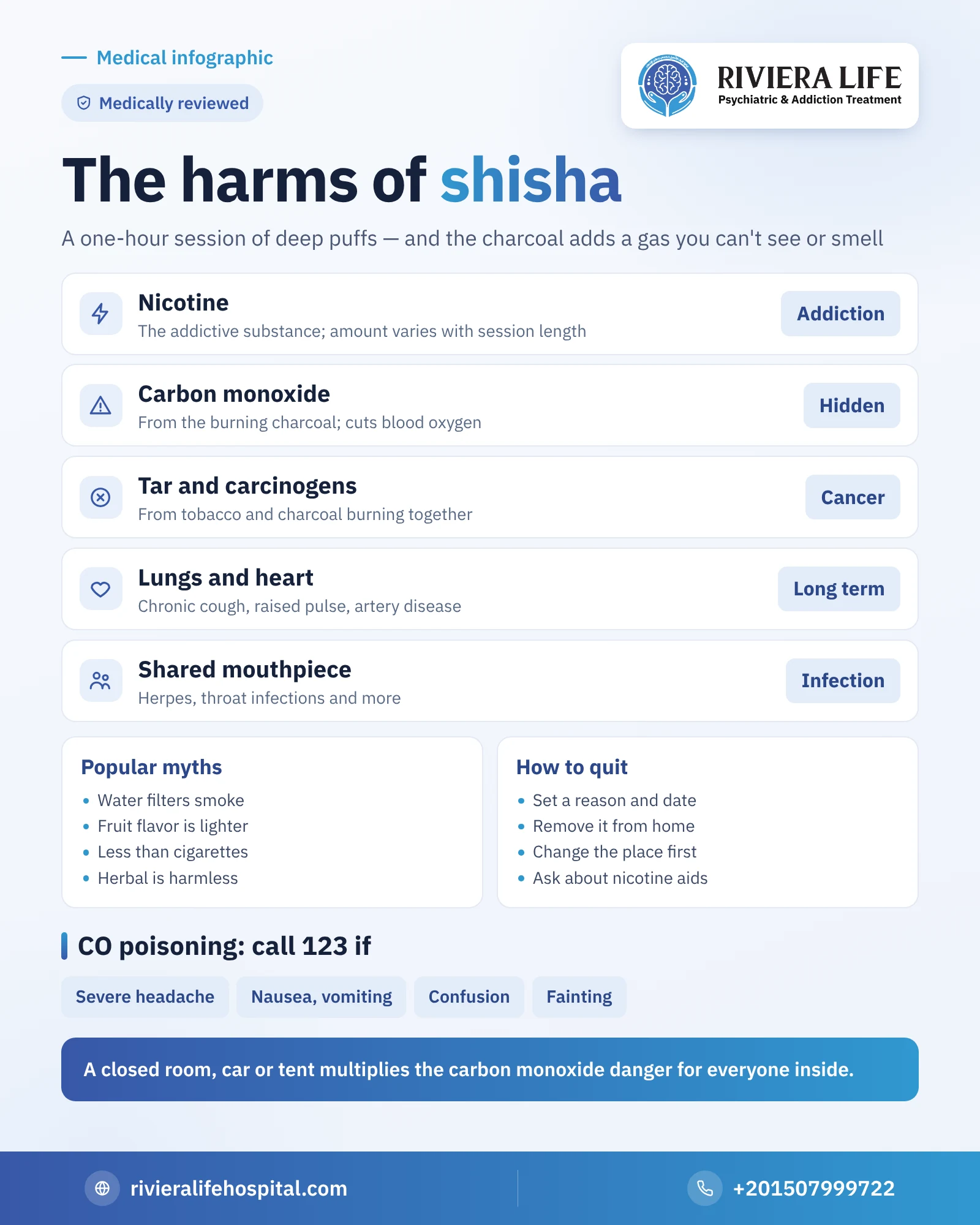
- Nicotine: the substance that causes addiction, its amount varying with the type of tobacco and the length of the session.
- Carbon monoxide: a toxic gas produced by the burning of charcoal, which reduces the blood’s ability to carry oxygen.
- Tar and carcinogens: the products of tobacco and charcoal burning together.
- Heavy metals and irritants: such as lead and arsenic in amounts that vary with the product.
The essential difference between shisha and a cigarette is that a cigarette ends after minutes, while shisha lasts an hour or more, in which the smoker takes long, deep, successive puffs. This means that the total volume of smoke entering the lungs in one session is much larger than with a single cigarette, even if each puff seems lighter.
Common shisha myths
“The water filters the smoke”
The water cools the smoke and makes it smoother on the throat, which is why the person inhales deeper and longer puffs. But it doesn’t remove nicotine, carbon monoxide or most carcinogens. The result is that the smoke seems gentler while much reaches the lungs.
“Fruit-flavored tobacco is lighter”
The flavor changes the taste and smell, and doesn’t change the fact that the basic material is burned tobacco. In fact, the sweetness of the taste encourages inhaling more and staying longer.
“Shisha is less harmful than a cigarette”
Health authorities state that a single session may expose the smoker to an amount of smoke equal to that in a large number of cigarettes, and to large amounts of carbon monoxide. The figure varies with the length of the session and the way of inhaling, so it isn’t right to be reassured by a comparison that makes it seem “less”.
“Nicotine-free shisha or herbs are harmless”
“Tobacco-free” shisha made from herbs or dried fruit isn’t free of harm, because burning any plant material over charcoal produces tar and carbon monoxide. Nicotine may be less, but the rest of the toxins remain.
“Once a week doesn’t hurt”
A weekly session means hours of dense smoke, and it remains a social habit that is hard to reduce because the craving comes with the place and the company. And regular exposure, even if spaced out, raises the risks compared with someone who doesn’t smoke at all.
Carbon monoxide: the hidden danger
Burning charcoal produces a gas with no color or smell. When sitting in a closed room or a poorly ventilated café, the concentration of the gas in the air may rise, so smokers and workers are poisoned without sensing its cause. Medical reports describe cases that reached the emergency department after sessions in closed places. The danger increases when shisha is used in a bedroom, a car or a closed tent.
Call an ambulance on 123 immediately if, after a shisha session, you see
These are possible signs of carbon monoxide poisoning, and those around you may be exposed as you are:
- Severe headache and dizziness
- Nausea or vomiting
- Confusion or unusual drowsiness
- Shortness of breath or chest pain
- Fainting or loss of consciousness
Take the affected person out into the open air immediately, get those with him out of the place, then call an ambulance.
Shisha, the lungs and the heart
In studies shisha is linked to bronchitis, chronic cough and weak breathing, to an increased risk of lung cancer, and to raised blood pressure and pulse rate and an increased risk of artery disease. Nicotine together with carbon monoxide may increase the burden on the heart faster than a young man expects. Health sources also point to its link with cancers of the mouth, esophagus, stomach and bladder, and with gum disease and tooth decay.
Infection from a single mouthpiece
One of the peculiarities of shisha is that it is passed around a group. If those sitting share the same mouthpiece without sterilizing it or without a personal mouthpiece, infections of the mouth and respiratory system may be transmitted, including herpes, throat infections and colds, and more serious diseases such as tuberculosis may be transmitted in certain conditions. Health authorities warn of this risk, and the problem grows with poor cleaning of the hoses and water in some places. Disposable or personal mouthpieces don’t solve the whole matter, as the smoke itself remains harmful.
Pregnancy, children and those sitting around you
Smoking during pregnancy, with shisha or anything else, is linked to low birth weight and an increased risk of premature birth. And whoever sits around shisha smokers, especially in a closed place, inhales similar smoke and the charcoal gas with it. A child in a home where shisha is smoked is exposed to what the children of smokers are exposed to, and you will find the details in our article on the harms of passive smoking.
Is shisha addictive?
Yes, flavored shisha tobacco contains nicotine, and with long sessions it reaches the blood in large amounts. Many don’t realize their addiction because the shisha habit is linked to the place and friends, so they think it is “a night out” and not dependence. But someone who feels tension or distress if days pass without a session, thinks about shisha in the morning, or smokes shisha at home daily, has a dependence on nicotine. Our article on nicotine addiction explains the signs and withdrawal symptoms.
Combining shisha and cigarettes
Many young people smoke cigarettes all week and shisha on the weekend, or switch between them whenever they try to reduce one. Combining them doubles the daily dose of nicotine and harmful substances and makes stopping harder, and if you decide to quit, put them both in one plan. And include in the same plan any other nicotine product you use, such as toombak or e-cigarettes, because moving from one product to another doesn’t count as quitting.
How do you quit shisha?
- Set the reason and the date: your health, a child on the way, or saving money, and choose a day soon.
- Get rid of the shisha at home and take its accessories out of your car and workplace.
- Change the place before the habit: the craving comes with the café and the company, so start by meeting your friends somewhere else or doing another activity.
- Prepare an alternative for the evening: a cold drink, a game or a walk, and tell your friends about your decision so they support it.
- Ask the doctor about nicotine replacements and about a plan that suits your situation, and don’t start medicines on your own.
- Expect the first weeks: irritability, insomnia and strong cravings, which ease gradually.
You will find a longer plan for smokers in general in quitting smoking.
When do you need specialist help?
If your repeated attempts have failed, if you combine shisha with cigarettes or other substances, or if shisha has been your refuge from anxiety or depression, a psychiatric medical assessment helps you understand what lies behind the habit. The consultants of Riviera Life, a hospital licensed by the Ministry of Health with fourteen years of experience, can set a plan covering everything you use, with a free, confidential first consultation around the clock on +201507999722, and our premises are in Sheikh Zayed, Giza.
More from our smoking and nicotine guide
- Nicotine addiction: symptoms, withdrawal and harms
- Quitting smoking: a practical plan
- The harms of passive smoking
- Toombak: its harms and how to quit
- The harms of snuff: nicotine, the nose and smell, what is proven and what isn’t settled
- Smoking and nicotine: the complete guide
Questions many people ask
The water only cools the smoke, and doesn't remove nicotine, carbon monoxide or most carcinogens.
No, a session lasts an hour or more with deep puffs, and a large volume of smoke and carbon monoxide from the charcoal may enter the lungs.
No, burning any plant material over charcoal produces tar and carbon monoxide, and the toxins may remain even with little nicotine.
Yes, sharing the mouthpiece may pass on infections of the mouth and respiratory system, including herpes, throat infections and more serious diseases in certain conditions.
Yes, flavored shisha tobacco contains nicotine, and with long sessions a habit forms that is hard to leave, with withdrawal symptoms such as tension and strong cravings.