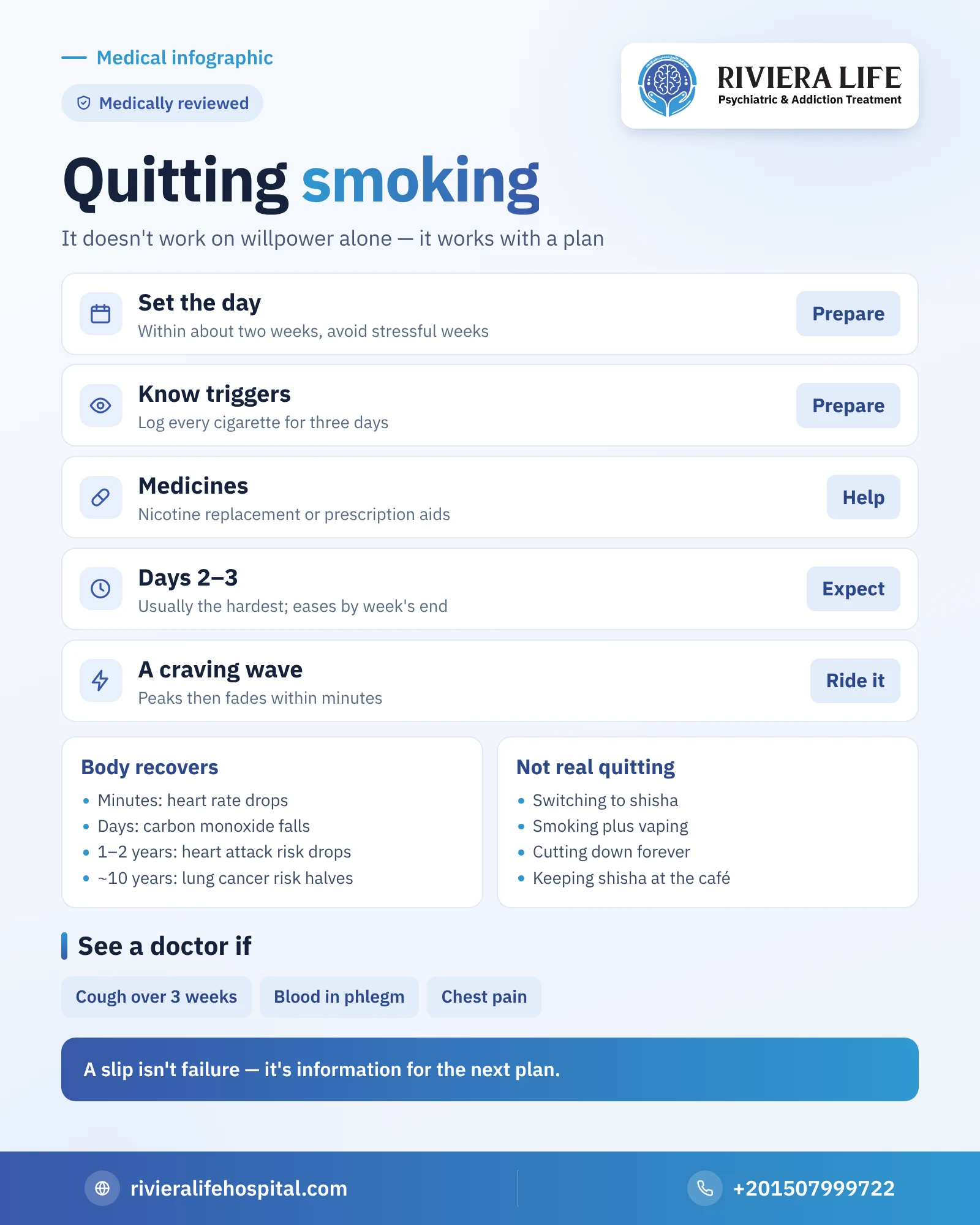
Quitting smoking doesn’t succeed by willpower alone, but with a plan: a set day, knowing the situations that ignite your craving, a ready way of dealing with each wave of craving, and medicinal help when needed, decided by the doctor. Most smokers try more than once before stopping for good, and every attempt teaches them something. In this guide is a practical plan from decision day to the third month: how to prepare, what to expect day by day, how to deal with craving, weight, shisha and vaping, and what to do if you go back to the cigarette.
As for understanding nicotine addiction itself, its symptoms and harms, we have dedicated the article on nicotine addiction to it. Here we focus on putting it into practice.
Before you start: why do you want to quit?
Write your reasons on paper or on your phone, in your own words: a chest that tightens when climbing the stairs, a son who has started imitating you, money that goes every day, or a smell you don’t like in your car. You will need this sheet on day three, when the cigarette seems the most important thing in the world. Personal reasons have a stronger effect than the general information about harm you have known for years.
Set your quit day
Choose a day within about two weeks: close enough that your enthusiasm doesn’t cool, and far enough to prepare. Avoid days crowded with pressure, such as an exam week or a big work deadline. Before the set day:
- Tell your family and a close friend, and ask them not to smoke in front of you in the first weeks.
- Get rid of cigarettes, lighters and ashtrays, and shisha equipment at home.
- Clean the smell from the car and clothes.
- Prepare alternatives within reach: water, sugar-free gum, and cut vegetables.
Know your triggers before they surprise you
For three days before quitting, record every cigarette: when you lit it, where you were, with whom, and what you were feeling. You will discover that a large part of them has nothing to do with physical need, but with a habit linked to a situation. Among the best-known triggers:
| Situation | A ready alternative |
|---|---|
| Morning coffee or tea | Change the place or the time, or try another drink in the first weeks |
| After eating | Get up from the table immediately, and brush your teeth or walk a little |
| Coffee with friends | Choose places where smoking isn’t allowed, or reduce the gatherings temporarily |
| Stress and irritability | Slow breathing for two minutes, or leave the place for a while |
| Driving | Gum or water, and changing the station you listen to |
Stopping suddenly or gradually?
Both roads may succeed. Stopping suddenly on a set day is clear and decisive, and suits those who know that “one cigarette” drags them into the whole pack. Gradual reduction suits some people who fear the shock of day one, provided it has a clear final date, otherwise it turns into permanent cutting down that never ends.
The important thing in both cases is that there is a day zero on which you stop completely. Reducing the number of cigarettes alone doesn’t achieve the same health benefit, because the smoker may compensate by inhaling more deeply.
Nicotine replacement and medicines: a decision the doctor makes
Medicinal help raises the chances of success in many smokers, especially heavy smokers or those who failed in previous attempts. It falls broadly into:
- Nicotine replacement: such as patches, gum and lozenges, which deliver nicotine without smoke and ease the severity of withdrawal, then are reduced gradually.
- Prescription medicines: containing no nicotine, they reduce the craving or the pleasure of smoking, and the doctor prescribes them after reviewing your health and other medicines.
The type, duration and method of use are determined by the doctor or pharmacist, especially with heart disease, pregnancy or a history of depression. And don’t smoke while using nicotine replacement.
What to expect after the last cigarette
Knowing what will happen reduces the fear of it. This is an approximate timeline, and it varies from person to person:
- Day one: repeated craving, especially in the usual situations, and some tension.
- Days 2–3: usually the hardest; irritability, difficulty concentrating, higher appetite and disturbed sleep.
- End of the first week: intensity starts to fall, and a temporary cough may appear as the lungs clear.
- Weeks 2–4: mood and sleep gradually improve, and waves of craving become less frequent.
- Months two and three: the biggest risk is no longer physical, but sudden situations: a night out, bad news, or a moment of overconfidence telling you one cigarette won’t hurt.
Troublesome symptoms after quitting: why they happen and when they end
Many are surprised that some symptoms increase in the first days after the last cigarette, so they think quitting harms them. Most of these symptoms are a sign the body is adapting, and ease within weeks:
- Cough and phlegm: increase temporarily because the tiny hairs in the airways regain their movement and start expelling accumulated mucus, and usually improve within weeks to a few months.
- Headache and dizziness: common in the first days with nicotine’s absence, changed blood flow and more oxygen, and ease quickly.
- Chest tightness: often linked to the anxiety accompanying withdrawal, but severe chest pain or worsening breathlessness calls for a doctor and isn’t explained by quitting.
- Nausea and constipation: because nicotine used to stimulate bowel movement; water, fiber and movement help.
- Insomnia and vivid dreams: usually improve within two to four weeks.
- Increased appetite and weight: covered in the weight section below.
- Minor mouth ulcers: occur in some people and go away on their own.
If the cough continues more than three weeks, blood appears in the phlegm, or there is unexplained weight loss, see the doctor; these symptoms aren’t attributed to quitting.
How do you deal with a wave of craving?
Intense craving peaks then usually calms within a few minutes. Your task is to get through these minutes. Try the delay rule: tell yourself you will wait just ten minutes, and fill them by slowly drinking a glass of water, walking, messaging a friend, or reading your sheet of reasons. With every wave you get through without a cigarette, the next wave weakens.
Quitting smoking and weight
Weight gain after quitting is common, caused by a mix of improved appetite and taste, replacing the cigarette with food, and changes in metabolism. But it is usually limited, and the benefit of quitting is much greater than the harm of a few kilograms. To reduce it:
- Prepare healthy snacks instead of sweets.
- Add a daily walk, which helps with both weight and craving.
- Drink water regularly.
- Don’t start a harsh diet in the first weeks; one battle at a time.
Shisha and vaping: are they a substitute?
Moving from cigarettes to shisha isn’t quitting; shisha contains nicotine and smoke, and its long sessions may mean heavy exposure. Someone who quits cigarettes but keeps shisha at the café usually keeps the door open to return.
As for e-cigarettes, some adult smokers may use them as a complete replacement for cigarettes, but they usually contain nicotine and keep the addiction going, aren’t a safe product, and aren’t suitable for non-smokers, teenagers or pregnant women. It is better to discuss using them with your doctor within a plan that has a clear end, not to use them alongside cigarettes.
How does your body recover after quitting?
The benefits begin sooner than many expect, and continue for years. Roughly, according to health bodies:
- Within minutes to hours: the heart rate drops.
- Within days: carbon monoxide in the blood falls to levels close to non-smokers.
- Within one month to a year: cough and breathlessness gradually decrease.
- Within one to two years: the risk of heart attacks falls clearly.
- After years: the risks of stroke and a number of cancers fall, including lung cancer, whose risk falls by about half after around ten years.
If you go back to the cigarette
A slip isn’t failure, but information. One cigarette doesn’t erase the days of stopping, but the danger is telling yourself that since you have smoked, there is no point. Stop immediately, and ask: what situation came before it? What was I feeling? What plan will prevent it next time? And if you go back to smoking completely, set a new day soon, and think about adding support you didn’t use last time, such as medicinal help or cognitive behavioral therapy.
Smoking with hash: why does it need a different plan?
In Egypt hash is often rolled with tobacco in the same cigarette, so quitting one becomes tied to the other. Some who try to quit cigarettes find themselves increasing hash, and some who quit hash smoke more. Here an ordinary quitting plan isn’t enough, and an assessment is needed that deals with both substances together, and with the anxiety or insomnia that drives them. You will find the stages of this in hash addiction treatment.
How can Riviera Life help you?
Most smokers quit without entering hospital, with the help of their doctor and a good plan. But if smoking is linked to hash or another substance, or comes with depression or anxiety that makes every attempt collapse, Riviera Life’s consultants in psychiatry and addiction treatment can assess the whole case and set a plan covering everything the patient uses. The first consultation is free and confidential, around the clock on +201507999722, and we are based in Sheikh Zayed, Giza.
Read also
- Nicotine addiction: symptoms, withdrawal and harms
- When does the body return to normal after quitting hash?
- Dopamine and addiction: how substances hijack the reward system
- Anxiety treatment: psychotherapy and medication
- Nicotine gum: how it works, the right way to chew it, its harms and who it doesn’t suit
- E-cigarettes: nicotine, harms and do they really help quitting?
- The harms of passive smoking: on children and pregnancy, and how to protect your home and car
- The harms of shisha: myths about water and molasses, carbon monoxide and infection
- Toombak addiction treatment: mouth examination, medicinal support and behavioral therapy
- Bupropion: depression, quitting smoking and seizure risk
- Smoking and nicotine: the complete guide
Questions many people ask
Usually roughly the first three days, then intensity starts to fall during the first week, while sudden cravings remain possible in certain situations for weeks.
Both can succeed, but cutting down needs a clear final date for stopping completely, because reducing the number of cigarettes alone doesn't achieve the same health benefit.
A small gain is common, and it can be limited with daily walking, healthy snacks and drinking water, without a harsh diet in the first weeks.
No, shisha contains nicotine and smoke, keeps the addiction going and makes returning to cigarettes easier.
If repeated attempts fail, smoking is linked to hash or another substance, or it comes with depression or severe anxiety, a medical assessment helps set a suitable plan.