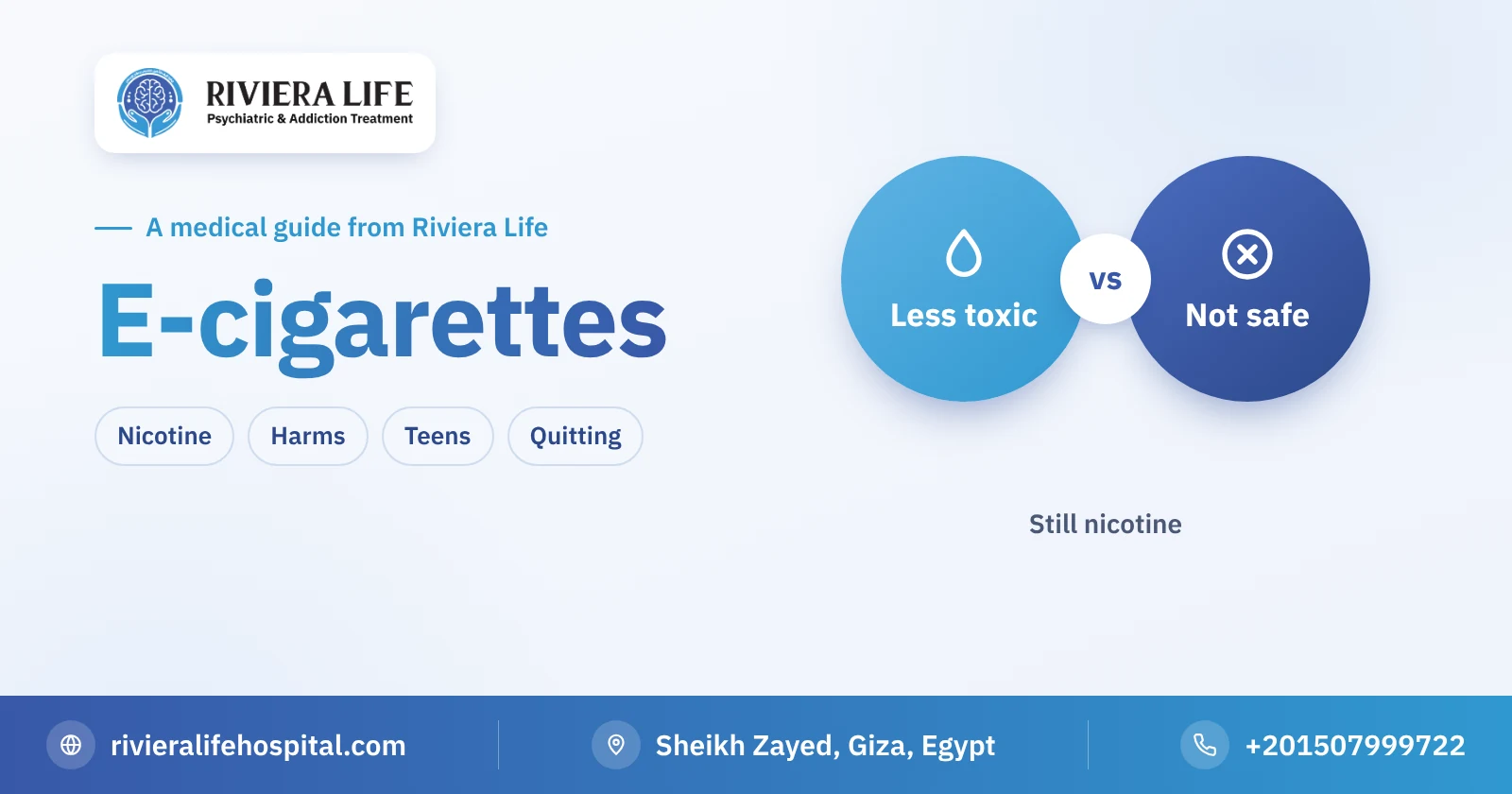
E-cigarettes are battery-powered devices that heat a liquid usually containing nicotine, flavorings and other substances, turning it into an aerosol the user inhales, without burning tobacco. They contain fewer toxic substances than ordinary cigarette smoke, but they aren’t safe: they cause nicotine addiction, some have been linked to cases of serious lung injury, and their spread among teenagers worries health bodies. Their role in quitting smoking is a real point of disagreement between medical bodies. In this article we explain the types of vapes and pods, how much nicotine they contain, their harms, what the evidence says about quitting, and why combining them with cigarettes is the worst option.
How do e-cigarettes work?
The device consists of a battery, a metal coil that heats up, and a tank or cartridge containing the liquid. On drawing, the coil heats the liquid so it turns into a dense aerosol that resembles vapor, but is actually fine particles carrying nicotine and other substances into the lungs. The liquid usually consists of propylene glycol, vegetable glycerin and flavorings, with a varying proportion of nicotine.
Types of vapes and pods
- Disposable devices: small, colorful and ready to use, and widespread among young people.
- Pod devices: small, the size of a USB stick, using ready-made or refillable cartridges, and many use nicotine salts.
- Refillable and modifiable devices: larger, with the user controlling the heating power and type of liquid.
These devices differ from heated tobacco products, which heat real tobacco leaves without burning them; those are tobacco products by nature and not e-cigarettes in the precise sense.
How much nicotine do they contain?
The amount varies greatly, from nicotine-free liquids to very high concentrations. The nicotine salts used in many pods make inhaling a high concentration easier and less harsh on the throat, so the user takes in more nicotine without feeling it. A single cartridge may contain nicotine roughly equal to a pack of cigarettes or more depending on its type. The label also isn’t always accurate; some products labeled “nicotine-free” have been found to contain it. You will find an explanation of what nicotine does in the brain in our article on nicotine addiction.
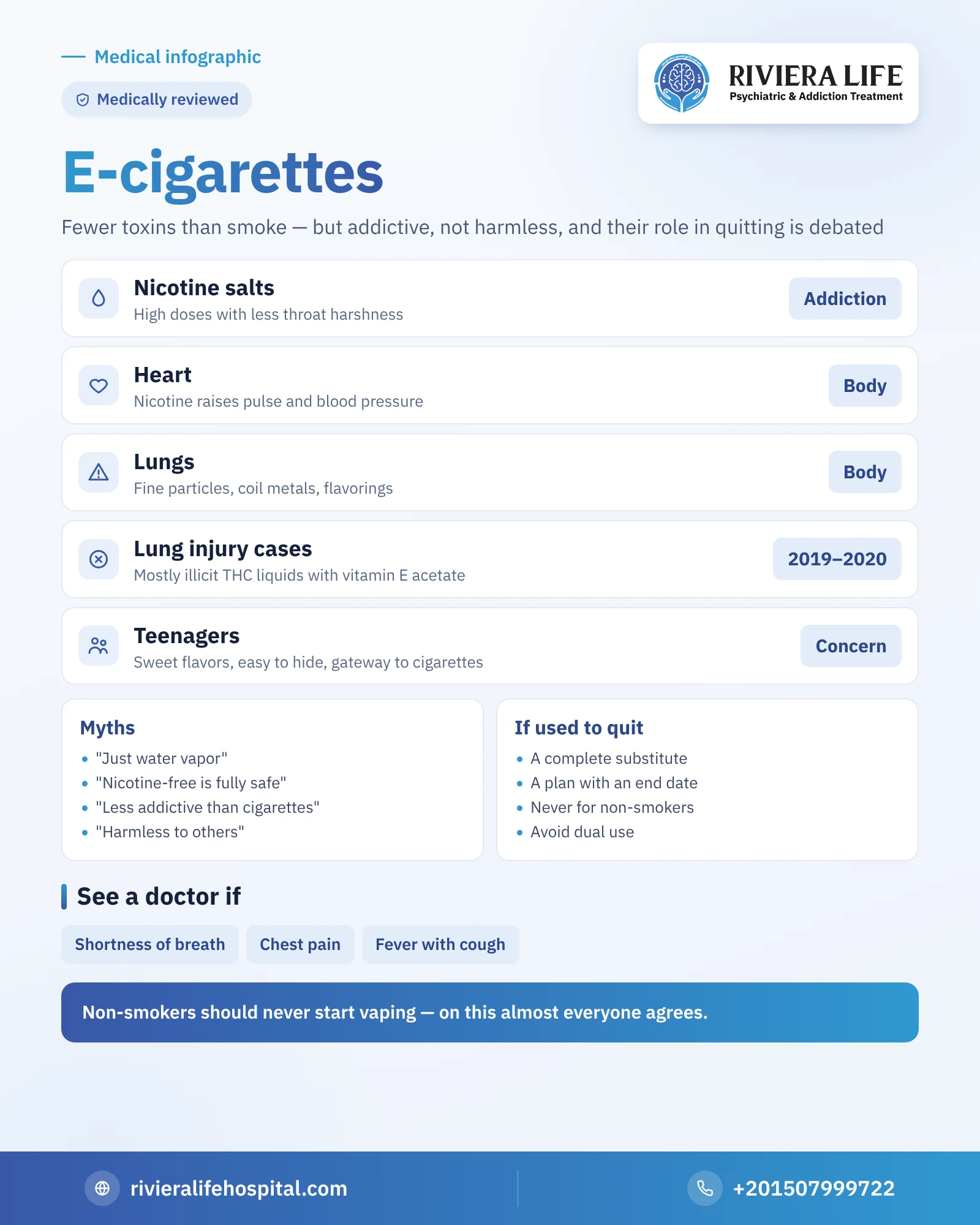
The harms of e-cigarettes
The vape being less harmful than the cigarette doesn’t mean it is harmless. What we know so far includes:
- Addiction: nicotine causes strong dependence, and many users draw on the device all day because it doesn’t go out like a cigarette.
- The heart and blood vessels: nicotine temporarily raises the pulse and blood pressure.
- The lungs and airways: the aerosol may contain fine particles, metals from the coil and substances from flavorings that may irritate the lungs, and some may notice coughing or wheezing.
- Accidents: batteries exploding or catching fire have caused burns in rare cases.
- Child poisoning: swallowing or touching vape liquid may cause serious poisoning in a child.
The long-term effects are still not fully known, because these products are relatively new compared with decades of studying smoking.
Cases of vaping-related lung injury
Around 2019 and 2020, thousands of cases of acute lung injury in vape users were recorded in the United States; some needed intensive care and some ended in death. Investigations linked most cases to liquids containing THC from cannabis sourced from the informal market, and to an additive in them, vitamin E acetate. The lesson here matters in Egypt too: liquids of unknown origin, modified cartridges, and mixing hash or other substances into the vape all multiply the risk. Any shortness of breath, chest pain or fever with a cough in a vape user needs a prompt medical examination.
Widespread myths about vaping
- It’s just water vapor: the aerosol contains fine particles, nicotine and chemicals from the liquid and coil; it isn’t water.
- Nicotine-free liquid is completely safe: inhaling heated flavorings and substances remains unstudied in the long term, and the label may not be accurate.
- It isn’t as addictive as cigarettes: nicotine salts may deliver a large amount, and continuous drawing all day may make dependence stronger.
- It doesn’t harm those around me: people nearby may be exposed to part of the aerosol; it is less than cigarette smoke but it isn’t clean air, especially for children and pregnant women.
Vaping and teenagers
Sweet flavors and small, easily hidden designs have made vaping attractive to teenagers, to the point that their use exceeds adults’ use in many countries according to the World Health Organization. Many of them don’t even know the device contains nicotine. The problem is that the teenage brain is still developing, and nicotine may affect attention, learning and impulse control, and make addiction faster. Studies also indicate that a teenager who starts with vaping is more likely to move on to ordinary cigarettes later.
If you find a small device resembling a USB stick or pen among your son’s things, or notice an unexplained sweet smell, start with a calm conversation that asks and listens before it punishes.
Do e-cigarettes help you quit smoking?
Here health bodies clearly differ, and honesty requires presenting both views:
- A view that sees them as a helpful tool: the UK’s NHS considers nicotine vaping less harmful than smoking, and states that a smoker who uses it as a complete substitute for cigarettes may have a higher chance of quitting compared with some other nicotine replacements, while stressing that it isn’t free of harm.
- A more cautious view: the World Health Organization considers their effectiveness for quitting unproven at the population level, and prefers approved means such as medicinal nicotine replacement, medicines and behavioral support.
What almost everyone agrees on: a non-smoker should never start vaping, teenagers and pregnant women aren’t a target group for it, and if it is used for quitting it must be a complete substitute for cigarettes within a plan that has an end, which you discuss with your doctor. You will find approved alternatives in our article on nicotine gum.
In all cases, medicinal nicotine replacements and medicines prescribed by the doctor, with behavioral support, remain studied and approved options, and can be started before considering any consumer product.
Dual use: the worst of both
Many who start vaping intending to quit end up using both: a cigarette at the café and a vape at home and in the car. This dual use doesn’t achieve the health benefit of quitting, because exposure to smoke continues, and it may even increase total daily nicotine and strengthen addiction. Reducing the number of cigarettes alone isn’t equivalent to stopping them. So if you use both, set a date with your doctor to quit cigarettes completely and then a plan to quit the vape after that.
How do you quit the vape itself?
The principles are close to quitting smoking: a set day, knowing the times you reach for the device automatically, and substitutes for the hand and mouth. Some are helped by gradually lowering the nicotine concentration before stopping, under specialist supervision. On stopping, the familiar nicotine withdrawal symptoms of irritability, insomnia and craving appear, and calm within weeks. Nicotine keeps its trace in tests for a period after stopping, as we explain in our article on how long nicotine stays in the body.
How can Riviera Life help you?
If the vape is being used for hash or other substances, or your teenage son has become addicted to it, or repeated attempts to quit have failed, the consultants in psychiatry and addiction treatment at Riviera Life assess the case and set a plan suited to the age and condition, and we have a program for students and teenagers. The first consultation is free and confidential on +201507999722.
More from our smoking and nicotine guide
- Nicotine addiction: symptoms, withdrawal and harms
- Quitting smoking: a practical plan
- Nicotine gum: how it works and who it suits
- Toombak and the harms of smokeless tobacco
- Drug vapes: cannabis and synthetic cannabis in liquids and how to protect your children
- Smoking and nicotine: the complete guide
Questions many people ask
They contain fewer toxic substances than tobacco smoke, but they aren't safe; they cause nicotine addiction and may irritate the lungs, and their long-term effects aren't fully known.
Most liquids contain it in varying concentrations, and some products labeled nicotine-free have been found to contain it, so the label can't always be relied on.
Health bodies differ; some see it as helpful if used as a complete substitute for cigarettes, while the World Health Organization considers its effectiveness unproven at the population level. Discuss it with your doctor.
Dual use keeps exposure to smoke, increases total nicotine and strengthens addiction, so it doesn't achieve the benefit of truly quitting.
You may notice a small device resembling a USB stick or pen, an unexplained sweet smell, or irritability when he is cut off from it. Start with a calm conversation and consult a specialist if needed.