How to deal with an alcoholic starts from two rules: protect his safety and the home’s safety first, and don’t try to force him to stop suddenly on your own, because alcohol withdrawal in someone who drinks daily may cause seizures or dangerous delirium. After that comes the calm conversation at the right time, clear boundaries by which the family stops bearing the consequences of his drinking on his behalf, and then a realistic step toward medical assessment. This guide is written for the wife, mother, brother and son who live with the person every day, and are trying to help him without breaking down themselves.
First understand what you are dealing with
Someone addicted to alcohol doesn’t drink because he doesn’t love you or doesn’t care about his promises. Addiction changes the way the brain works in reward and impulse control, so the drink becomes a need rather than a free choice. This doesn’t excuse him from responsibility, but it explains why sincere promises collapse after a few days. And if you aren’t yet sure it has reached addiction, review the signs in our article on alcohol addiction symptoms.
Don’t force him to stop suddenly at home
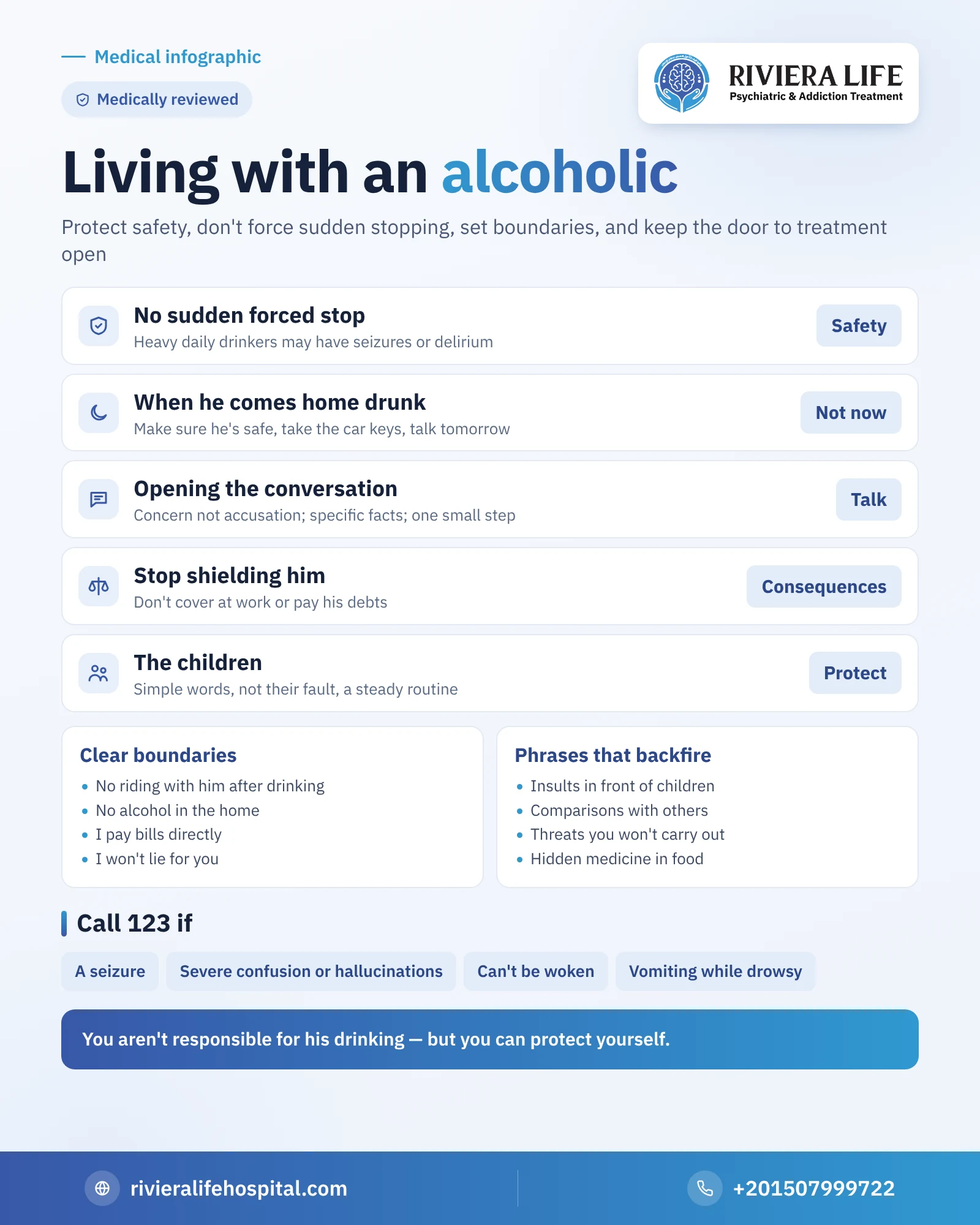
Many families decide in a moment of anger to pour away all the bottles, lock the door and stop him going out. This is understandable, but it can be dangerous. Someone who drinks large amounts every day for a while may, within hours of the last drink, enter a withdrawal that starts with tremor, sweating and anxiety, and in some cases may develop into seizures or life-threatening delirium tremens, especially in the first days. That is why stopping needs a medical assessment that determines whether it can be done at home with follow-up, or needs a hospital stay. Our article on alcohol withdrawal symptoms explains this stage in detail.
Call an ambulance on 123 immediately if you see
Whether the person stopped drinking hours or days ago, or drank a large amount in one session.
- A seizure or epileptic fit, even once
- Severe confusion, hallucinations or not recognizing his family
- Loss of consciousness or difficulty waking him
- Slow or irregular breathing, or blue lips
- Repeated vomiting while barely conscious
Until the ambulance arrives, don’t leave him alone, don’t give him coffee or sedative pills from the home, and if he is asleep and vomits, turn him onto his side.
When he comes home drunk
This isn’t the moment for discussion. An intoxicated person doesn’t remember well what is said, may be quick-tempered, and any argument may turn into a fight. It is better to make sure he is safe, take away the car keys, and postpone the conversation to a morning when he is sober and calm. And if you feel any threat to you or the children, leave the room or the home temporarily; your safety is no less important than his.
How do you open the conversation with him?
Choose a time when he is sober, not exhausted or in the middle of a crisis, and a quiet place without an audience. Then:
- Start with concern, not accusation: say “I’m worried about you” instead of “you’re a drunk”.
- Mention specific facts: “On Friday you forgot to pick your son up from training because you were drinking” is stronger than “you’re always neglectful”.
- Talk about the drinking’s effect on you: how you feel and what you fear, without a long medical lecture.
- Listen: he may mention pressure, insomnia or sadness behind the drinking, important information for later.
- Suggest a clear, small step: a visit to a doctor or a single consultation, not a big promise to stop forever.
Expect denial the first time. This is normal, and doesn’t mean the words were wasted. Many remember the calm conversation weeks later, when a new crisis happens.
Phrases that make things worse
Some responses come out of frustration but push him toward more stubbornness or concealment: insulting him in front of the children or relatives, comparing him with others, threatening punishments you won’t carry out, searching his pockets and phone openly, and digging up the whole past in every discussion. Among the dangerous mistakes, too, is putting medicine in his food or drink without his knowledge on the pretext of treatment, as some alcohol medicines cause a violent reaction if he drinks afterward.
Stop protecting him from the consequences of his drinking
Out of love or fear of scandal, families learn over time to cover for the addict: they call his work to say he is ill, pay his debts, clean up what he has damaged, and excuse his absence to the family. This spares him the pain that might push him toward change. It doesn’t mean abandoning him, but stopping paying the price of his drinking on his behalf, and leaving him to face the results of his choices as long as they don’t threaten his safety or anyone else’s.
Set clear boundaries and stick to them
A boundary isn’t a threat to control him, but a decision about what you will do. The best boundaries are few, clear and enforceable, such as:
- I won’t get in the car with you if you have been drinking, and I won’t let the children get in.
- No alcohol inside the home.
- I won’t give you money, and I will pay the bills myself directly.
- I won’t lie to your work or your family for you.
- If you raise your voice or your hand while drinking, I will leave with the children for my family’s home.
State the boundary once, calmly, when he is sober, then carry it out without long discussion when the situation happens. A boundary that isn’t carried out teaches him your words mean nothing.
Protect the children in the middle of all this
Children notice more than we think, and often blame themselves. Explain to them in words suited to their age that their father or mother has an illness called addiction, and that they aren’t the cause and can’t fix it. Keep a steady daily routine as far as possible, and don’t make them messengers between you and him, or guards over him.
How do you get him to treatment?
An addict rarely says of his own accord that he is ready. But there are moments when a window opens: after an accident, a warning at work, a bad liver test result, or a frightening night of tremors. Prepare for this moment in advance:
- Gather information about a suitable place of treatment, and a number to call immediately.
- Try a family consultation first yourself; many hospitals meet the family before the patient to help them plan.
- If you decide on a family meeting, keep it small, with people he respects, and aimed at inviting him to a specific step, not putting him on trial.
- Present treatment as a chance to regain his health, work and family, not as punishment.
And to understand the stages of treatment itself, what happens in withdrawal and in psychological and medical treatment, read our article on alcohol addiction treatment.
If he refuses treatment
Refusal today doesn’t mean refusal tomorrow. Keep your boundaries, repeat the offer calmly at each new crisis, and don’t cut the thread completely. And in cases of serious danger, such as threats to harm himself or others or an acute deterioration in health, contact the psychiatrist or emergency services immediately to find out the available options.
After treatment: the family’s role doesn’t end
The first weeks after discharge are sensitive. Help him by keeping alcohol away from the home and family occasions, and encouraging follow-up appointments, without turning into a watchdog who searches everything. And if he goes back to drinking, don’t treat it as the end of the road; relapse is possible, and what matters is that he returns to his treatment team quickly. You will find what he goes through in this period in our guide to quitting alcohol.
Look after yourself too
Years of worry and waiting drain the family. Set aside time for yourself, talk to someone you trust, and seek psychological support if you need it. You aren’t responsible for his drinking, and you can’t stop it by your own strength alone, but you can protect yourself and your children, and keep the door to treatment open.
How can Riviera Life help you?
The family can start before the patient: a free, confidential first consultation with consultants in psychiatry and addiction treatment to set a plan for coping and persuading, then safe withdrawal under round-the-clock medical supervision, and a family program and aftercare. Contact us on +201507999722; our center is in Sheikh Zayed, Giza.
More from our alcohol guide
- Alcohol: the complete guide
- Alcohol addiction treatment: stages and medicines
- Alcohol withdrawal symptoms and danger signs
- Medicines for treating alcohol addiction
Questions many people ask
Removing alcohol from the home is a right goal, but forcing someone who drinks heavily every day to stop suddenly without a doctor may cause dangerous withdrawal. It is better done within a medical plan.
No, an intoxicated person doesn't take in what is said well and may become agitated. Make sure he is safe now, and postpone the conversation to a time when he is sober and calm.
Keep your boundaries, stop bearing the consequences of his drinking on his behalf, and calmly repeat the offer at each crisis. The family can also start with a consultation for themselves before the patient.
No, giving any medicine without his knowledge is dangerous and unethical, and some alcohol medicines cause a violent reaction if he drinks afterward. Treatment needs his consent and medical follow-up.
In simple words: he has an illness called addiction, they aren't the cause and can't fix it. A steady daily routine gives them a sense of security.