Sexual OCD is a form of obsessive-compulsive disorder in which sexual thoughts or images intrude into a person’s mind that they don’t want and strongly reject, so they feel panic and guilt and try every way to get rid of them. These thoughts don’t reflect a real desire; what distinguishes them is precisely that they conflict with the person’s values, which is why they hurt so much. Many patients fall into a cycle of checking, avoidance, seeking reassurance and confession, so the thoughts increase instead of disappearing. The good news is that this type responds well to exposure and response prevention therapy and to medicines decided by the doctor.
What is sexual OCD?
It isn’t a separate diagnosis in medical manuals, but a description of the theme of OCD in some patients. OCD, as explained in our guide to OCD, consists of an intrusive thought that causes intense anxiety, followed by a visible or hidden act to relieve that anxiety. When the content of the thought is sexual, specialists call it sexual OCD or intrusive sexual thoughts. It is more common than people think, but one of the least talked-about types of OCD, because the patient is ashamed and afraid of being misunderstood.
It usually begins in adolescence or early adulthood, and may appear or intensify during transitional stages such as engagement and marriage or after having a child. It is sometimes accompanied by depression or anxiety because of long suffering in silence, and a person may go through more than one obsessive theme over their life.
Why do these thoughts hurt so much?
Almost everyone has passing strange or inappropriate thoughts, then forgets them within seconds. The difference in a person with OCD is that they stop at the thought and put it on trial: “Why did it come to me? What does it say about me?” Doctors call these thoughts “ego-dystonic”, meaning they clash with the person’s real values and feelings, so they receive them as a threat to their identity. The paradox is that the most religious or morally careful people are often the ones who suffer most, because the thought touches what matters most to them.
Common themes of this OCD
The details differ from person to person, but the themes recur in clinics:
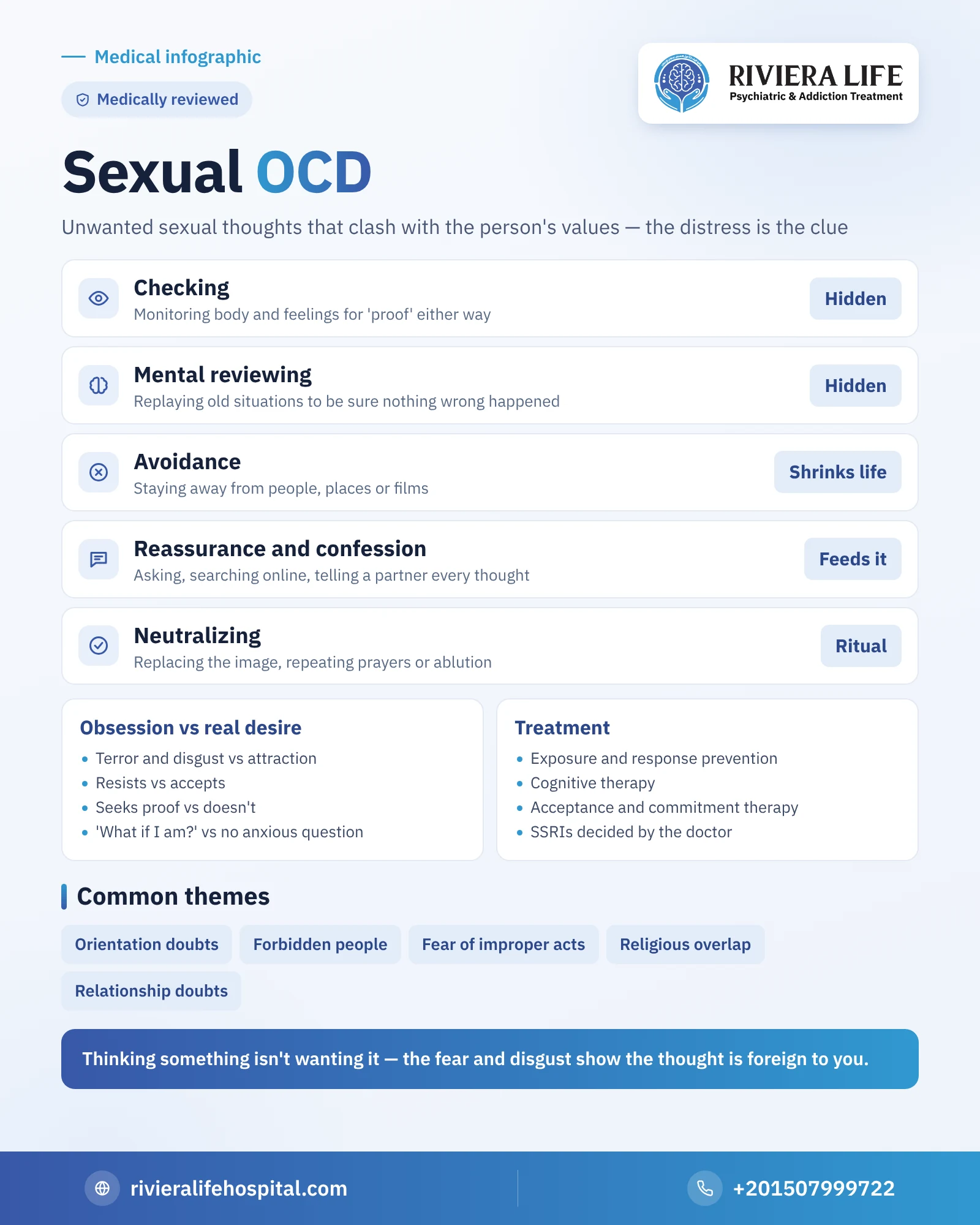
- Doubts about orientation: a persistent fear of being other than what the person knows about themselves, with constant examination of their feelings toward others.
- Thoughts involving people one shouldn’t think of this way: such as relatives or children; these are among the most painful thoughts, and the person meets them with terror and disgust, not desire.
- Fear of an improper act: anxiety about behaving unacceptably in front of people, or having done so without noticing.
- Overlap with religion: sexual thoughts intruding during prayer or when thinking about sacred things.
- Doubts about faithfulness: repeated questions about their feelings toward their partner, and whether they truly love them.
Compulsions: what the patient does to calm down
Compulsions in this type are usually hidden, unseen by anyone, which is what makes them exhausting and long-lasting:
- Checking: monitoring the body and feelings for any sign that proves or disproves the fear, with any passing sensation interpreted as evidence.
- Mental reviewing: replaying old situations again and again to make sure they didn’t do or feel anything wrong.
- Avoidance: staying away from children, relatives, or particular places or films, and sometimes leaving a job or relationship.
- Seeking reassurance: asking family or a sheikh, or searching online for hours for one sentence that will bring relief.
- Confession: a pressing need to tell their partner or family every thought, to get rid of the guilt.
- Neutralizing: replacing the thought with a “clean” image, or repeating a prayer, ablution or supplication until it feels “right”.
Each of these acts brings minutes of relief, but teaches the brain that the thought really is dangerous, so it returns stronger. Our article on OCD symptoms presents the general picture of visible and hidden compulsions.
Does having the thought mean I want it?
No. This is the most important sentence in the article. People with OCD fall into a thinking error specialists call “thought-action fusion”: the belief that merely thinking about something equals wanting it, makes it more likely to happen, or makes the person guilty. The truth is that intrusive thoughts don’t predict behavior, and that the intense fear of them and the disgust that accompanies them are evidence that they are foreign to the person. The evidence doesn’t suggest that people with sexual OCD are more inclined than others to do what they fear. This is linked to our article on OCD and doubt, because doubt that never settles is the fuel of this type.
The difference between sexual OCD and real desire
| Point of comparison | Obsessive thought | Real desire |
|---|---|---|
| Accompanying feeling | Terror, disgust and guilt | Attraction or interest |
| The person’s attitude to it | Resists it and wants to get rid of it | Accepts it or seeks it |
| What they do afterwards | Checking, avoidance and seeking reassurance | Doesn’t look for evidence to disprove it |
| The constant question | What if I am like that? | Doesn’t ask this question anxiously |
This table is for understanding, not self-diagnosis; the psychiatrist makes the diagnosis after assessment.
When sexual OCD mixes with religious OCD
In our societies the two types often overlap. A person may fear that the thought is a sin they will be held accountable for, so they repeat prayer or ablution many times, or ask about the religious ruling again and again without finding relief. It helps for the patient to know that many scholars distinguish between thoughts that come upon a person without their will and what they resolve to do and actually do, and that a good therapist respects the patient’s faith and works with them on stopping the compulsive rituals, not on casting doubt on their belief. Coordinating with a religious authority who understands the nature of OCD can sometimes help.
Treating sexual OCD
The treatment is the same as for OCD in general, but done in a way that respects the sensitivity of the subject:
- Exposure and response prevention: the patient gradually faces what frightens them, by imagining or writing down the thought or approaching situations they used to avoid, while refraining from checking and reassurance. This never means doing anything inappropriate; it means learning to tolerate the thought until the anxiety fades on its own.
- Cognitive therapy: works on correcting mistaken beliefs about the meaning and importance of thoughts.
- Supporting approaches: such as acceptance and commitment therapy, which teaches the patient to let the thought pass without struggle.
- Medicines: selective serotonin reuptake inhibitors are the main class, and OCD may need different adjustment from depression. The doctor decides the type and duration of treatment, and the medicine is only stopped in coordination with them.
The details of the stages and duration of treatment, and treatment-resistant cases, are in our article on OCD treatment.
How can you ask for help without shame?
You don’t need to explain your thoughts in detail in the first session. It is enough to say: “I get intrusive sexual thoughts that frighten me and that I don’t want.” A specialist psychiatrist has heard these thoughts from many patients, knows they are OCD and not desire, and the sessions are governed by confidentiality. It helps to write down before the appointment what you do to calm down, because the compulsions are what is actually treated. As for the family, its role is not to offer endless reassurance, not to mock or blame, and to encourage treatment.
And if exhaustion and guilt lead to hopelessness or thoughts of self-harm, seek help immediately from an ambulance on 123 or the nearest emergency department; you can also read our article on OCD and suicide.
How can Riviera Life help you?
At Riviera Life, consultant psychiatrists assess the condition in complete confidentiality, and the team builds an exposure and response prevention plan that progresses at a pace suited to the patient, with medicine when needed and follow-up after improvement. The first consultation is free on +201507999722, in Sheikh Zayed, Giza.
More from our OCD guide
- OCD: the complete guide
- OCD symptoms
- OCD and doubt
- OCD treatment
- OCD and marriage: when OCD comes home, and how treatment protects the relationship
Questions many people ask
No. Obsessive thoughts are intrusive and rejected by the person, and the anxiety and disgust that come with them are evidence that they go against their real desires and values.
The evidence doesn't suggest that people with OCD act on what they fear. The problem is the anxiety and compulsions that consume their lives, which is what treatment targets.
Because trying to suppress and monitor a thought makes the brain treat it as important and dangerous, so it brings it back more. Treatment teaches you to let the thought pass without struggle or rituals.
You don't need details at first; it is enough to describe the type of thought and what you do to calm down. A specialist knows this type well, and sessions are confidential.
Many notice improvement within weeks to a few months of exposure and response prevention therapy, and the duration varies with severity and any accompanying depression.