OCD and marriage aren’t necessarily enemies; OCD doesn’t prevent marriage or condemn a person to a failed family life, but if it isn’t treated it comes into the home with them and takes its share of the bedroom, the kitchen and the bed. A husband with OCD may wash for a long time, check the doors and avoid intimacy,
while a wife may be asked to perform daily rituals she doesn’t understand, so she becomes exhausted and angry and then feels guilty. And the person with OCD suffers more, because they see the effect of what they do and can’t stop. This article explains how OCD shows up within married life, what protects it, and how the couple can deal with what happens together, bearing in mind that diagnosis and treatment are the psychiatrist’s job.
OCD and marriage: how does OCD creep into married life?
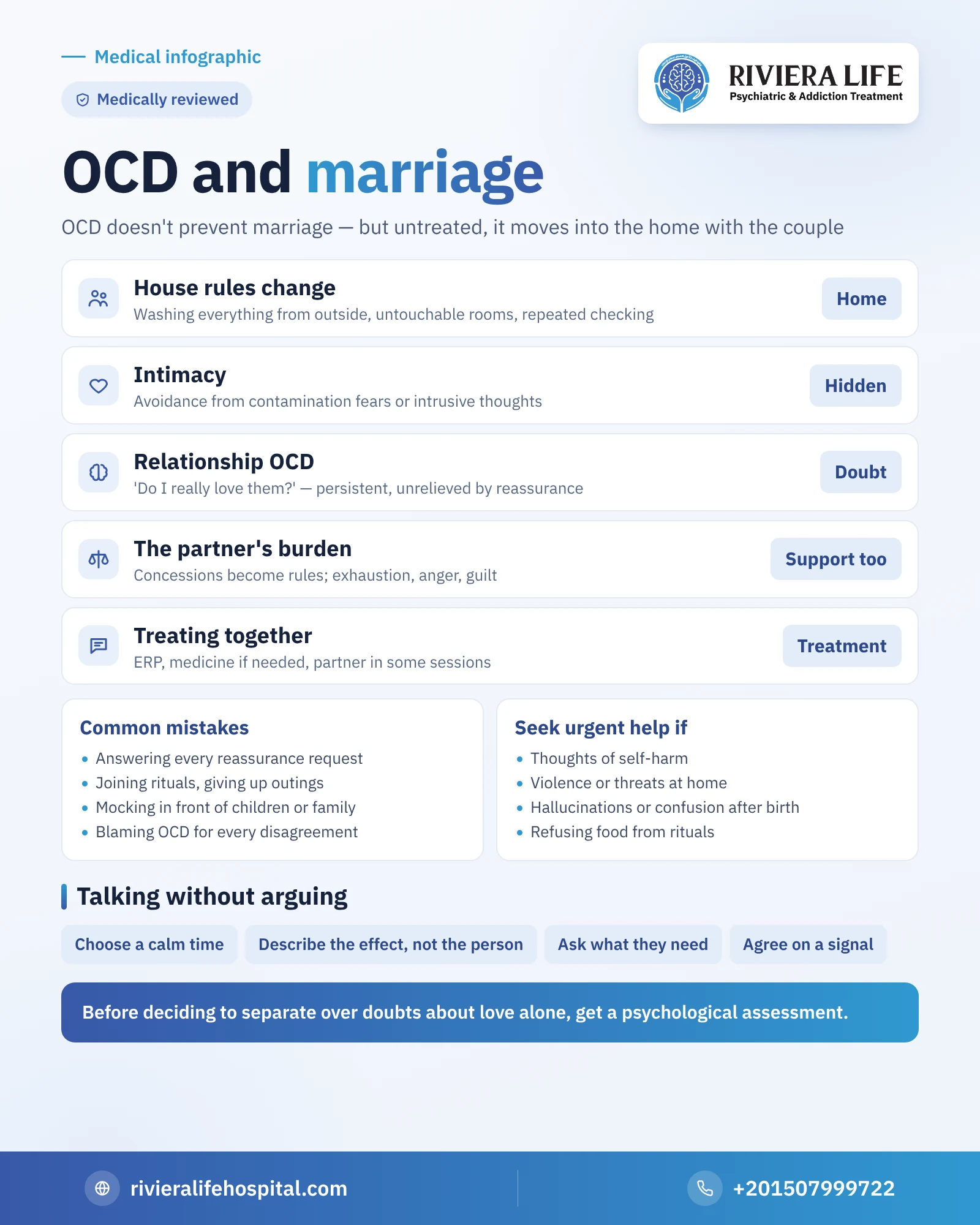
In a single person OCD revolves around themselves; in a married person it extends to the partner. The house rules change: anything that comes in from outside is washed, every room has an arrangement that mustn’t be touched, and the wife is late for an appointment because her husband went back three times to check the door. The person may ask their partner repeatedly to confirm that everything is fine, or to join in the ritual. This doesn’t mean ill intent; they are trying to reduce a fear that is real to them. But the family pays the price when the whole home turns into a service for OCD.
OCD and intimacy
This side is hidden more than any other, and it hurts a lot. Someone who fears contamination may avoid intimacy or wash for so long afterwards that they exhaust their partner, and someone intruded on by unwanted sexual thoughts may avoid closeness for fear of what they might mean about them; the details of this picture are in our article on sexual OCD. Someone with religious OCD may repeat ritual purification many times or doubt the validity of what they did. The other partner may interpret the distance as rejection or coldness, gets hurt, and the distance builds up.
The solution starts with talking: for the person with OCD to explain what happens in simple words, and for the partner to know that the distance isn’t a rejection of them. Therapy sessions help address this subject without embarrassment.
Relationship OCD: “Do I really love them?”
A particular type of OCD targets the marriage itself. The person doubts their feelings for their partner every day: are they the right person? Do I love them enough? Why don’t I feel what I saw in TV series? They compare, test themselves and ask friends, and never settle on an answer, because the doubt itself is the illness.
This differs from normal hesitation in that it is persistent, painful and repetitive, and isn’t eased by reassurance. It may be misunderstood as the end of love, so life-changing decisions are made under its pressure. That is why a psychological assessment is advised before any decision to separate because of these thoughts alone. Related to it is our article on pre-wedding depression, for those overwhelmed by heavy feelings before the wedding.
What does the partner carry?
The partner of someone with OCD lives under hidden pressure. They give up small things first, then the concessions become rules, and then they find themselves living in a home that looks nothing like what they imagined. They may feel drained and angry, guilty for being angry with someone who is ill, and lonely because the family doesn’t understand what is happening. Studies show that a partner who gets involved in the rituals suffers higher psychological stress. This doesn’t blame anyone, but it means the partner deserves support and care too.
Should a person with OCD tell their fiancé or fiancée?
There is no single recipe, but experience says gradual honesty is safer than long concealment that comes out after marriage. The person can talk about receiving treatment and improving, and explain clearly what they need. The shock is softened when the other person hears from the doctor that OCD is a known, treatable disorder, not a flaw in character or upbringing. The question of inheritance is answered in our article on hereditary mental illnesses; the bottom line is that a genetic predisposition exists but it isn’t inevitable destiny.
Common mistakes in homes with OCD
- Answering every request for reassurance until the partner becomes a “reference” asked twenty times a day.
- Joining in the rituals and giving up outings, visits and travel.
- Mockery or scolding in front of the children or family, which increases shame and concealment.
- Blaming OCD for every disagreement in the marriage, although couples have other, normal problems.
- Long silence instead of seeking treatment, waiting until the home collapses.
How can the couple share in treatment?
The main treatment is cognitive behavioral therapy with exposure and response prevention, with the doctor adding medicine when needed, as detailed in our article on OCD treatment. The chances of improvement increase when the partner attends some sessions to learn how to support without feeding the OCD. In practice, the couple agrees a plan with the therapist: which rituals are gradually reduced, how to respond to a request for reassurance with a calm, fixed sentence, and how to celebrate small progress. These steps aren’t improvised at home, because suddenly stopping accommodation may spark a conflict. And no one changes or stops their medicine except on their doctor’s instructions.
How can the couple talk about OCD without arguing?
Choose a calm time away from the moment of the ritual, as discussion during an anxiety episode makes things flare up. Start by describing the effect of OCD on the home, not by blaming the person: “I see that we lose two hours every morning because of the OCD” is easier to accept than “you always hold us up”. Ask the person with OCD what they need from you instead of guessing. And agree on a simple signal to use when a request for reassurance begins, such as a short sentence meaning “I’m with you, but I won’t answer the question this time”. On the difficult days, remember that the enemy is OCD, not either of you.
When is a disagreement a marriage problem and not OCD?
Not every disagreement in a home with OCD is caused by the illness. Couples have their normal problems with money, in-laws and parenting, and blaming everything on OCD is unfair to the person with it and hides the real problem. If tension continues despite improvement in the symptoms, or contempt, violence or a betrayal of trust appears, what is needed is separate marriage counseling alongside OCD treatment. The therapist assesses what comes from the disorder and what comes from the relationship.
Pregnancy, birth and afterwards
OCD symptoms may begin or intensify during pregnancy and after birth in some women, appearing as frightening thoughts about harming the baby or about contamination. These thoughts are unwanted and terrifying to the mother, and aren’t a desire. Even so, the mother should see a psychiatrist quickly to assess the condition and distinguish it from postnatal depression and other conditions; she needs neither punishment nor separation from her baby without an assessment.
Seek urgent help immediately if you see
Call an ambulance on 123 or go to the nearest emergency department; you can also contact the mental health hotline on 16328 in case of:
- Thoughts of self-harm or ending one’s life
- Physical violence or threats of harm in the home
- Hallucinations or strange convictions with severe confusion after birth
- Refusing food and drink or severe collapse because of rituals
How can Riviera Life help you?
Riviera Life in Sheikh Zayed, Giza, receives people with OCD and their husbands and wives in complete confidentiality. A consultant psychiatrist assesses the condition, sets a treatment plan, and involves the family through a dedicated program and follow-up after discharge. The hospital is licensed by the Ministry of Health and has fourteen years of experience, and the first consultation is free on +201507999722.
More from our OCD guide
- OCD: the complete guide
- Types of OCD: the most common themes
- Cleanliness OCD: symptoms and the family’s role
- Religious OCD: symptoms and treatment
- Pathological jealousy: when worry about a partner turns into suspicion that threatens the relationship
Questions many people ask
Yes. Many marry and live stable lives, especially with regular treatment. What matters is that the partner is informed and treatment continues.
Gradual honesty is usually better than concealment that comes out after marriage. It helps to mention that you are in treatment and improving, and for the other person to hear an explanation from the doctor.
Not necessarily. If the doubt is persistent, repetitive and isn't eased by reassurance, it may be relationship OCD. A psychological assessment is advised before any life-changing decision.
Don't refuse harshly and don't take part without limits. Agree with the therapist to reduce your involvement gradually and on a calm, fixed sentence to respond with.
Genetics plays a role, but it is a predisposition, not destiny. Many children of people with OCD don't develop it, and early intervention improves the outcome if symptoms appear.