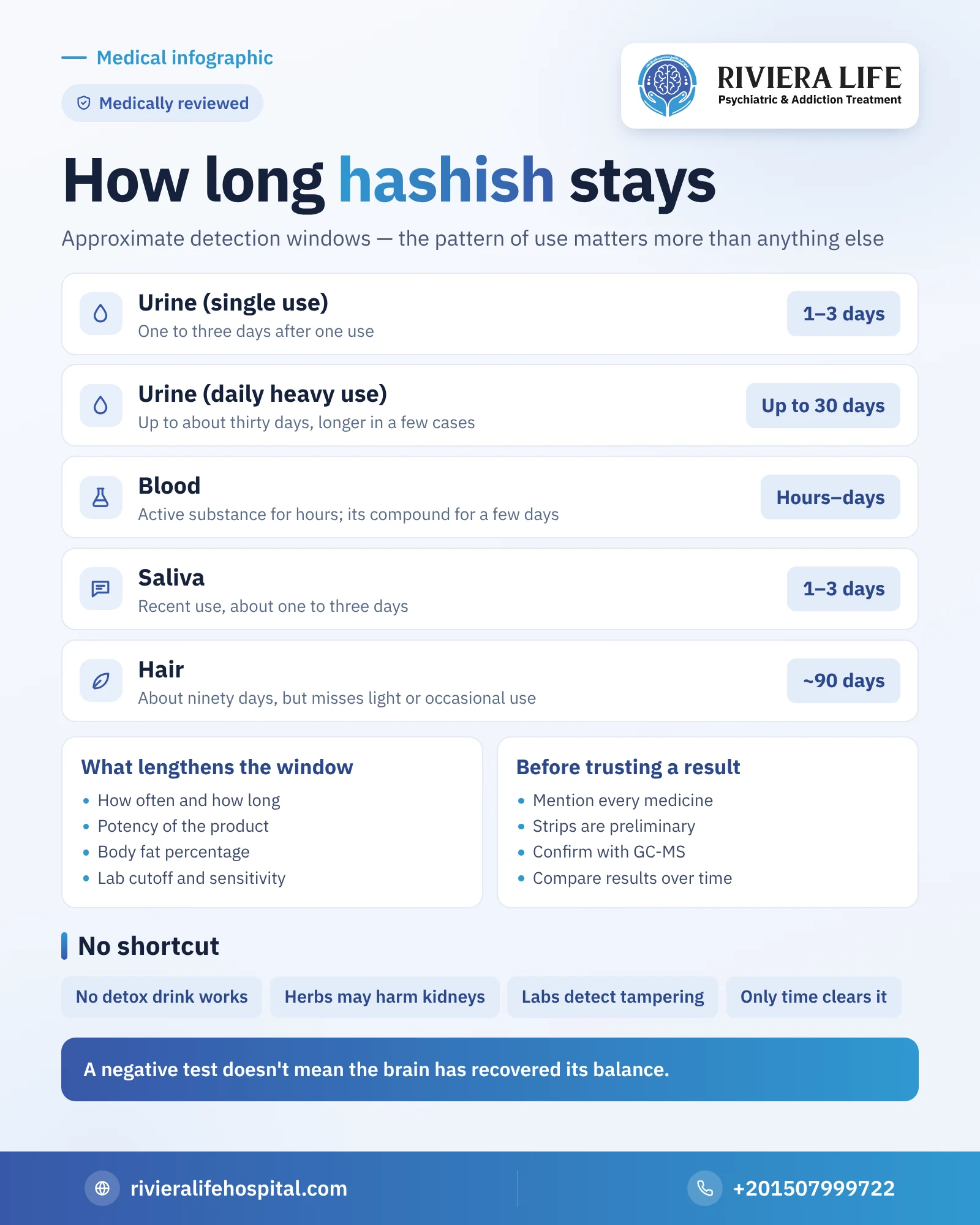
Hashish stays in the body longer than most drugs, because its active substance is stored in fat and leaves it slowly. In a urine test it usually shows for one to three days after a single use, about a week with use several times a week, and it may extend to roughly a month or more in someone who has smoked daily for a long time. In the blood it shows for hours to a few days, in saliva for roughly one to three days, and in hair its trace may remain for about three months. These figures are approximate, and the article explains why they differ from one person to another and what the result actually means.
What does a hashish test look for?
After smoking, the active substance, tetrahydrocannabinol (THC), reaches the blood within minutes, then the liver begins breaking it down into other compounds. The most important of these is a psychologically inactive substance known by the abbreviation (THC-COOH), which is what urine tests mostly look for. This means the test doesn’t measure whether the person is “high” now, but whether their body has been through hashish in the past days or weeks. That is why a test can be positive days after any effect of the substance has worn off.
Why does hashish stay longer than others?
Most drugs dissolve in water and leave with the urine within hours or days. The hashish substance, however, dissolves in fat, so it moves from the blood into fatty tissue and is stored there, then returns to the blood in small amounts over a long period. With every new cigarette, more accumulates in the store before what came before has emptied. That is why there is no talking about “one duration” for hashish staying in the body: a daily hashish smoker of many years is completely different from someone who tried it once at a party.
How long hashish shows in each type of test
How long hash stays in urine
This is the most widely used in laboratories and workplaces, and its duration depends mainly on the pattern of use:
| Pattern of use | Approximate detection time in urine |
|---|---|
| Once | One to three days |
| Several times a week | About five to seven days |
| Daily | About ten days to two weeks |
| Daily and heavily for a long period | Up to about thirty days, and longer in a few cases |
These durations are averages, not fixed dates. A daily user who stops may have fluctuating results in the first weeks, coming back negative one time and positive the next, depending on how concentrated the urine is and what has left the store. That is why doctors compare more than one result over time, instead of judging from a single sheet.
How long hash stays in urine for a non-regular or first-time user
Someone who tried hash once, or uses it at long intervals, has no large store in body fat, so its trace usually disappears from urine within one to three days, and may last a little longer if the amount was large or the hash concentrated. The long figures that reach a month apply to someone who has used daily for months or years, not to a first try.
Can hash show in a test from breathing the smoke only?
Sitting in an open or well-ventilated place next to someone smoking is usually not enough to give a positive urine result at the cut-off laboratories use. But spending hours in a closed room full of smoke may leave a tiny trace that a sensitive test detects for a day or so. That is why no judgement is built on a single low result: the test is repeated, and a confirmatory test is used when in doubt.
How long hash stays in the blood
It detects the active substance itself for a few hours after smoking, and the compound it produces for longer, up to a few days, and more in a chronic user. It is mostly requested in emergencies or after accidents, because it comes closer to identifying recent use.
How long hash stays in saliva
It detects recent use, within roughly one to three days, and may be a little longer with heavy use. The ease of taking the sample under a specialist’s eye has made it used in some road and workplace checks.
How long hash stays in hair
It covers a longer period, about ninety days depending on the length of the sample, but it is less sensitive to hashish than to other drugs, may not detect light or intermittent use, and doesn’t detect the last days before the sample was taken.
What lengthens or shortens the duration?
- How often and for how long the person has used: by far the most important factor.
- The concentration of active substance in the product: concentrated hashish usually leaves a longer trace than bango (marijuana).
- Body fat percentage: a larger store means slower release.
- Metabolic rate and liver activity, which differ between people.
- The sensitivity of the test itself and the cutoff the laboratory uses to judge a positive.
- How concentrated the urine is when the sample is taken.
It is notable that rapid weight loss or intense exertion may temporarily move some of the store from fat into the blood in a chronic user, which can sometimes explain a positive result after a period of abstinence.
Signs that hash has left the body: can you tell?
There is no physical sign you can rely on to know that hash has left the body. Better sleep, returning appetite or a clearer mind are signs the body is recovering from use, but they don’t mean the test has become negative, because the substance’s trace may stay in urine for weeks after a person feels back to normal. Conversely, withdrawal symptoms such as insomnia and irritability may continue after the test has become negative. The only way to know is the test itself.
Does hash show in a test after 60 days?
In a urine test this rarely happens, and is almost limited to someone who smoked hash daily and heavily for years; even for them, results after the first month are fluctuating and low. A hair test, however, may detect use for about three months depending on the length of the sample, so if the required test is a hair test, sixty days are not enough for the trace to disappear.
Is eaten hashish different?
When hashish is eaten in sweets or drinks, all of it first passes through the liver, so the effect is delayed and longer, and a larger amount of some of the resulting compounds forms. But how long it shows in a test remains governed by roughly the same rules: amount, frequency and the store in the body. There is no method of use that “escapes” the test.
Screening tests and confirmatory tests
The rapid test strips in pharmacies and laboratories rely on an immune reaction and give a result within minutes, but they can be wrong. So any positive result from them is treated as preliminary, and when needed the sample is sent for a confirmatory test with a more precise device known as gas chromatography with mass spectrometry, which identifies the specific substance and its concentration. Important decisions, at work, before an official body or in treatment, shouldn’t be based on a home strip alone.
Can a positive result appear without use?
This sometimes happens, but less than people imagine:
- Some medicines can interfere with rapid strips, including medicines for HIV and medicines for stomach acidity, and some anti-inflammatory painkillers in older types of strip.
- Cannabidiol products on the market may contain amounts of the active substance not stated on the package.
- Exposure to hashish smoke in a closed room rarely exceeds the approved cutoff for a positive, except under conditions of heavy exposure.
That is why you should mention every medicine you take before the test, and ask for a confirmatory test when in doubt.
Can the body be cleaned of hashish quickly? The truth about “detox” recipes
Drinks, herbs and recipes that promise to flush hashish from the body in days circulate online. There is no scientific evidence that any of them speeds the substance leaving fat, and some may harm the kidneys or upset the body’s salts. Laboratories also examine the sample itself and detect tampering with it. The only thing that clears hashish from the body is time after stopping.
Hashish testing at work and in official procedures
Drug testing in Egypt has become part of many procedures, including appointment to some government and private jobs, obtaining some licenses such as driving licenses, and periodic checks in particular workplaces. Because hashish is the most widespread and stays the longest, it is what most often shows in these tests. And anyone who discovers they can’t stop before a required test should see that in itself as a sign worth pausing on, and read our article on hashish addiction symptoms.
What can a test not tell you?
A positive test proves the person used during some period, but it doesn’t determine exactly when, or how many times, or whether they are addicted or tried it once. And a negative test doesn’t mean the brain has regained its balance; concentration, sleep and mood need weeks or months after the substance leaves, as we explain in our article when does the body return to normal after quitting hashish? So the family shouldn’t turn a home test into a weapon for confrontation, but into a way into a calm conversation and then a specialist assessment.
How are tests used during treatment?
In treatment programs, periodic tests are used as a follow-up tool, not a punishment. The medical team knows that a daily hashish smoker’s result may stay positive in the first weeks despite full commitment, so it follows the concentration falling gradually instead of settling for the word positive or negative. At Riviera Life, tests come as part of the hashish addiction treatment plan, with complete confidentiality of their results, and the first days after stopping, with their insomnia and irritability, are managed as explained in our article on hashish withdrawal symptoms.
And if you have a test coming up, practical, safe steps according to your situation are in our article I have a drug test soon: what should I do?
More from our hashish guide
- Hashish: the complete guide
- Hashish withdrawal symptoms
- Hashish addiction treatment
- When does the body return to normal after quitting hashish?
Questions many people ask
After a single use it usually shows for one to three days; with daily use it may show for about two weeks, and in a heavy long-term user it can extend to a month or more.
The active substance disappears from the blood within hours, but the compound it produces may be detected for a few days, and longer in a chronic user. A urine test is better suited to detecting older use.
Because its active substance dissolves in fat and is stored there, then returns slowly to the blood over days or weeks, especially with repeated use.
Some medicines can cause a false positive on rapid strips. So every medicine is mentioned before the test, and the result is confirmed with a more precise laboratory test.
Rarely. Ordinary exposure to smoke usually doesn't exceed the approved cutoff for a positive, except under conditions of heavy exposure in a closed space for a long time.
No recipe, drink or herb has been scientifically shown to speed hashish leaving the fat, and some may strain the kidneys. What actually lowers the substance is time after stopping, and anyone who uses daily and wants to stop would do best to consult a doctor to help them through the first weeks.