Spice withdrawal symptoms usually start within hours to a day of the last cigarette, because the effect of its compounds is short. They usually intensify in the first three to five days, then gradually ease over one to two weeks, while disturbed sleep, mood and craving may continue for further weeks. Patients’ most prominent complaints: severe insomnia, irritability, depressed mood, sweating, palpitations and tremor. In a British study of users who had tried hash and spice, about nine in ten described spice withdrawal as worse. Here we explain the timeline in detail, what makes withdrawal harder, and when it needs a doctor or the emergency department.
Why do withdrawal symptoms appear at all?
With repeated smoking, the cannabinoid receptors in the brain are exposed to full, strong activation many times a day. The brain defends its balance by reducing the number and sensitivity of these receptors. When the substance suddenly disappears, the brain finds itself with fewer receptors and a weak natural signal, so the functions this system regulates are disturbed: sleep, mood, appetite and the feeling of comfort. This temporary imbalance is withdrawal, and it is a sign that the body has adapted to the substance, not a sign of weakness of character.
The most common spice withdrawal symptoms
In studies that asked users about their experience after stopping, psychological symptoms came first, then physical symptoms clearer than with hash:
- Disturbed sleep: insomnia, broken sleep, or disturbing dreams and nightmares.
- Irritability and quick anger over small things.
- Depressed mood, listlessness and loss of pleasure.
- Anxiety and tension, and sometimes panic attacks.
- A strong urge to smoke that intensifies at the usual times and places of use.
- Sweating, especially at night, palpitations and hand tremor.
- Loss of appetite, nausea and headache.
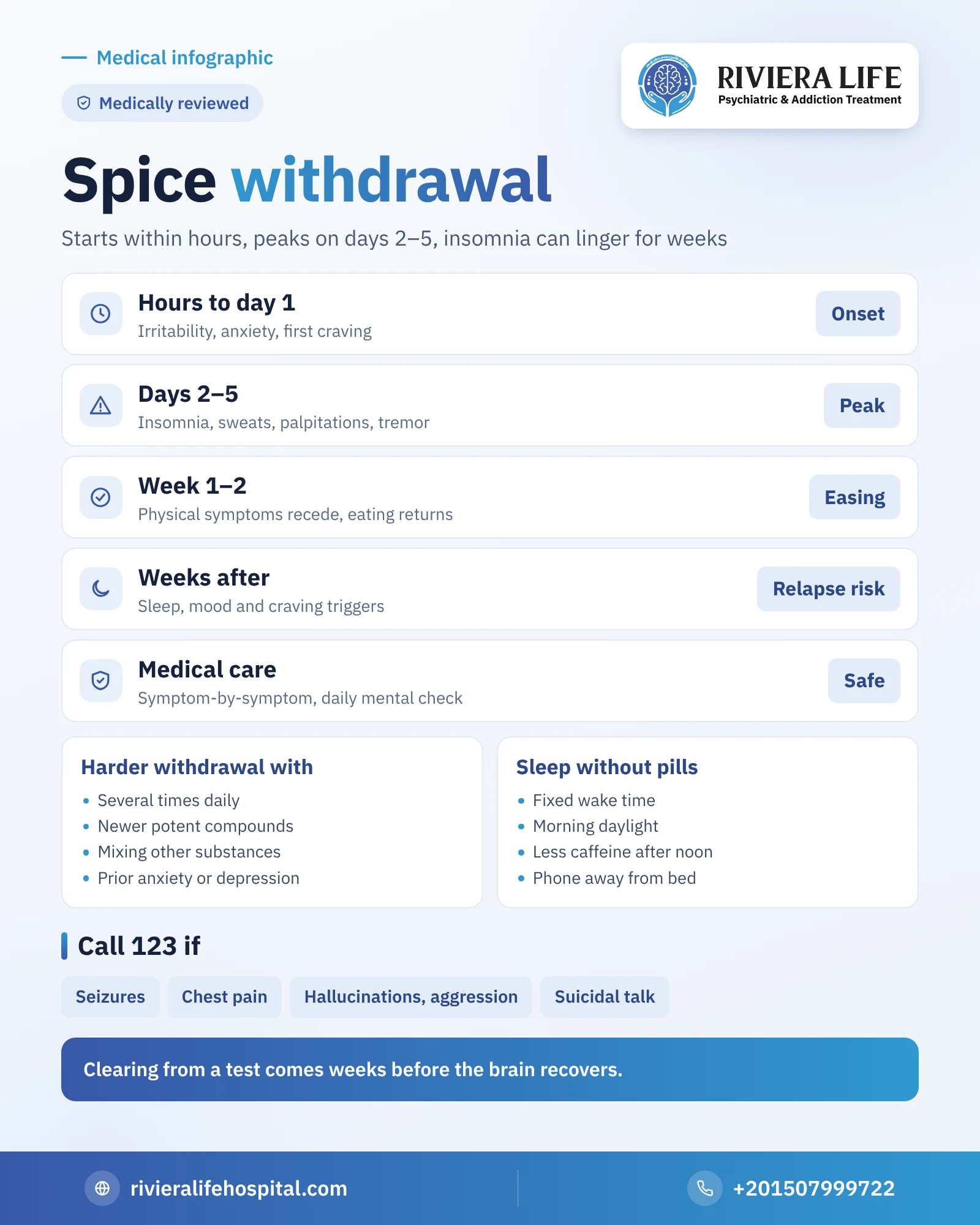
The spice withdrawal timeline
The following timings are approximate, and vary with the compound and the length and intensity of use:
The first hours to day one
Irritability, anxiety and the first urge to smoke appear, and sleep is difficult on the first night. Many users go back to smoking at exactly this stage because the symptoms start quickly.
Days two to five: the peak
Symptoms usually reach their most severe: insomnia that may last nights, sweating, palpitations and tremor, nausea and loss of appetite, and mood swinging between anger and sadness. In these days the rare but serious complications also appear, if they are going to appear.
The end of the first week to the second week
Physical symptoms gradually recede, and eating and sleep return to some regularity, but irritability and listlessness remain to a lesser degree.
The following weeks
Disturbed sleep and mood may continue, with intermittent bouts of craving set off by triggers, such as seeing old friends or passing the place of use. This stage looks calm on the surface but is one of the highest-risk stages for relapse.
How does it differ from hash withdrawal?
The two are similar in the general picture: disturbed sleep, low mood and craving. But spice withdrawal starts faster, carries clearer physical symptoms such as sweating, palpitations and tremor, and most people who have tried both describe it as more severe. The reason is that spice compounds activate receptors fully and more frequently throughout the day, so the brain’s adaptation is deeper. For a detailed comparison with the period after hash, you can read the article on hash withdrawal symptoms.
Factors that make withdrawal harder
- Smoking several times a day for a long period.
- Using newer, very potent compounds or concentrated e-liquids.
- Mixing with alcohol, sedatives, pregabalin or tramadol, because each has its own withdrawal that overlaps with it.
- Previous anxiety, depression or psychiatric disorder.
- Previous failed attempts to stop, as each solitary attempt may be harder than the last.
- Staying in the same environment with the same friends.
Rare complications that call for caution
Most cases of withdrawal are exhausting but not life-threatening. However, medical reports have documented less common cases in which seizures, severe agitation, psychotic symptoms of suspicion and hallucinations, or heart rhythm disturbance appeared, especially in heavy users. Added to this is the risk of acute depression and suicidal thoughts in the first days. These possibilities are what make stopping under medical supervision safer than stopping suddenly alone at home.
Danger signs during withdrawal
Call an ambulance on 123 immediately if you see
Especially in the first five days after stopping, or if the person mixes spice with other substances.
- Seizures or loss of consciousness
- Chest pain or severe irregular palpitations
- Hallucinations or intense suspicion with aggression
- Talk of suicide or self-harm
- Continuous vomiting that prevents drinking fluids
How is withdrawal managed medically?
There is still no medicine approved specifically for spice withdrawal. But this doesn’t mean leaving the patient to suffer; the medical team deals with each symptom separately: monitoring pulse, blood pressure and fluids, short-term medicines for sleep and anxiety dispensed in measured amounts and under supervision, treatment for nausea, and a daily psychological assessment to spot any dangerous thoughts or psychotic symptoms and treat them early. At the same time, psychotherapy begins so that the first days don’t pass without building motivation to continue. The details of this stage and what follows are in the article on spice addiction treatment.
Can withdrawal be got through at home?
Some mild cases, of a person who used for a short period, doesn’t mix other substances and doesn’t have a psychiatric disorder, may be managed with outpatient medical follow-up and strong family support. But admission is safer for someone who smokes heavily, mixes substances, has previously had seizures or hallucinations, or has suicidal thoughts. The decision is made by medical assessment, not personal judgment.
What helps get through insomnia without medicines?
Insomnia is the symptom patients complain of most, and the longest to remain after other symptoms have gone. Alongside what the doctor may prescribe, simple habits help restore sleep gradually:
- A fixed time to wake up every day, even if the previous night was bad.
- Exposure to daylight in the morning, and light physical activity such as walking in the first half of the day.
- Cutting down on tea, coffee and energy drinks after the afternoon.
- Keeping the phone away from the bed, as staying up on the screen prolongs insomnia and opens the door to contact with using friends.
- Not staying in bed awake for long; getting up for a calm activity, then going back when feeling sleepy.
And using sleeping pills or sedatives without a prescription to get through this stage is never advised, as they may swap one dependence for another.
Advice for the family during withdrawal
Expect irritability and don’t take it personally, and avoid arguments in the first days. Help organize sleep and reduce noise, and provide fluids and light food. Keep any substances or unprescribed medicines out of their reach, and watch for the danger signs mentioned above without a suffocating siege. And remember that the end of physical withdrawal doesn’t mean the end of danger; the substance disappearing from a test, as the article on how long spice stays in the body explains, comes weeks before the brain recovers.
How does Riviera Life help you?
At Riviera Life, the days of withdrawal are managed under round-the-clock medical supervision, with a daily psychological assessment that spots any acute depression or psychotic symptoms early, and psychotherapy starts from the first days so that withdrawal isn’t the end of the road but its beginning.
More from the spice guide
- Spice: the complete guide
- Spice addiction treatment
- Spice addiction symptoms
- The harms of spice addiction
Questions many people ask
They usually start within hours to a day of the last use, because the effect of its compounds is short, and usually intensify between the second and fifth day.
Physical symptoms usually ease within one to two weeks, while insomnia, mood swings and craving may continue for further weeks to a lesser degree.
According to most people who have tried both, yes; it starts faster and has clearer physical symptoms such as sweating, palpitations and tremor.
There is no medicine approved specifically for it, but the doctor treats symptoms such as insomnia, anxiety and nausea with suitable short-term medicines under supervision, with psychological follow-up.
This isn't common, but medical reports have recorded cases of seizures and psychotic symptoms during withdrawal, especially in heavy users, which is why stopping under medical supervision is preferable.