The harms of voodoo don’t wait years to appear as happens with many substances. Alongside the cumulative harm left by long use, voodoo carries the risk of acute poisoning from a single joint: a heart rhythm disturbance, a seizure, sudden kidney injury, or psychosis that sends its owner to the emergency department. This article explains what voodoo does to every system in the body in the short and long term, what mixing it with other substances adds, which of these harms improve after stopping, and when you must call an ambulance without hesitation.
Why do the harms of voodoo differ from those of hash?
The active substance in hash partially activates the cannabis receptors, as if it had a natural ceiling to its effect. The manufactured compounds in voodoo, however, often activate these receptors fully, some of them bind to them far more strongly than the hash substance, and some affect other systems in the brain and body. Add to that the concentration of the substance differing from bag to bag and even from joint to joint, so poisoning becomes a possibility every time. That is why emergency departments record complications with synthetic cannabinoids rarely seen with hash.
The harms of voodoo on the heart and blood vessels
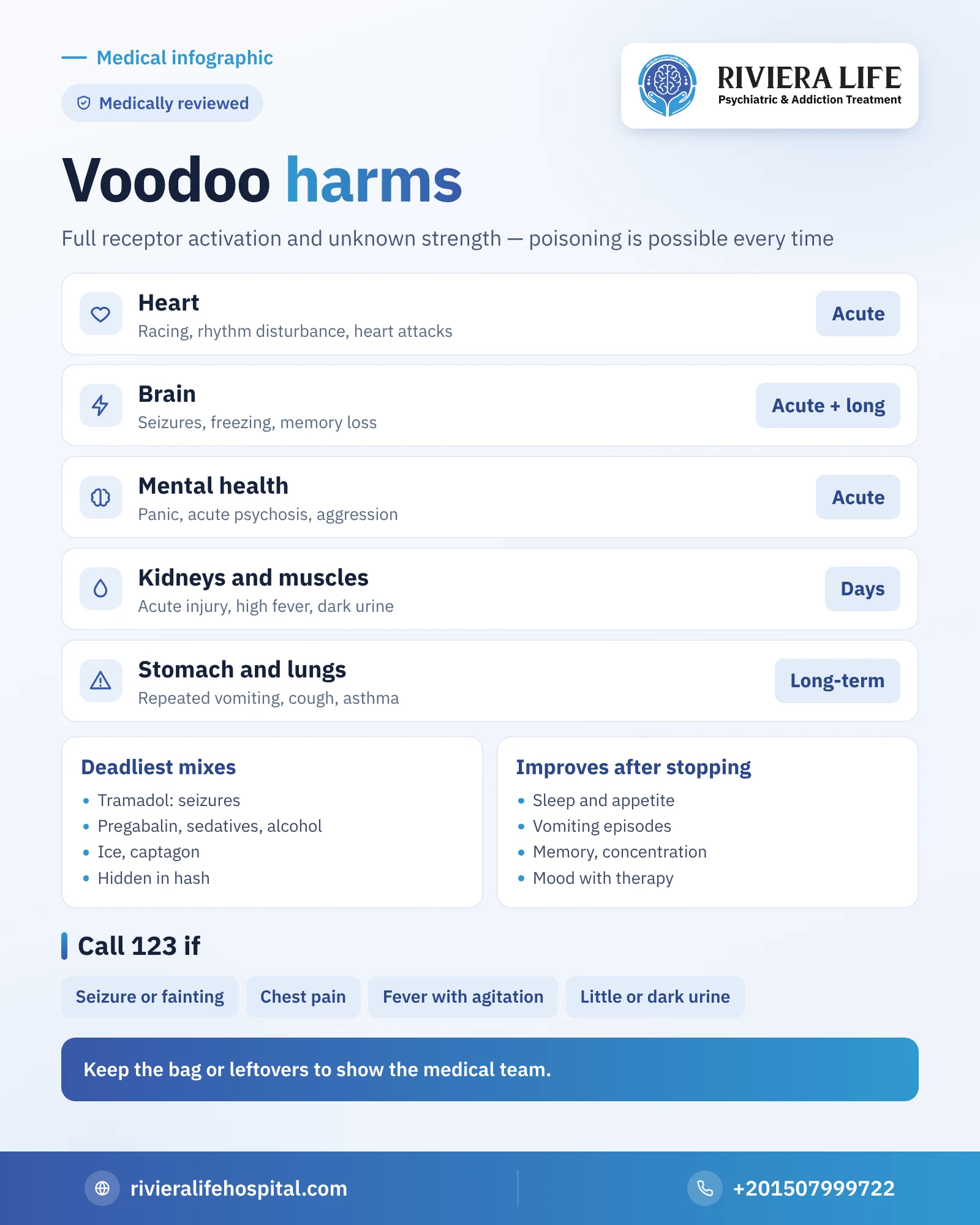
The heart is among the organs most affected by acute poisoning. Voodoo causes a severe racing of the heartbeat, high or disturbed blood pressure, and may lead to a heart rhythm disturbance. Cases of chest pain and ischemia of the heart muscle have been documented, even heart attacks in young people without previous illnesses. The risk increases in those with an undiscovered heart problem, when mixing with stimulants, and with physical effort or extreme heat.
The harms of voodoo on the brain and nervous system
In the short term
Seizures are among the most dangerous things linked to synthetic cannabinoids, and may happen for the first time in a person’s life without any history of epilepsy. Severe confusion, poor balance, and states of freezing and unresponsiveness that users describe as “going stiff” also appear, and in severe cases may develop into loss of consciousness.
In the long term
With regular use many complain of poor short-term memory, slow thinking, and difficulty concentrating and learning. Part of this improves after stopping, but recovery may take months, and some reports indicate that its effect may be longer in those who started at a young age.
The harms of voodoo on mental health
Here lie most of the complications that reach psychiatric departments:
- Panic attacks and severe fear during the effect, with a feeling of imminent death or loss of control.
- Acute psychosis: auditory or visual hallucinations, persecutory thoughts and incoherent speech, which may continue for days after the last joint.
- Agitation and aggression that may expose the person or those around them to harm.
- Continuous depression and anxiety with long use, and thoughts of despair in some patients.
- Revealing or worsening latent psychiatric disorders such as schizophrenia or mood disorder in those with a predisposition.
The appearance of any psychotic symptom after voodoo needs an urgent psychiatric assessment, even if it seems to have gone.
The harms of voodoo on the kidneys
Among the complications that have caught doctors’ attention in recent years is acute kidney injury after smoking synthetic cannabinoids, sometimes in healthy young people. The patient usually complains of pain in the side or back, nausea and vomiting, and a decrease in the amount of urine. Most cases improve with treatment in hospital, but some needed temporary dialysis. Dehydration resulting from repeated vomiting increases this risk.
Temperature and muscles
In some poisoning cases body temperature rises dangerously, especially with agitation and excess movement or in hot weather. Breakdown of muscle fibers may happen, a condition that releases substances from the muscles into the blood that strain the kidneys. The signs of this condition are severe pain and weakness in the muscles and dark-colored urine, and it needs treatment in hospital.
The harms of voodoo on the digestive system
Repeated vomiting is a very common complaint among voodoo users. With long use, episodes of severe vomiting and abdominal pain may appear and recur every few weeks, and the patient notices that bathing in hot water eases them temporarily; it is a condition known with cannabinoids that usually improves with stopping completely. It is accompanied by loss of appetite, weight loss and dehydration.
The harms of smoking on the lungs
Voodoo is usually smoked with tobacco or in a shisha, so it adds the harms of smoke to the harms of the substance: chronic coughing, irritation of the throat and airways, shortness of breath, and worsening of asthma in those who have it. Deep inhalation of the chemicals may cause acute lung irritation in some users.
The most dangerous things voodoo is mixed with
The harm increases when voodoo comes together with other substances, which is common in Egypt:
- Tramadol: the seizure risk from both sides comes together, so the likelihood of a seizure rises.
- Pregabalin, sedatives and alcohol: increase confusion, drowsiness and the risk of choking on vomit during loss of consciousness.
- Stimulants such as ice and captagon: a doubled burden on the heart, raised temperature and a higher risk of psychosis.
- Hash: it is sometimes mixed with it without the user’s knowledge, so they think they are smoking ordinary hash.
The harms of voodoo on daily life
The harm doesn’t stop at the limits of the body. A young man who spends his day between one joint and another gradually loses his ability to commit to a lecture or a work shift, and warnings accumulate until he loses his place. The relationship with the family turns into a series of suspicions and quarrels, and debts and borrowing from friends appear. And since voodoo is a legally prohibited substance, possessing it or being caught under its influence may open the door to legal problems that leave a long mark on the study and professional future. Driving under the influence adds the risk of accidents to the driver and others.
Short-term and long-term harms
| Term | Most prominent harms |
|---|---|
| Within hours of use | Racing heart, vomiting, panic, confusion, seizures, acute psychosis, raised temperature |
| Within days | Kidney injury, muscle breakdown, continuation of psychotic symptoms in some |
| With long use | Dependence, poor memory and concentration, depression and anxiety, repeated vomiting episodes, weight loss, lung problems |
| In daily life | Decline in study and work, family disagreements, debts, legal problems |
What improves after stopping?
The good news is that many of these harms can improve. Sleep and appetite return gradually within weeks, vomiting episodes calm down, concentration and memory improve over months, and mood stabilizes with psychotherapy. Harms that may remain, such as damage to the heart or kidneys after a severe poisoning episode or an unmasked psychotic disorder, need long follow-up, and the earlier the person stops, the lower their likelihood. Learn about the symptoms expected in the first days after stopping in the article on voodoo withdrawal symptoms, and about the recovery plan in the article on voodoo addiction treatment.
When do you need an ambulance?
Call an ambulance on 123 immediately if you see
Keep the bag or the leftovers of what the person used to show the medical team.
- A seizure or loss of consciousness
- Chest pain, severe palpitations or fainting
- High fever with agitation or confusion
- Hallucinations or aggression that put the person or others in danger
- Continuous vomiting, or very little or dark-colored urine
And even if the episode passes safely, it is a real warning that the body has reached a dangerous limit. The complete guide to voodoo page helps you understand the substance, while at Riviera Life you can start a confidential medical and psychological assessment after the patient leaves the emergency department, to prevent what happened from repeating.
More from the voodoo guide
- Voodoo: the complete guide
- Voodoo addiction symptoms
- How long voodoo stays in the body and testing
- The causes of voodoo addiction
Questions many people ask
Yes, cases of chest pain, ischemia and heart attacks have been recorded after synthetic cannabinoids even in young people without previous illnesses. Any chest pain after use is an emergency.
It may cause acute psychosis with hallucinations and persecutory thoughts, sometimes lasting days. It may reveal latent psychiatric disorders in those with a predisposition, which is why any psychotic symptom needs specialist assessment.
Vomiting is among the common effects of synthetic cannabinoids, and with long use repeated vomiting episodes may appear that usually improve after stopping completely. Severe vomiting may cause dehydration that strains the kidneys.
Many improve after stopping, such as sleep, appetite and concentration. But some acute complications on the heart, kidneys or mental health may leave an effect that needs follow-up.
Yes, because each of them may cause seizures, so the risk rises when they come together. And mixing it with sedatives or alcohol increases the risk of loss of consciousness and choking on vomit.